


 CDN NEWS |
  US NEWS







By Grady Munro and Jake Fuss
Since Prime Minister Mark Carney took office, there’s been much focus on how he’s doing things differently than his predecessor Justin Trudeau. And certainly, the Carney government has reversed a number of Trudeau-era policies during its first year in power. But in managing federal finances, the Carney government is largely taking the same approach as the Trudeau government—if not doubling down.
The Trudeau government’s irresponsible management of federal finances is one of its defining legacies. During its nine years in office, it recorded the seven-highest levels of annual spending in Canadian history (even excluding pandemic-related spending), ran nine consecutive deficits, and recorded the five highest years of total government debt on record (both spending and debt account for changes in population and inflation).
During the election campaign, the Carney government promised a “very different approach” that involved “spending less” to “invest more.” This appeared to be a recognition that record-high spending, persistent deficits and massive debt accumulation under Trudeau failed to deliver greater prosperity for Canadians, and that something different was needed.
Yet the Carney government has failed to deliver on the promise of better fiscal management. Instead, as noted in our recent study, it plans to spend more, run larger deficits and accumulate more debt that the Trudeau government.
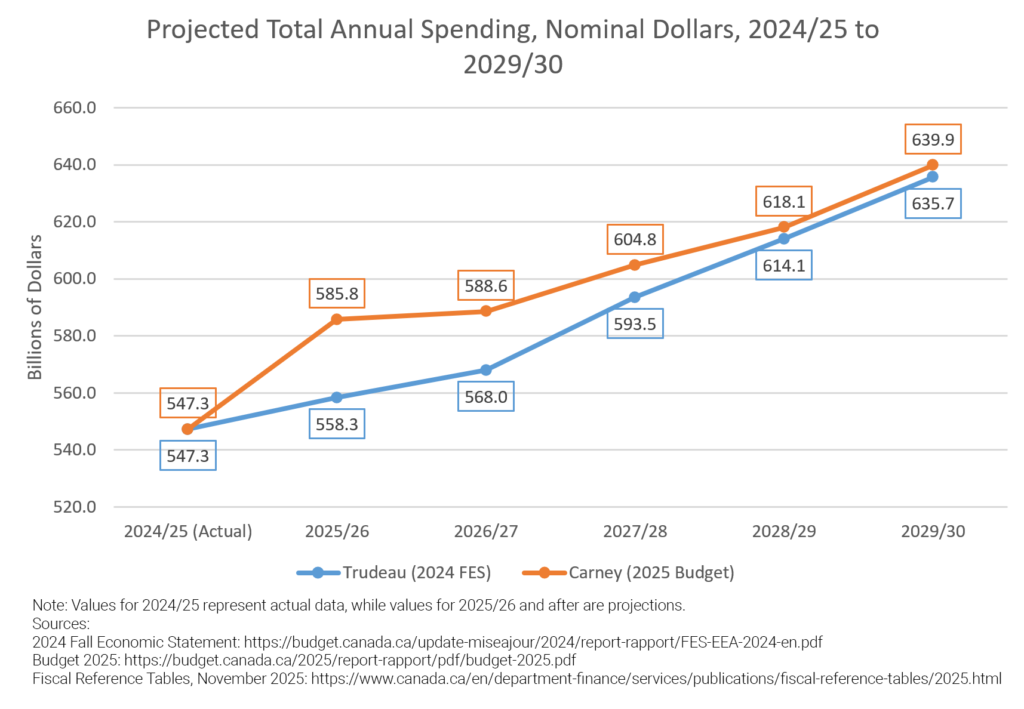
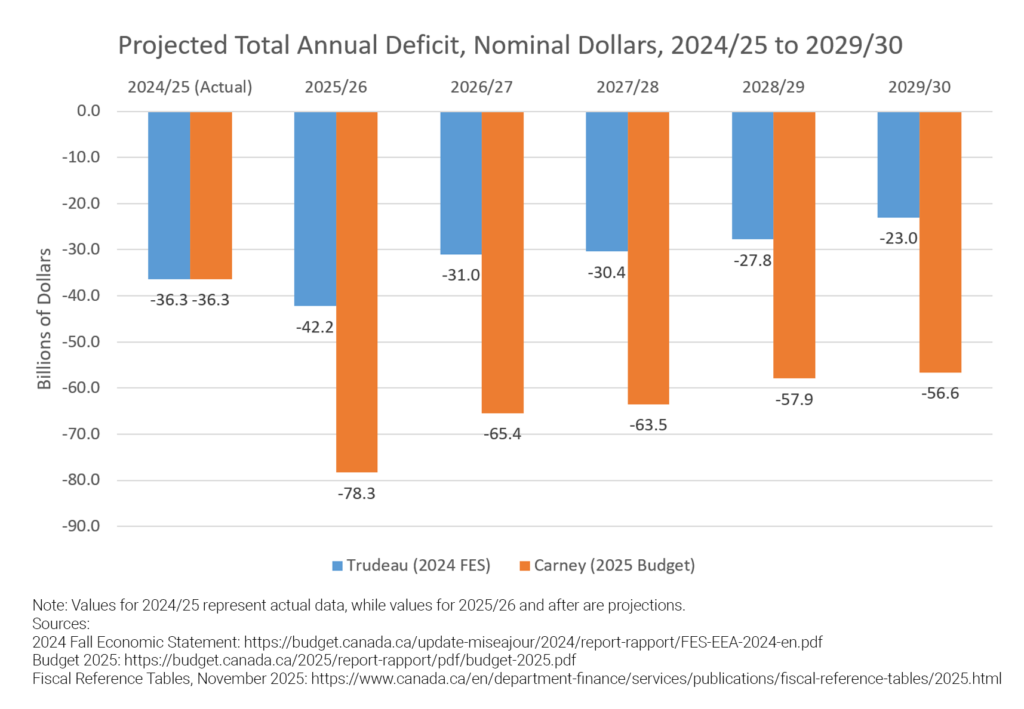
To illustrate this, the following charts compare total annual spending and the budget deficits projected in the 2024 Fall Economic Statement (Trudeau’s last fiscal release) and Budget 2025 (Carney’s first fiscal release) from 2024/25 to 2029/30.



Specifically, the Carney government plans to spend more than the Trudeau government every year from 2025/26 to 2029/30, with total spending a combined $67.6 billion higher than the Trudeau government had planned. This additional spending is split between $47.8 billion in additional program spending and $19.8 billion to cover higher debt interest payments.
Higher spending by the Carney government, coupled with slower expected growth in total revenues, will produce significantly higher deficits. The Trudeau government had originally planned to run deficits declining from $42.2 billion in 2025/26 to $23.0 billion by 2029/30. Now, the Carney government plans to run deficits declining from $78.3 billion to $56.6 billion over that same period. In other words, the Carney government plans to borrow a cumulative $321.7 billion—more than double the $154.4 billion planned by the Trudeau government.
In large part due to this borrowing, the Carney government is expected to accumulate $266.4 billion more debt in total by 2029/30 compared to the Trudeau government. The Carney government expects total federal debt will reach $2.9 trillion (79.0 per cent of the economy) by 2029/30 whereas the Trudeau government had planned to grow the debt burden to $2.6 trillion (71.7 per cent of the economy) by that same year.
To put the Carney government’s planned spending and debt accumulation into broader perspective, consider that (after adjusting for both population and inflation) both planned program spending and the expected total federal debt in 2025/26 will represent the second-highest levels of spending (excluding COVID-related spending) and debt in Canadian history.
Simply put, for all the talk about change, the Carney government plans to continue the Trudeau government’s fiscal legacy. In fact, the Carney government plans to spend more, run larger deficits and accumulate more debt. In the coming weeks the Carney government will release an update on the state of its finances. Hopefully, the government will come to its senses and abandon the fiscal legacy of its predecessor.
Share This:






















On The Verge: Energy Sector Primed for New Wave of Growth – ATB Economics