


 CDN NEWS |
  US NEWS







One question that comes up regularly in boiler applications is whether ASME Section I allows the use of magnetic level gages on power boilers.
The short answer is yes. The longer answer — and the reason there is so much confusion around the topic — is that they are only permitted within very specific boundaries.
That distinction matters.
Magnetic level gages can be a very useful addition to drum level instrumentation, particularly in modern plants where operators are often monitoring boiler conditions from a control room rather than standing at the drum. But they are not a workaround for the fundamentals of Code compliance, and they are not a substitute for the direct-reading instrumentation required by ASME.
Why the confusion exists
Part of the confusion comes from the fact that magnetic level gages provide a clear local indication and are often mounted near the drum, which can make them seem comparable to a gage glass at first glance. In practice, though, ASME Section I treats them differently.
A gage glass is a direct-reading device. A magnetic level gage is not. Even when it is locally mounted, it is still considered an indirect level indicator because it relies on magnetic sensing rather than direct visual observation of the water level.
That distinction is not just technical wording. It drives how the instrument can be used, where it can be installed, and what it can and cannot replace.
What the Code requires
For power boiler applications, ASME Section I still requires a functional water gage glass.
On boilers operating up to 400 PSIG, that gage glass must be in service at all times. On higher-pressure boilers, the Code allows the use of two remote level indicators maintained on continuous display for the operator, together with a water gage glass. In those cases, the gage glass may be isolated while the remote indicators are in service, but it still must be maintained in good working condition.
This is the point that often gets missed in the field: a magnetic level gage may complement the required instrumentation, but it does not eliminate the Code requirement for a gage glass.
Where magnetic level gages fit
Used correctly, a magnetic level gage can be an excellent supplemental instrument on a power boiler.
It can provide local level indication at the drum, and it may also be paired with a transmitter to send an additional level signal to the control room for remote indication. That can be valuable in plants where the operator does not have a direct line of sight to the boiler drum and needs reliable, continuously displayed level information.
In fact, many facilities benefit from using multiple remote indication technologies rather than relying on just one. Conductivity probes, differential pressure instruments, guided wave radar, and magnetic level sensing all have a place in boiler drum level strategies. Using different technologies can help reduce the risk of common-mode failure and provide greater confidence in the readings operators depend on.
Where installations go wrong
The trouble is that a magnetic level gage that looks reasonable on paper can still fall out of compliance if the details are not handled properly.
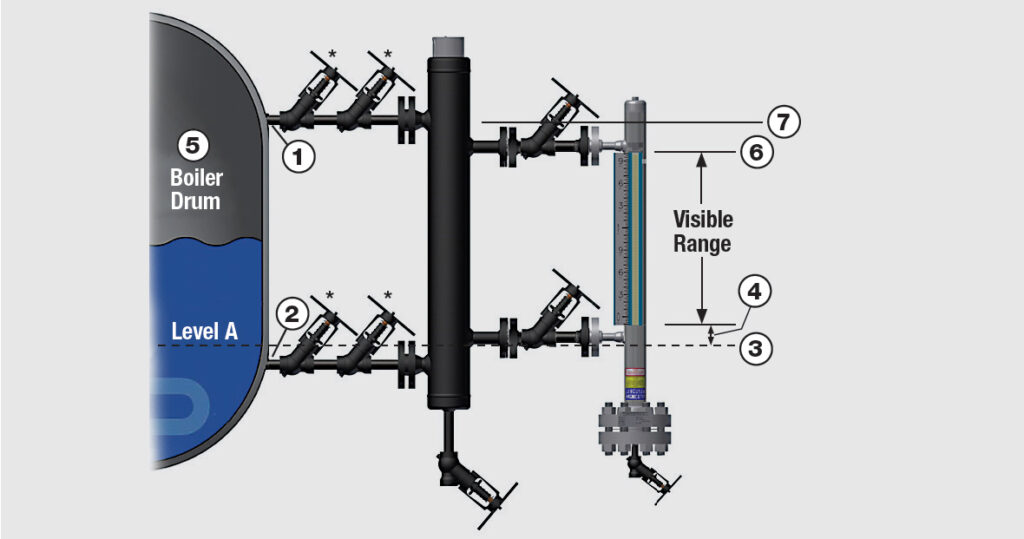
ASME Section I places clear limits on how these devices may be applied. For example, the maximum operating pressure for a magnetic level gage in this service is 900 PSIG. The indication scale must also fall within specific limits relative to the vessel connections and the boiler manufacturer’s defined danger point. Those location requirements are more restrictive than what many people are used to seeing on non-boiler magnetic level gage applications.
There are other important boundaries as well.
A magnetic level gage cannot replace the required gage glass. It cannot be used as a water column. Accessories such as a gage glass are not to be attached to it. And while a transmitter may be used for remote indication, external switches or transmitters cannot be attached for control functions. Isolation and drain valves are also required.
None of these details are especially complicated on their own, but they are easy to overlook when a project is moving quickly or when teams are more familiar with general level applications than power boiler Code requirements. That is usually where the confusion begins — not because the rule is impossible to understand, but because several small requirements must all be satisfied at the same time.
Compliance is only part of the equation
Even when the installation is compliant, dependable performance still comes back to maintenance and operating conditions.
Periodic float inspections are recommended to remove debris that may collect over time, and periodic blowdowns of the sensing lines help maintain reliable indication. Water quality also plays a role. Systems with strong water treatment practices will generally require less intervention than those dealing with dirtier conditions or more aggressive service.
That is why successful boiler drum level applications are rarely about choosing a single instrument in isolation. The better approach is to look at the full picture: Code requirements, operating pressure, visibility needs, control room practices, maintenance realities, and how the boiler is actually run day to day.
The practical takeaway
So, can magnetic level gages be used on ASME Section I power boiler applications?
Yes — but only within defined limits, and only as part of a properly designed level indication strategy.
They are a strong complement to boiler drum instrumentation when applied correctly. They can improve visibility, provide useful supplemental indication, and support operator awareness. But they are not a replacement for the fundamentals, and they are not a device to install casually and assume compliance afterward.
That is where experience matters.
At Westech Industrial, we work with customers to bridge the gap between what the Code requires and how level instrumentation is applied in the real world. The goal is not simply to meet the minimum. It is to help ensure the level indication strategy is compliant, reliable, and practical for the way the boiler actually operates.
If you are reviewing a power boiler application and want to sanity-check whether a magnetic level gage fits, it is a conversation worth having before the specification becomes a field issue.
This draft is grounded in the Clark-Reliance guidance that magnetic level gages may supplement power boiler drum level instrumentation, but do not replace the required gage glass, are limited to 900 PSIG in this service, and must follow specific installation and maintenance rules.
Learn more by contacting one of our Westech Technical Representatives by calling us at 1-800-912-9262 or emailing us at [email protected]. You can also visit our website at https://westech-ind.com.
Share This:






















On The Verge: Energy Sector Primed for New Wave of Growth – ATB Economics