


 CDN NEWS |
  US NEWS







The deferral of the Jackpine oilsands expansion shows just how far we still have to go on development.
By Geoff Russ
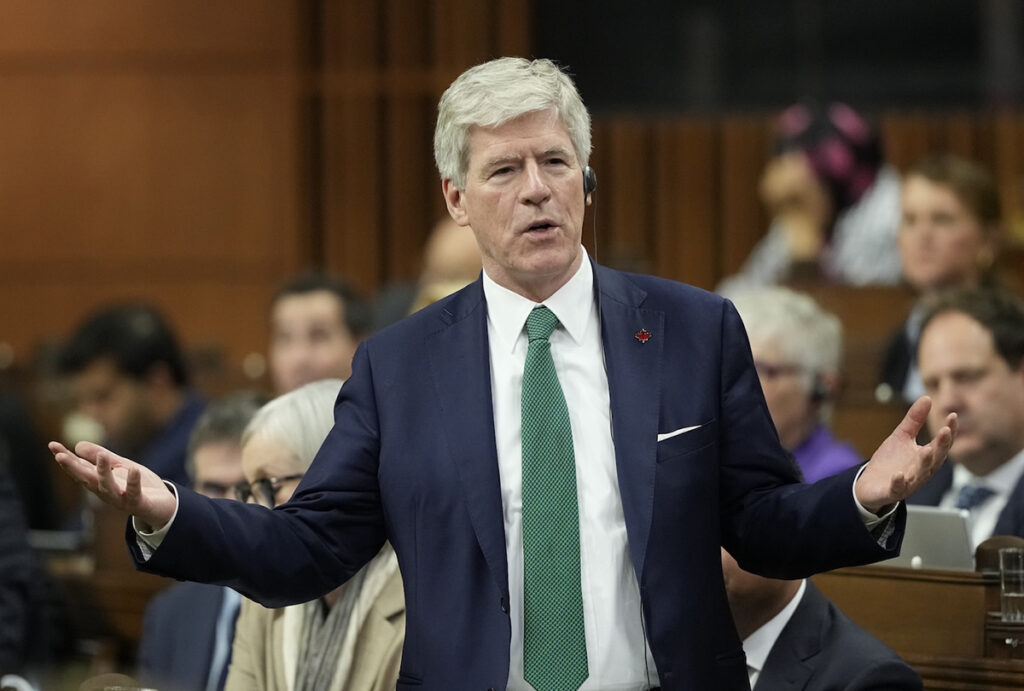
Minister of Energy and Natural Resources Tim Hodgson rises during Question Period on Parliament Hill in Ottawa, Wednesday, Nov. 26, 2025. THE CANADIAN PRESS/Adrian Wyld.
By Resource Works
More News and Views From Resource Works Here
Ottawa is talking about moving faster on natural resources. But Canada’s biggest producers are signalling that speeches, funding announcements and broad promises are not enough to unlock multi-billion-dollar projects.
Canadian Natural Resources Ltd., the country’s largest oil and gas producer, said it is deferring front-end engineering and design work on its planned $8.25-billion Jackpine oilsands mine expansion in northern Alberta. The project had been expected to add about 150,000 barrels a day of bitumen production. The company said it is waiting for clarity on industrial carbon pricing, methane rules, approval timelines and export capacity before reassessing whether the project was viable.
The contrast between rhetoric and reality
The decision landed just as Energy and Natural Resources Minister Tim Hodgson rolled out more than $3.6 billion in federal programs and investments aimed at accelerating critical-minerals development, including a new $1.5-billion First and Last Mile Fund, an upcoming $2-billion Critical Minerals Sovereign Fund, and a mine permit navigator meant to help companies move through federal approvals more quickly. Ottawa also announced targeted spending on transmission upgrades in British Columbia tied to the Red Chris and Teck copper projects.
The contrast is difficult to miss. On one hand, the federal government says Canada is acting with “speed, scale and purpose” to get minerals from deposit to market. On the other hand, a blue-chip producer with deep technical capacity, a long reserve life and a strong balance sheet has decided that policy uncertainty still outweighs the case for moving ahead on a flagship growth project.
Strong fundamentals meet policy risk
CNRL’s pause does not reflect operational weakness. The company reported record annual production of about 1.571 million barrels of oil equivalent a day in 2025, up 15 per cent from 2024, and record fourth-quarter production of about 1.659 million barrels of oil equivalent a day. It generated about $5.3 billion in fourth-quarter net earnings, raised its quarterly dividend by 6.4 per cent to 62.5 cents a share, and cut its 2026 operating capital forecast by about $310 million, a reduction that includes the Jackpine deferral.



The company also continued to expand elsewhere. CNRL closed an asset swap with Shell in November that gave it full ownership and operation of the Albian oil-sands mines, and after year-end it bought Peace River natural gas assets from Tourmaline Oil for $765 million. President Scott Stauth said the added gas properties fit well with existing operations, and he has also argued that Canada needs more gas export capacity to move growing Western Canadian supply to overseas buyers.
That wider market question sits behind the Jackpine decision as much as environmental policy does. CNRL has 256,500 barrels a day of contracted crude transportation capacity to both Canada’s West Coast and the U.S. Gulf Coast, but Stauth still tied the expansion decision not only to methane and carbon-pricing rules, but also to pipeline export capacity. In other words, even a company built around scale and diversification is telling governments that access to markets and regulatory certainty remain inseparable.
The strategic case for resources
That matters because Ottawa is making a broader strategic case for resource development. Economist Philip Cross wrote this week that energy and mining accounted for 41 per cent of Canada’s merchandise exports by November 2025, up from 30.4 per cent in 2015, while autos had fallen to a 10 per cent share. He argued that more than half of mining exports already go outside the United States, while about 88 per cent of Canadian energy exports still head south because Canada has been slow to build the infrastructure needed to reach overseas markets.
Those figures help explain why Hodgson is trying to “level up” mining at the same moment oil producers are warning about the costs of delay. Canada wants to position itself as a reliable supplier of copper and other critical minerals for electrification, data centres and defence supply chains, while also presenting itself as a stable energy producer in a more fractured global economy. But private capital does not move on rhetoric alone. It moves when project economics are durable, approval paths are credible and transportation routes are available.
Rewarding restraint
Investors, for now, still appear to like CNRL’s discipline. Analysts at Scotiabank and RBC raised their price targets this week after the company’s latest results, citing strong mining and upgrading performance and solid fundamentals. That is a reminder that public markets may reward restraint when policy risk clouds a long-dated investment.
The larger message for governments is plain enough. Canada can announce funds, pitch itself as an energy and minerals power, and speak confidently about national strength. But when a company as large and experienced as Canadian Natural decides to wait, it is a sign that the real work of building a resource economy still lies beyond the podium.
Geoff Russ is a writer for Resource Works, a non-partisan organization that champions responsible resource development in British Columbia and Canada. Reach Geoff at [email protected].
Share This:






















On The Verge: Energy Sector Primed for New Wave of Growth – ATB Economics