


 CDN NEWS |
  US NEWS







Why the closure of the Strait of Hormuz is a massive economic warning and a rare opportunity to double Canadian GDP growth
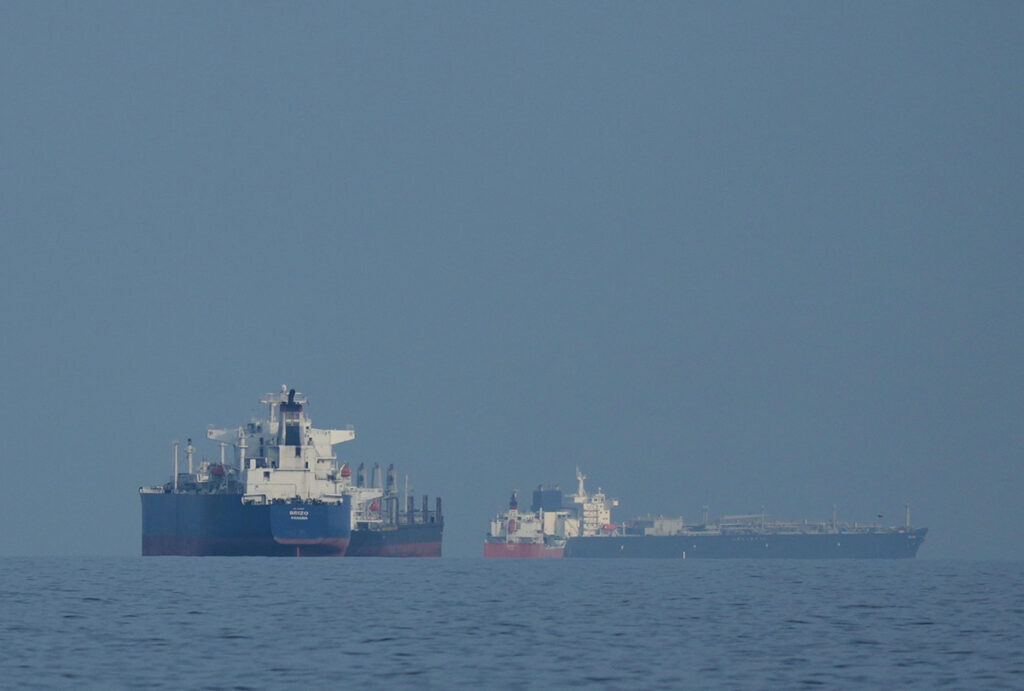
Oil tankers and cargo ships line up in the Strait of Hormuz as seen from Khor Fakkan, United Arab Emirates, Wednesday, March 11, 2026. (AP Photo/Altaf Qadri)
By Resource Works
More News and Views From Resource Works Here
I am old enough to remember the last oil crisis and recession triggered by events in Iran in 1979. It was bad.
It contributed to the highest inflation since the Second World War, followed by crippling interest and mortgage rates and a global recession.
So I’m worried that, should the current war in Iran drag on, and the Strait of Hormuz remain closed much longer, the economic shock could be even worse than it was in the late 1970s and early 1980s.
The closure of this oil and gas chokepoint has caused what the International Energy Agency calls the largest oil supply disruption in history.
You cannot suddenly take 20% of the world’s oil and gas off the market and not expect an epic shock to the global economy.
“If this (closure) of the Strait of Hormuz continues, it will make the supply shocks of the 70s look like child’s play,” Rory Johnston of Commodity Context told me.
Since the bombing of Iran started on February 28, Brent crude oil prices have increased 40% to US$100 per barrel, gasoline has gone over $2 per litre in Metro Vancouver, and we are less than three weeks into this war.
Some 20 million barrels per day (bpd) of crude transiting the Strait of Hormuz has been suspended, and another 10 million bpd of oil production has been shut in by Arab countries like Iraq, the IEA confirms.
A worst-case scenario could be oil at US$200 per barrel, if the Strait of Hormuz remains closed indefinitely, Johnston said.
The upside to the energy crisis
If there is any upside here, it’s that it could be a short-term boon for Western Canada, because higher oil and gas prices are good for oil and gas producers.
Western Canadian Select has increased by US$35 per barrel, to US$85, in just two weeks.
That’s obviously good for Alberta, but it’s bad for everyone else, because everything we consume moves by car, truck, train, plane or ship, which means everything will cost more.
One other upside to the energy crisis is that it could be a teachable moment for Canada: The world needs our oil and gas.
“I think this is going to reinvigorate discussions of supply, which brand Canada always benefits from when energy security is in the headlines,” Johnston said.
Oil shocks often precede a recession
Ultimately, everyone suffers from an energy crisis, even energy secure nations like the U.S. and Canada. An energy crisis often precedes recession because it is so inflationary.
So I think the whole world could be in for some real pain, if things don’t get sorted out soon in the Persian Gulf.
But pain can be instructive, and hopefully this latest energy crisis will firm up Canada’s resolve to become a bigger player in both oil and gas.



“Let’s be reminded how important it is to have redundancy in global markets,” said Heather Exner-Pirot of the Macdonald-Laurier Institute.
“Canada’s in the unique position that we can export on the Pacific Coast, off the Atlantic Coast, and we can also export through the Gulf of Mexico. This is an opportunity to grow global market share.”
Of course, there’s no way a new West Coast pipeline can be built in time to meet the current crisis.
“There’s always going to be a next crisis,” Johnston said. “So we need to start investing to better prepare for optionality and flex in our system to be able to contribute in the future.”
In the short term, thanks to the Trans Mountain pipeline expansion, Canada may be able to squeeze a bit more oil through the pipeline to get to Asia, which will be starving for oil, since most of its oil comes from the Middle East. Canada could also try to move more oil and refined fuels by rail.
Johnston estimates there could be 10% of spare capacity on TMX that isn’t spoken for, and that could mean an additional 100,000 barrels being rushed through Vancouver to Asia.
As Johnston notes, that would be “a drop in the bucket” compared to how much oil is being stranded in the Persian Gulf right now.
In the intermediate term, Canada can help address world oil security through pipeline optimization – something that Canadian midstreamers are already working on.
Exner-Pirot notes that pipeline optimization could increase Alberta oil production and export capacity by 1.3 million bpd.
That would come mainly from three projects: optimization of TMX and the Enbridge Mainline, and South Bow’s Prairie Connector – an updated version of the Keystone XL project.
Longer term, the proposed West Coast pipeline could vastly improve energy security for Asia, and make it less dependent on Middle East oil.
Asia is knocking on our door
Peter Tertzakian of ARC Energy Research Institute recently paired up with ATB Financial to model the GDP impacts of a $100 billion investment in 1.5 million bpd of additional pipeline capacity. That figure includes the $20 billion required for carbon capture and storage.
The modelling estimates it would add $31.4 billion to national real GDP each year over the next decade – a 1.1% increase to Canada’s real GDP.
Until fairly recently, there have been doubts about whether that kind of investment is warranted, given expectations of a decline in fossil fuel demand and concerns over stranded assets.
The current Middle East energy crisis should put that to rest because it underscores just how important oil is to the world economy, especially Asia.
“We keep being told fossil fuels are going away,” said Adam Pankratz, a professor at the Sauder School of Business. “Well, look at the data — it’s not true.
“We’re still going to be consuming over 100 million barrels of oil a day for decades. Where should that come from? I think pretty clearly it should come from Canada.”
Tertzakian told me that, last fall, when he was in Asia, it was clear that there is a big demand for more Canadian energy.
“Those Asian economies were knocking on our door, saying ‘We need more of your oil, and specifically, we need more of your heavy oil, we need your LNG – what can you do for us? And we’re willing to come and help pay for it.’
“That was even before all this happened. So you can be assured, once the hostilities cease, and we hope that’s very soon, they’re going to be knocking a lot harder on our door.”
Nelson Bennett’s column appears weekly at Resource Works News. Contact him at [email protected]
Share This:






















On The Verge: Energy Sector Primed for New Wave of Growth – ATB Economics