CDN NEWS |
  US NEWS







But does that mean 50 or 100 million tonnes a year?
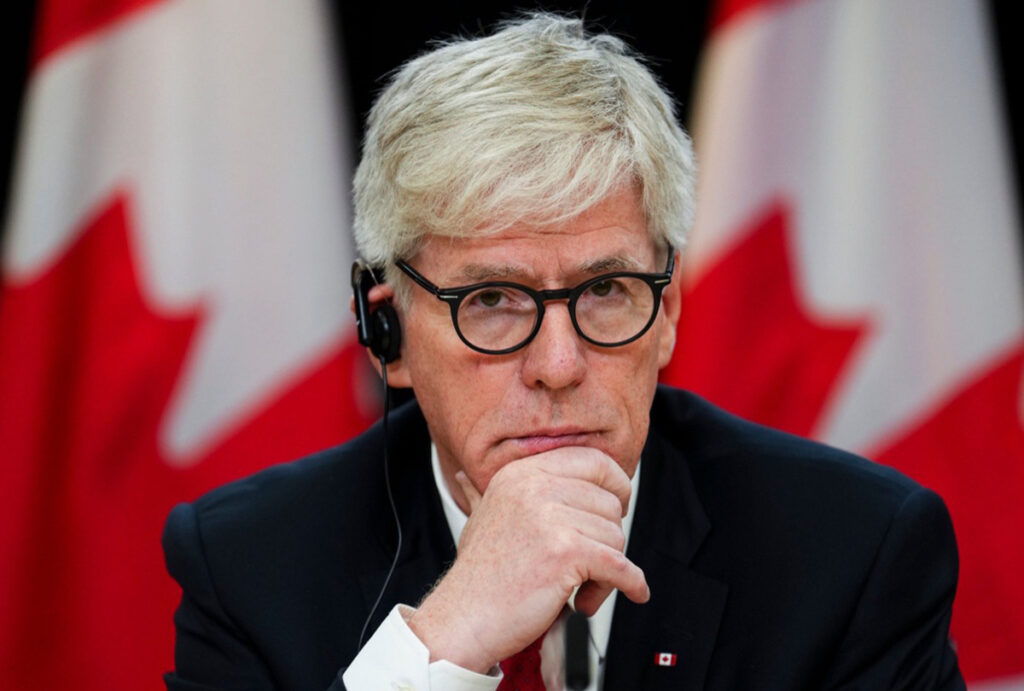
Tim Hodgson at a news conference, 2025.
By Resource Works
More News and Views From Resource Works Here
We begin with this word from Prime Minister Mark Carney: “By 2030, Canada will produce 50 million tonnes of LNG each year, all of which will be destined for Asian markets.”
But then came a surprise double-down number from Energy and Natural Resources Minister Tim Hodgson, who declared that Canada could be one of the largest suppliers of LNG in the world —”as much as 100 million tonnes per annum.”
Hodgson told Parliament’s Standing Committee for Natural Resources earlier this month that if Canada delivers on its LNG targets “as we hope, proponents will ultimately increase our production to as much as 100 million tonnes per annum.”
That new figure is out on the bright side: Canada’s current and planned LNG projects have the capacity to produce 34.8 million tonnes a year.
The missing 65 million tonnes
So from where would the remaining 65.2 million tonnes a year come from?
Even if expansion plans for current plants proceed, their output capacity would be some 46.65 million tonnes a year — still more than 53 million short of Hodgson’s figure, and 3.5 million tonnes shy of Carney’s number.
What we know so far:
- LNG Canada in BC has a current production capacity of 14 million tonnes a year.
- Woodfibre LNG in BC will be able to produce an annual 2.1 million tonnes when it goes online in 2027.
- Ksi Lisims LNG aims to start producing 12 million tonnes a year in late 2028 or 2029.
- The Haisla Nation’s Cedar LNG aims to produce 3.0 to 3.3 million tonnes a year, starting in late 2028.
- Tilbury LNG in the BC Lower Mainland can produce 250,000 tonnes.
There are some expansion plans: LNG Canada’s partners are considering adding Phase 2, which would double output capacity to 28 million tonnes a year. Tilbury LNG has plans to expand to 3.4 million tonnes by 2027.



If those plans go ahead, Canada’s LNG production could hit 46.65 million tonnes a year.
And there is some talk these days of reviving the Énergie Saguenay LNG project in Quebec, which was blocked by the Quebec government in 2021 and by Ottawa in 2022. On paper, it could produce 10.5 million tonnes a year. And there’s current talk of an LNG plant in Newfoundland and Labrador, but the proponents have given no number for output.
Ghost projects and regulatory silence
Hodgson recently visited India, the world’s fourth largest importer of LNG, and he talked trade, minerals, and LNG with leaders there. He has also talked about LNG and other natural-resource exports with China, Poland, Türkiye, the European commissioner for energy, and New Zealand (which is planning its first LNG-import terminal). But none of them has cited any numbers.
So Hodgson’s figure of 100 million tonnes a year of LNG carries with it a plethora of question marks.
Neither the Quebec nor NL projects has become firm enough for Ottawa to send one or both to the Major Projects Office (MPO), which is supposed to streamline and speed up the regulatory approval processes for big natural-resource projects.
The MPO was launched in August 2025 with a promise of accelerating approvals for projects “and committing to a two-year timeline for major project decisions.”
At last count, it has on its desks 11 projects that have been designated to be “of national importance and significance” and more than 500 other “key natural resource projects” that have not been so designated.
Prime Minister Carney announced last September the first series of major projects being referred to the MPO for consideration (including Phase 2 expansion of the LNG Canada operation).
And last November 13 he announced the second series of referred projects, which included the Ksi Lisims LNG project in BC, led by the Nisga’a Nation, and BC Hydro’s North Coast Transmission Line, which would serve Ksi Lisims and other LNG and resource projects.
Since then, though, there has been silence from the MPO: No announcements, no updates, no news, and certainly no LNG production or export numbers.
So, Mr. Hodgson, could you please fill us in on how and when Canadian LNG output could hit your “hope” of 100 million tonnes a year?
Don MacLachlan is a writer for Resource Works, a non-partisan organization that champions responsible resource development in British Columbia and Canada. Reach Don at [email protected].
Share This: