CDN NEWS |
  US NEWS







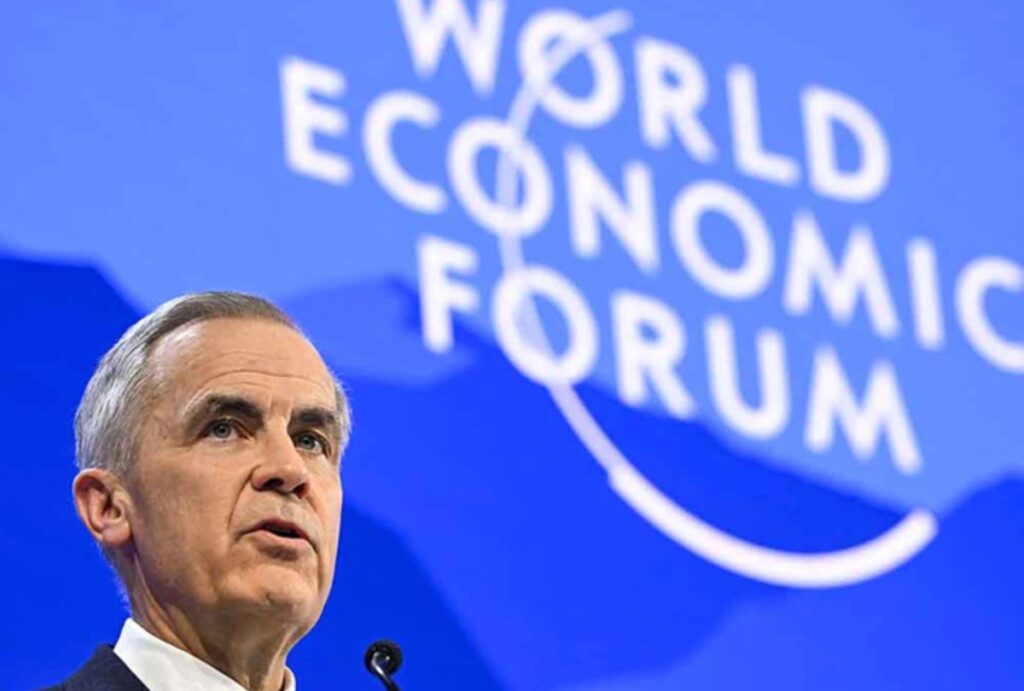
Mark Carney presented his vision for a new world order at Davos. He has failed to provide a similarly compelling vision for resuscitating Canada’s economy. Our prime minister is afraid to publicly admit Canada’s economic revival can’t be achieved without substantially increasing conventional energy production and exports.
By Jim Warren
We long remember those great speeches that captured the spirit of a generation, helped change the world, launched political careers and saved others.
Churchill, for example, made several of them: “…blood, toil, tears and sweat, “Never in the field of human conflict…”
Lincoln’s Gettysburg Address and Martin Luther King’s “I have a dream,” speech are also on the list of all-time hits.
We tend to forget speeches that briefly captured the public imagination but became less popular once it was clear the messages they conveyed failed to reflect reality.
A case in point: Justin Trudeau’s “Sunny Ways,” sermons. They helped make him prime minister in 2015. Yet, by the end of his first year in office, supporters of the conventional energy sector on the prairies had correctly concluded the “sunny ways” did not apply to them. By the fall of 2025 a majority of Canadians no longer felt the sunshine and Trudeau was forced into ignominious retirement.
Our current prime minister is basking in the warm glow of international acclaim in the wake of the speech he delivered in Davos. It was a fine speech, masterfully delivered.
The mainstream media have dubbed it a masterpiece, but have so far failed to give it a suitably inspirational name. It may go down in history as the “Rupture Speech.”
Justin Trudeau’s sunny ways rhetoric will quickly fade from memory. On the other hand, vivid recollections of his government’s ten-year assault on the conventional energy sector and the economic fortunes of the Prairie Provinces could live on for another generation.
The Jury is still out regarding the historical staying power of Carney’s “Rupture” speech.
Ten long, lost years
Here is why the Justin Trudeau years are destined to stick in our collective memory.
For ten long years, running from 2015 into 2026, Canada’s fossil fuel producers endured federal Liberal efforts to stifle growth in their industries and an avalanche of legislation designed to restrict production and consumption. These measures drove up the cost of living. They killed new investment in Canada’s resource industries. And, they paved the way for a long-term decline in the economic fortunes of the entire country.
Prominent among the misfortunes faced by the energy sector, were the cancellation of the Northern Gateway and Energy East pipelines in 2016 and 2017 respectively. Both projects failed to proceed due largely to barriers imposed by federal anti-development environmental legislation, primarily Bill C-48, the Tanker Ban, and Bill C-69 the Impact Assessment Act.



No less frustrating was the Trudeau government’s timid reaction to the Biden administration’s cancellation of the Keystone XL pipeline. It met with barely a whimper of complaint on the part of Liberal Ottawa. After all, Canada’s Liberal and US Democrats shared anti-fossil fuel agendas, based largely on hyperbolic alarm over climate change.
The economic costs have been enormous. Investment in Canadian industry has fallen by an estimated $500 billion since Justin Trudeau became prime minister. We will never recover the billions in revenue lost because the Northern Gateway and Energy East pipelines weren’t completed. Based on their nameplate capacity when planned, they would have added an additional 1.5 million barrels per day to the volume of crude oil exported from the Prairies to new international customers and consumers in eastern Canada. Even at the relatively low price of $60 US per barrel the two new pipelines would generate $90 million US in new revenues per day when running at full capacity—up to $30 billion US per year in lost export revenues.
In the spring of 2025, Alberta’s Danielle Smith provided the prime minister with a concise nine-point list of the legislative and regulatory measures blocking pipelines along with other policies harmful to the Canadian economy, consumers and the conventional energy sector. Smith’s “nine bad laws” laid out what her government and executives from Canada’s oil and gas companies said was required to attract investment in the resource sector. No less important was Smith’s claim that addressing the nine bad laws was essential to convincing Albertans that Canada could be made to work in ways that served their needs and interests.
An oratorical giant at Davos—a pipsqueak at home
Mark Carney became prime minister because he promised to revive the economy, reduce the cost of living, attract new investment, and reverse the chronic fiscal mismanagement of the former prime minister and cabinet. However, the most compelling argument made by the federal Liberal campaign was the contention that Carney’s resume showed he had the international negotiating skills required to shield Canada from the threat of US tariffs.
As of today, Carney’s ‘elbows up’ efforts to “tame” the Trump administration have been a colossal flop. Trump’s latest trade policy tantrum threatens a 100% tariff on all things Canadian. The president thinks Carney has gone soft on China.
Carney’s public statements regarding Albertans’ concerns about the future of their energy sector have been vague. The prime minister has only rarely provided unequivocal support for new oil pipelines and has made few meaningful changes to the nine bad laws.
Carney has to know Canada’s economic performance is unlikely to improve in the absence of increased oil and gas exports. Yet, he has avoided expressing enthusiastic support for the pipelines required to make it happen.
Our prime minister claims he remains wedded to the economically impractical environmental legislation and emissions reduction targets of the Trudeau government. This is in part because a good number of MPs from in the Liberal caucus are Net Zero zealots dedicated to the economically ruinous policies adopted during Trudeau’s tenure. Carney fears that if he openly challenges environmental orthodoxy, some of them might jump ship and put his slim plurality in jeopardy.
His own longstanding commitment to the green energy transition also contributes to his lack of enthusiasm for ramping up oil production and exports. This is a big problem for him because he won’t succeed as prime minister unless he puts the climate crusade on the back burner. Until Canada’s economic performance substantially improves, we simply can’t afford the luxury of economically impractical emissions reduction policies.
The Memorandum of Understanding (MOU) signed by Danielle Smith and the prime minister in November presumably supports “in principle” the building of a million barrel per day pipeline from Alberta to Prince Rupert. However, the contingent nature of the MOU along with subsequent statements and actions on the part of the prime minister indicate his support for the pipeline could prove illusory. Before a Northern Gateway 2.0 can be launched, its proponents will have to comply with a daunting list of conditions. At this point it’s not clear whether prospective investors will accept those conditions—or if some of the conditions can be relaxed.
Danielle Smith remains optimistic that Ottawa will stand by its MOU commitments, and that any troublesome conditions will be overcome. Smith’s frank and open optimism is good enough to reduce the levels of cynicism for many (but not all) supporters of conventional energy on the prairies.
Carney has rarely if ever come close to matching the speech making qualities he demonstrated at Davos when talking directly to Canadians; especially when dealing with issues important to increasing our oil and gas production and exports. He frequently demonstrates an inability to communicate fluently, particularly in response to questions from journalists. Many of his responses are discombobulated word salads worthy of Kamala Harris. He’s been accused of speaking in riddles when dealing with issues and policy positions he is unwilling or afraid to commit to. Listening to him can be painful.
Yes, Carney was touted as a world class orator at Davos. He has been far less inspirational when talking to Canadians; people on the prairies in particular. He clearly saved his best communicating efforts for the Davos elite.
Carney was immersed in his comfort zone at Davos. It’s his political safe space. Here’s hoping he starts feeling more comfortable talking to Canadians; especially here on the prairies. Grandstanding in Davos won’t do it. If the prime minister hopes to revive Canada’s flagging economy and reduce the political temperature in the Prairie West, he has to get completely behind Northern Gateway 2.0, live up to the spirit of the MOU, and meet any commitments made to Alberta’s negotiators.
-30-
Share This: