


 CDN NEWS |
  US NEWS







‘I would like to see Canada continue to be involved,’ Hansen said. ‘It’ll drive our own economy, drive jobs’
By This Article and More by Steven Wilhelm Here
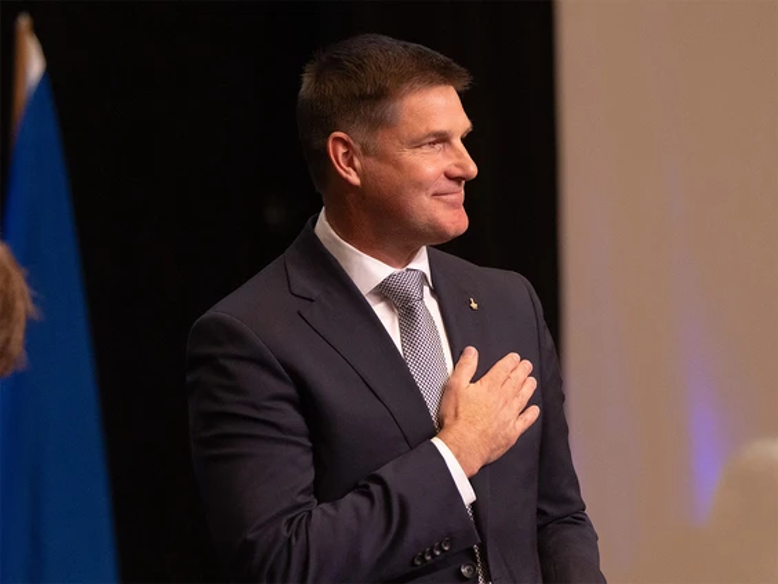
Col. Jeremy Hansen, the Canadian astronaut who took part in the Artemis II mission, spoke with Space Canada CEO Brian Gallant at the Global Business Forum in Banff, west of Calgary, on Thursday, Sept. 24, 2026. Brent Calver/Postmedia
BANFF – As Canadian astronaut Jeremy Hansen weaved through a crowded conference, the hum of Elton John’s 1972 hit “Rocket Man” was quelled only by the roar of applause.
At the Global Business Forum, Hansen said Canada is “very well positioned” to become a hub for future rocket launches, meeting growing demand.
“Canada would be providing additional capacity that is needed,” Hansen, who flew around the moon this year, told Postmedia Calgary in an interview.
Earlier this year, the federal government signed a 10-year, $200-million agreement to lease a dedicated launch pad in Nova Scotia, where commercial, scientific and defence-related cargo could be fired off into space.
There are limited areas on the planet fit for launches, and Canada’s proximity to the North Pole makes it an energy-efficient place to launch from, Hansen said.
More opportunities for Canada in space
Hansen, alongside his American crewmates Reid Wiseman, Victor Glover and Christina Koch, formed the crew of NASA’s Artemis II mission, where the four made history by flying around the moon for the first time in decades.
The first Canadian to fly on a lunar mission, Hansen began his retirement from the CSA this month and is pursuing new opportunities and remains a reservist in the Royal Canadian Air Force.
”The most impressive thing was seeing an Earth set behind the moon,” he said.
“Up close, all of that grandeur of the lunar surface right there through the window, and then seeing the Earth go behind it, little tiny Earth, and 40 minutes later watching tiny Earth come out the other side.”
At the conference, Hansen ditched the deep-blue jumpsuit he wore during his trip around the moon in favour of sharp business attire to share his experiences with dozens of leaders and community builders.
There are opportunities in space beyond launches, and even beyond the moon, Hansen said.



“Deep space robotics, we’ve been working on that for a while now,” he said. “What robotics really does for us on the lunar surface is logistics.
“As we go further and we establish a more permanent basis on the moon, eventually Mars, robotics logistics becomes really important,” Hansen said, adding health and food technologies are also an opportunity.
Nuclear energy, which has seen a resurgence of interest amid the global energy crisis, is also an area where Canada excels, according to Hansen.
“Nuclear energy is a huge opportunity for Canada right now. We need it for our country,” he said. “It’s the right investment for many domestic reasons.”
During their 10-day voyage, the crew reached more than 406,000 kilometres from Earth, the farthest any humans have ever been from the planet.
But is there intelligent life out there?
“How could there not be?” Hansen said.
“The universe is just so large.
“Every single star you see in the night sky is in our galaxy, in the Milky Way, and then to think there’s a couple other trillion galaxies out there somewhere,” he said.
The Artemis II mission also marked the first crewed flight of NASA’s Orion spacecraft, which will continue to play a major role in the agency’s future ambitions to explore and, eventually, establish a permanent presence on our celestial neighbour.
For those wondering why the U.S. has its sights set on the moon for the first time since Apollo 17 touched down in 1972, some point to China’s moon ambitions and growing geopolitical tensions between the two superpowers.
Still, there are scientific and possibly even economic reasons for returning to the moon’s surface.
The Canadian Space Agency says the moon is a good place to test new technologies that could eventually help take humans to Mars. Meanwhile, the Essential Minerals Association says mining on Earth’s largest satellite could provide resources for humans living there.
“I would like to see Canada continue to be involved,” Hansen said. “It’ll drive our own economy, drive jobs.”
[email protected]
Share This:





















