CDN NEWS |
  US NEWS







This isn’t the first time Canada has made a Trans Mountain offer to Indigenous communities
By Robert Tuttle and Laura Dhillon Kane
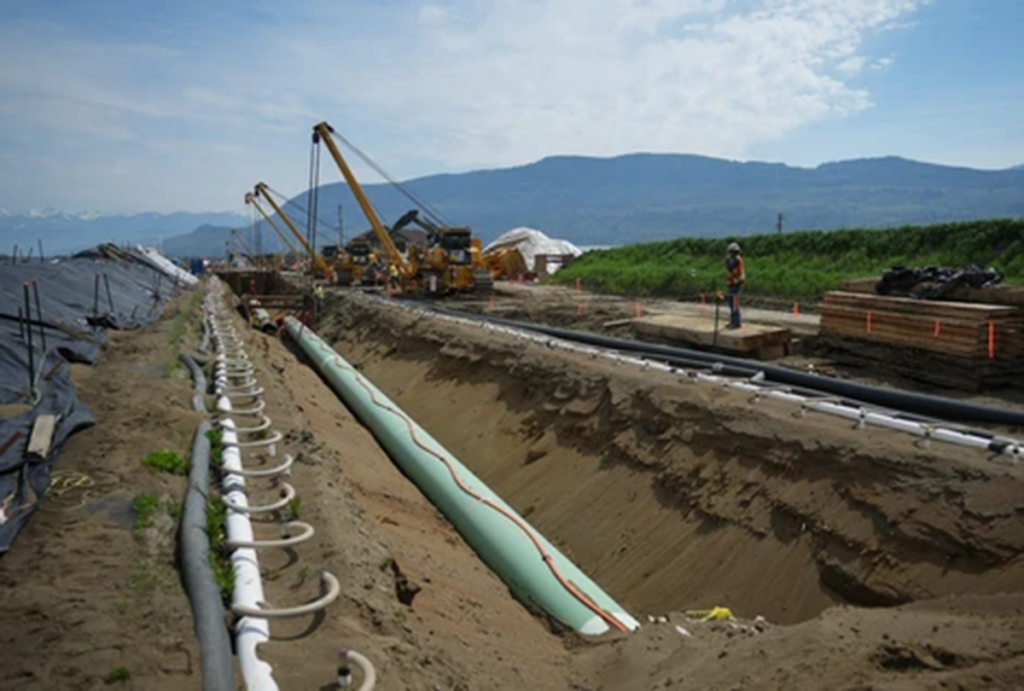
The Canadian government’s plan to offer a 15 per cent stake in the recently expanded Trans Mountain pipeline system to Indigenous communities is garnering criticism from some leaders as inadequate.
Trans Mountain Corp., the operator of the only oil pipeline running from Alberta to the British Columbia coast, was purchased by the government eight years ago from Kinder Morgan Inc. Soon after, Indigenous groups in western Canada formed to seek ownership stakes in the system.
Former Prime Minister Justin Trudeau’s administration started a process to sell a portion of it to them, but never followed through. Now, Mark Carney’s government is trying again.
“We’ve come a long way but, you know, the 15 per cent is somewhat a feeble attempt at economic reconciliation,” Stephen Buffalo, president of the Alberta-based Indian Resource Council, said in an interview. “They should at least put 50 per cent on the table.”
The project to expand Trans Mountain to a capacity of 890,000 barrels a day was completed in 2024, years behind schedule and at a cost of around $35 billion. The pipeline has opened up significant exports to Asia for Canadian oil producers, reducing reliance on United States buyers and improving the price they receive for their crude.
The expansion project was opposed by many Indigenous communities in the west, but others saw opportunity. Groups such as the Western Indigenous Pipeline Group in BC, which formed a partnership with Pembina Pipeline Corp., and Project Reconciliation argued that offering ownership to First Nations and Metis communities would provide them with both revenue and environmental oversight of infrastructure that would affect their traditional territories.
Project Reconciliation envisioned full First Nation ownership of the system, with revenue going into a sovereign wealth fund for communities. Steve Mason, the group’s top executive, formulated a plan to finance the purchase with a bond offering underpinned by the tolls collected on the pipeline.
First Nations “should own a material piece,” he said by phone. “When we say material, it should be a minimum of 30 per cent.”



The 15 per cent offer came in a recent letter sent by the government, Finance Minister François-Philippe Champagne’s office confirmed. The government also offered a $2.5 million lump sum payment to Indigenous communities as a “goodwill gesture,” Champagne said at a news conference Tuesday.
“I would say it’s a very meaningful offer,” he said. “You’re talking about an existing asset, which has been de-risked very much in line with market practice.”
This isn’t the first time Canada has made a Trans Mountain offer to Indigenous communities. Three years ago, the federal government sent a letter offering an undefined stake in the pipeline to dozens of communities on or near the pipeline route.
The government was interested in selling a stake of about 30 per cent, Alberta Premier Danielle Smith said in 2024. That effort eventually stalled.
While the Canadian government has said it doesn’t seek to be a long-term owner of Trans Mountain, the pipeline is paying taxpayers dividends and the system is being expanded further by 300,000 barrels a day.
Recently, Trans Mountain was commissioned to lead a new one-million-barrel-a-day line along a similar route, but ending at a new deep-water terminal that can handle the world’s biggest tankers.
Not every First Nation leader was critical of the government’s latest proposal. The offer is a starting point, Dale Swampy, chief executive of the pro-development National Coalition of Chiefs, said by phone. The stake could be increased later.
“It’s a great offer,” he said. “I think 15 per cent allows you to gain some control over environmental monitoring, over who gets hired.”
Bloomberg.com
Share This: