CDN NEWS |
  US NEWS







By Resource Works
More News and Views From Resource Works Here
Premier David Eby should be careful about proposing a new Canadian oil refinery, or someone just might take him up on the suggestion and propose building one here in B.C.
And wouldn’t that be interesting.
But of course, when Eby suggests Canada needs new refining capacity, he doesn’t mean it should be built in B.C.
What he really means is that Alberta’s oil industry should forget all this nonsense about building a new pipeline to the West Coast and build a refinery instead.
“If we’ve got tens of billions of dollars to spend, I think we should spend it on a refinery and we should develop oil products for Canadians and for export, instead of being reliant on American and Chinese refineries to do it for us,” Eby said at a Jan. 8 news conference, according to CBC.
Déjà vu all over again
If this gives you a sense of deja vu, that’s because we’ve heard this before from a B.C. NDP premier.
About eight years ago, the late NDP premier John Horgan threw out this same red herring during the Trans Mountain pipeline expansion debate.
Climate change champions don’t build oil pipelines — they build oil refineries, or some such nonsense.
The argument is just as incoherent today in the context of a new west coast pipeline as it was in 2018 in the context of TMX.
“Somehow it’s a facile solution to a non-existent problem,” said Dan McTeague, president of Canadians for Affordable Energy and founder of GasWizard.
“I’m just flabbergasted that the premier is trying to raise this red herring again, because it really does make the B.C. government look illiterate on the energy file, which is not a great look for them,” said Kent Fellows, an economics professor at the University of Calgary’s School of Public Policy.
But what’s wrong with Eby’s suggestion that Canada should be expanding its refining capacity?
The climate contradiction
First, there’s the climate calculus of it all.
Isn’t David Eby the one who wants to see gasoline powered vehicles phased out with electric vehicles?
Having zero emission vehicle mandates aimed at phasing out gas-powered cars seems just a tad inconsistent with the suggestion that we should be refining more oil.
Also, if you compare the emissions intensity of an oil pipeline with an oil refinery, a refinery is orders of magnitude worse. Refineries are among the biggest producers of greenhouse gas emissions on the planet.



“There’s a lot of emissions associated with refining – much more than with respect to crude oil production,” said Alberta economist Jack Mintz.
The economics don’t add up
Never mind the climate policy implications. The economics just don’t add up.
There’s no big domestic demand for more refined fuels, at least not in Western Canada.
B.C. is now sufficiently supplied with gasoline, diesel and jet fuel, thanks to (wait for it) … new pipeline capacity.
The expansion of the Trans Mountain pipeline has meant more refined fuels from Alberta refineries can move here by pipeline.
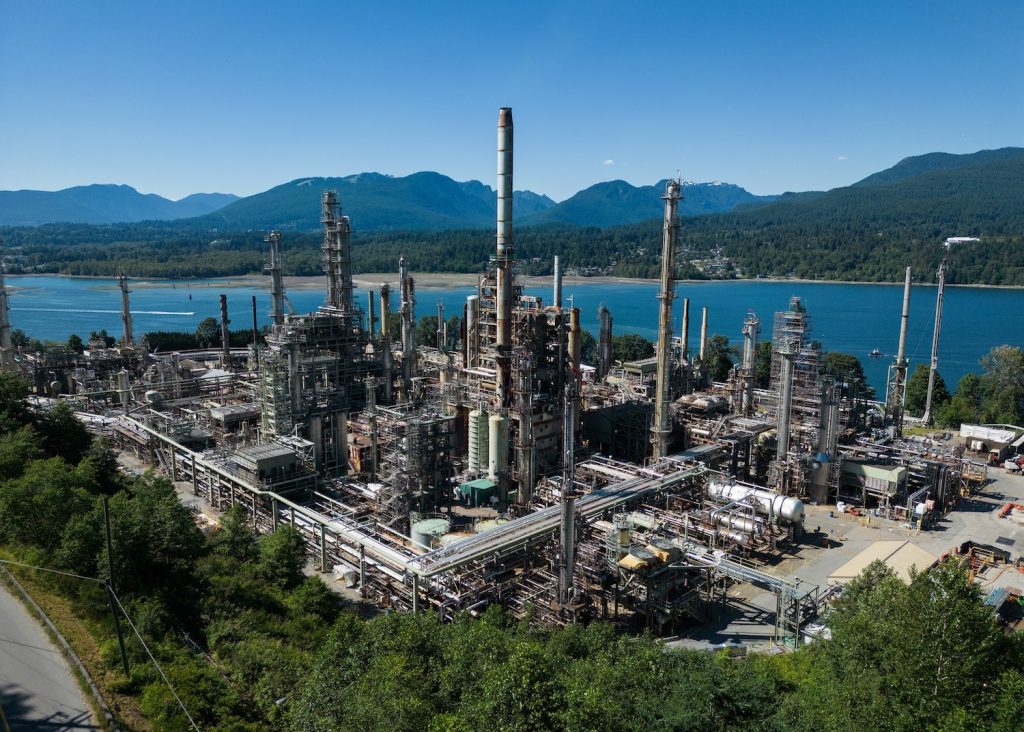
Burnaby refinery. | Darryl Dyck, CP
That explains why we have not seen the kind of price shocks at the pump that British Columbian drivers experienced prior to the expansion – that and the removal of the carbon tax on gasoline.
“If you look at the gasoline supply to the Lower Mainland post-Trans Mountain expansion, they’re getting significant volumes from Alberta refineries, and there’s also the refinery in the Lower Mainland,” Fellows said.
“There might be some trace imports from the Pacific Northwest, but I don’t think those are anywhere near the volumes they were at prior to the Trans Mountain completion.”
No one is building new refineries in North America because they are hellishly expensive to build there’s no business case for them. There is sufficient refining capacity in North America to meet domestic demand.
“There is no really strong reason to believe that the private sector is making a mistake by not investing in a new refinery,” Fellows said.
New oil refineries are being built elsewhere, however – in China, India, and Indonesia. David Eby appears to be suggesting that we export more refined fuel to those countries.
But those countries don’t want our refined fuels. They want our oil so they can put it through their own refineries.
“It tends to make a lot more sense to refine crude oil closer to the demand side of the market,” Fellows said.
A distraction technique
But if David Eby is serious about getting additional refineries built in Canada to export refined fuels to other countries, he could always give David Black a call and see if he is willing to dust off his plans for Kitimat Clean – the multi-billion dollar refinery that Black had pitched for Kitimat more than a decade ago.
Of course, if a refinery were to be built in Kitimat, you might need a new pipeline to feed it with oil.
“It really does feel like a distraction from the bigger conversation on the pipeline side of things,” Fellows said. “I find it almost ridiculous to be having this conversation as sort of a distraction, this red herring.”
Share This: