


 CDN NEWS |
  US NEWS







By Ron Wallace and Dennis McConaghy
Following a June 2025 First Ministers meeting in Saskatoon, a session that discussed the federal government’s plan to remove trade barriers and advance major projects of national interest with the Carney governments’ Bill C-5 the One Canadian Economy legislation, the Ministers agreed to “work together to accelerate major projects in support of building a strong, resilient, and united Canada.”
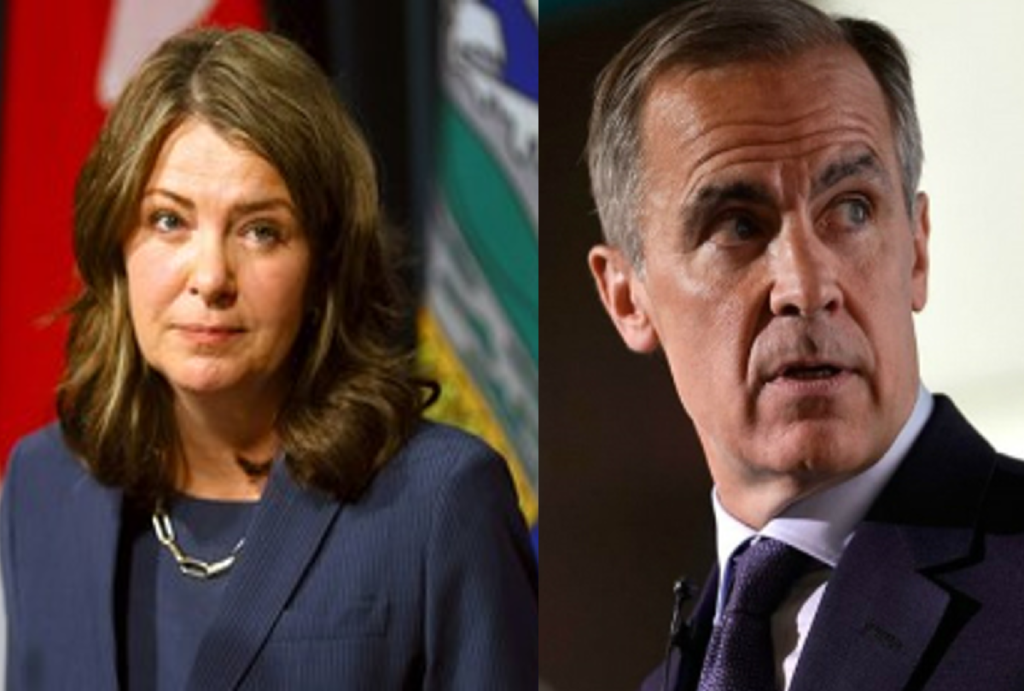
At that meeting Prime Minister Carney highlighted opportunities for Canada to build new export oil pipelines to tidewater – with the proviso that those projects would require parallel investments for carbon capture stating that it’s “absolutely in our interest” to de-carbonize Canada’s oil for export. Reflecting this stance, Alberta Premier Danielle Smith welcomed a “grand bargain” with the Prime Minister based on a bold trade-off: The rapid approval of a new oil pipeline from Alberta to tidewater in exchange for major investments in carbon capture technologies. Alberta has also suggested that it would commit barrels of physical bitumen received in lieu of cash royalties from oilsands producers to encourage a possible private-sector crude pipeline to Prince Rupert, B.C. Understandably, Alberta’s Premier hopes that the province could become a global energy leader by successfully navigating federal climate commitments – a strategy that, if successful could reshape not just Alberta’s, but the entire Canadian, economy.
However, there remain material challenges to this vision. Even with the tentative support from the federal government to fast-track these projects, there remain many challenges: These include B.C.’s skepticism about any new pipelines to their northern coast, Indigenous concerns and existing Acts and Regulations like the C-69 Impact Assessment Act (IAA) and C-48 tanker ban. A Carney-Smith “grand bargain” would entail a new “decarbonized” pipeline to transport 1 million barrels per day of Alberta heavy crude oil to the west coast, a project that Smith calculates would yield annual revenues of CAD$20 billion ($14.6 billion), revenues which she proposes to use to offset the massive estimated CAD$16.5 billion cost of the Pathways Alliance carbon-capture project. Are these assumptions accurate and what are the other policy implications for Canadian energy exports and imports?
First, let’s examine the concept of “decarbonization.”
Carney has advanced the concept of “de-carbonizing” Alberta oil – but what does this mean? If anything, it must mean that the incremental emissions from oil or gas production must be captured and sequestered to reduce global emissions – a proposition that assumes that Canada is the country that determines global demand and that also drives incremental production. Similarly, there are some that argue that Canada could buy off-sets (that is to pay others to stop their existing emissions, to accommodate Canada’s incremental emissions). Leaving aside the issue that the countries that have these offsets to sell are not forced to reduce emissions like Canada, it is highly unlikely that would they be sufficient to offset a potential Canadian oil production increase on the scale of 1.0 million barrels/day.
What would be demanded is that the Canadian hydrocarbon industry physically extract CO2 emissions from the production processes associated with oil sands production, followed by the compression of such emissions to pressures sufficient to enable transport to sequestration sites, typically abandoned or depleted hydrocarbon reservoirs. Presumably this would apply not only to the emissions of the upgrading step for mined bitumen but also for the emissions related to steam generation across all the in-situ recovery sites across north-east Alberta. In face of initial capital cost-estimates for the Pathways Alliance CAD$16.5 billion Carbon Capture and Storage Project (CCS), recent studies indicate that that proposed hub in northern Alberta won’t likely break even without “substantial efficiency improvements” and much better revenue prospects. The blistering analysis by the Institute for Energy Economics and Financial Analysis (IEEFA) concludes that “rising operating costs, uncertain revenues, an oversupplied market for emission credits, and stalled efforts to improve the technology could impede the plan to capture carbon dioxide from a dozen oil sands operations and store it underground at a repository in Cold Lake, Alberta”. Importantly the report finds:
“…. troubling cost implications for the Pathways CO2 transport and storage project and raises the concern that the Canadian federal government and the province of Alberta may be pressured to make up the likely shortfall.”
The brutal reality is that the proposal will likely represent an additional cost of more than $200/tonne of extracted CO2, more likely closer to $300/tonne. In fact, in equivalent $/bbl. terms, estimates of more than $100/bbl. could be optimistic. Most of that cost would be incurred by the ongoing, unavoidable operating costs related to compression. Who pays for this cost? Not crude oil markets. It is simply a cost that Canada would impose on itself to reduce netbacks from exported oil. But imposing that cost would simply impose a loss of market share for Canada. None of Canada’s heavy oil supply competitors are imposing such a cost and no other country is paying that cost. Can Alberta, much less Canada, afford this?
We consider that Carney’s “de-carbonized” oil represents a commercial standard that may be difficult, if not impossible, for Alberta’s hydrocarbon production industry to achieve. Many might consider this to be a sophistry whereby the Carney government professes to be open to another West Coast oil pipeline, or even expanded LNG production, with terms that are impossible to meet.
Next, what are the broader implications for the Canadian economy and the energy industry?



It should come as no surprise that Carney’s recent musing about the “real potential” for decarbonized oil pipelines have sparked debate. The plain fact is that “decarbonization” is specifically aimed at western Canadian oil production as part of Ottawa’s broader strategy to achieve national emissions commitments for net zero. The Alberta Oil sands presently account for about 58% of Canada’s total oil output. Data from December 2023 show Alberta producing a record 4.53 million barrels per day (MMb/d).
Meanwhile, in 2023 eastern Canada imported on average about 490,000 barrels of crude oil per day (bpd) at a cost estimated at CAD $19.5 billion. The Canadian Energy Regulator (2023) indicates that the United States remains the largest source of Canada’s imported crude oil at 72.4%, most of which originated from the U.S. Gulf Coast (68.8%). Nigeria was the second largest supplier of imported crude oil reaching 13% of Canada’s total while Saudi Arabia was third at almost 11%. In 2023 seaborne shipments to major eastern Canadian refineries in New Brunswick averaged around 263,000 barrels per day at an estimated cost of $19.5 billion. Since 1988, marine terminals along the St. Lawrence have seen imports of foreign oil valued at more than $228 billion while the Irving Oil refinery imported $136 billion from 1988 to 2020. Are any of these deliveries subject to “decarbonization” requirements and how do they contribute to Canada meeting its targets for net zero?
Meanwhile, in 2024 Canadian exports of metallurgical coal, largely from B.C., reached 7.4 million tonnes as the Westshore Terminal exported a total of 16 million tonnes from the province. In 2022 these shipments of “non-decarbonized” coal had an export value of $12 billion for metallurgical coal and $2 billion for thermal coal.
Carney’s call for the “decarbonization” of western Canadian produced implies that western Canadian “decarbonized” oil must selectively be produced and transported to competitive world markets under an exclusive, very material, regulatory and financial burden. Meanwhile, western coal exporters and eastern Canadian refiners are allowed to operate free from any comparable regulatory burdens for “decarbonization.” A “decarbonized” oil policy aimed specifically at the Alberta oil sands and pipeline sectors penalizes, and makes less competitive, Canadian producers while ignoring other carbon-laden imports and exports.
These proposed policies reflect a contradictory and unfair federal regulatory requirement that would force Alberta to decarbonize its crude oil production without imposing similar restrictions on imported oil. Many would consider these policies to render the One Canadian Economy Act moot while creating two market realities in Canada – one that favours imports, allows for the unrestricted export of coal and discourages, or at very least threatens, the competitiveness of Alberta oil exports.
The concept of achieving “decarbonized” oil arrives at a time of significant economic and fiscal challenges for Canada. The C.D. Howe Institute predicts that the Carney government is facing a deficit of $92 billion this fiscal year with additional deficits over four years of $78 billion “more than double the level forecast by the parliamentary budget officer before the spring federal election.” These facts compel a careful examination of alternative, cost-effective strategies affecting Canadian oil production and carbon sequestration.
For instance, Lennox recently noted that there are alternative methodologies that could represent a more pragmatic approach to sequestration and which could spur private investment and innovation in cleaner energy production. Bill C-59 earmarked $12 billion in tax credits to reduce the upfront costs of investments in carbon-capture equipment but it specifically excludes a proven method of carbon sequestration, to use CO2-enhanced oil recovery (EOR), from eligibility for its Carbon Capture Utilization and Storage Investment Tax Credit. Lennox suggests that should the Carney government remove this exclusionary clause it could unleash billions in investments in EOR for carbon sequestration.
As Black recently commented:
“If Mark Carney thinks he can stimulate the Canadian economy by embracing a number of these desirable and impressive projects at the same time that he lumbers the economy with tax increases and the continued war on the oil and gas industries to reduce our carbon footprint, the result will be a political and economic disaster. The stimulus of the grant projects will be more than offset by the depressive impact of the continuing war on oil and gas, which may well provoke the voters of Alberta to request consideration of the virtues of secession from Canada, an event that would produce instantaneous concurrence from Quebec for different reasons. An atmosphere of serious political lack of confidence will ensue, and the economy will both evoke and reflect that fact.”
Canadians understand that Canadian regulations for emissions caps and “de-carbonized” oil will not impact the growth of global emissions simply because other heavy producers will meet that demand – most of which would otherwise have been supplied by Canada. In addition to the billions in lost capital investment suffered under the previous Trudeau government, and the potential to incur irreconcilable differences within Confederation, the prospect of “decarbonized” oil represents not a “grand bargain” but a “pyrrhic” ideological victory. Is this what the Carney government would propose to impose on Alberta: To deny economic value to Canada at a crucial time in our economic history while achieving little, or no, reductions in global emissions?
Ron Wallace is a retired, former Member of the National Energy Board. Dennis McConaghy, a former executive at TransCanada Corp., now TC Energy, recently published his third book, “Carbon Change: Canada on the Brink of Decarbonization”.
Share This:






















On The Verge: Energy Sector Primed for New Wave of Growth – ATB Economics