CDN NEWS |
  US NEWS









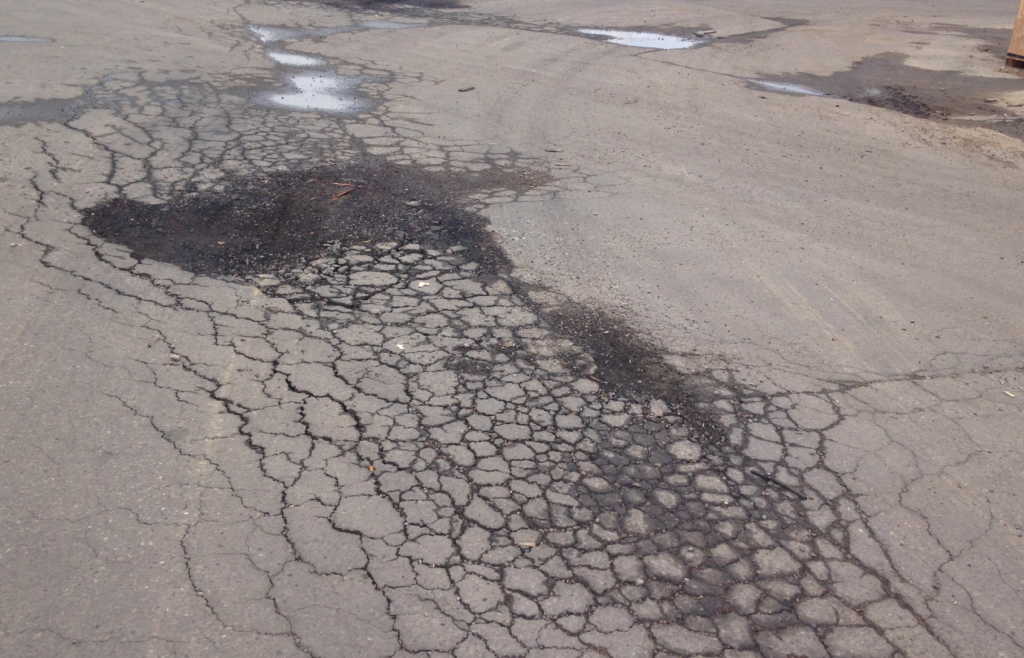
Let’s talk about road deterioration and how to build better roads.
Roads play a fundamental role in connecting societies and fostering economic growth. However, road construction methods have not kept up with the factors compromising road performance. In fact, as we traverse bumpy, pothole-riddled, or sinking roads, the common problems of conventional road construction become starkly apparent.
Innovative technology is revolutionizing road building by enhancing durability, reducing environmental impacts, and improving overall road performance. But before we discuss the future of roads, let’s understand the role of pavements and their inherent problems.
What is pavement?
Pavement is the top surface of roads that allows smooth and safe traffic flow. Pavement structure is made up of layers of engineered material placed over the natural ground (subgrade). Pavement supports the weight of vehicles by spreading the load to a wider area to keep the load transferred, within the strength and capacity of the subgrade below.
The primary functions of pavement include providing a smooth riding surface, a safe level of surface friction, protection of the underlying pavement structural layers and the subgrade, and a water-shedding surface to reduce road saturation.
Types of pavements
Conventional roads are either paved or unpaved. There are two main types of paved roads: flexible pavement (typically made up of multiple layers) and rigid pavement. Unlike paved roads, which are more structural, unpaved roads are built with gravel, rock, dirt, or other non-solidified materials.
- FLEXIBLE PAVEMENT is typically constructed with AC (asphalt concrete) composed of several layers of granular material that are covered with waterproof bituminous surface layers (bitumen is used to bind aggregate particles together). Designed to avoid the excessive flexing of any one layer, these pavements bend under tire loads.
- RIGID PAVEMENT is typically constructed with a PCC (plain cement concrete) surface course laid over a granular sub-base. They are substantially stiffer than their flexible counterparts due to the high modulus of elasticity of the PCC material. These pavements are seldom reinforced with steel and loads are supported by the flexural strength of the pavement. Its rigidity allows the concrete layer to bridge small weak areas in the supporting layer via the beam-slab action.
Pavement designs
Pavement design is instrumental to road performance and accounts for multiple factors, including:
- Traffic Requirements: Pavement is designed to accommodate a certain number of standard axle load repetitions, which determines a road’s lifespan.
- Moisture Resistance: Moisture can enter pavement structures through cracks and holes in the surface and significantly weaken the support strength of subgrades. Within the subgrade, moisture can cause a loss of particle interlock and particle displacement, resulting in pavement failure.
- Subgrade Integrity: Pavements support the applied force of wheel loads. If the subgrade layer is too weak, pavements can flex excessively, which can ultimately cause them to fail.
- Construction Quality: Pavement performance can vary depending on compaction levels, moisture conditions, the quality of materials, and the thickness of the layers.
- Maintenance: Pavement performance is directly related to what, when, and how maintenance is scheduled to maintain pavement consistency.
Other requirements that are considered in design include local road design guidelines, the road classification, drainage and exposure to moisture, pavement type, the strength and modulus of pavement layers, strength of the subgrade and reinforcements.
Pavement failures and types of road deterioration
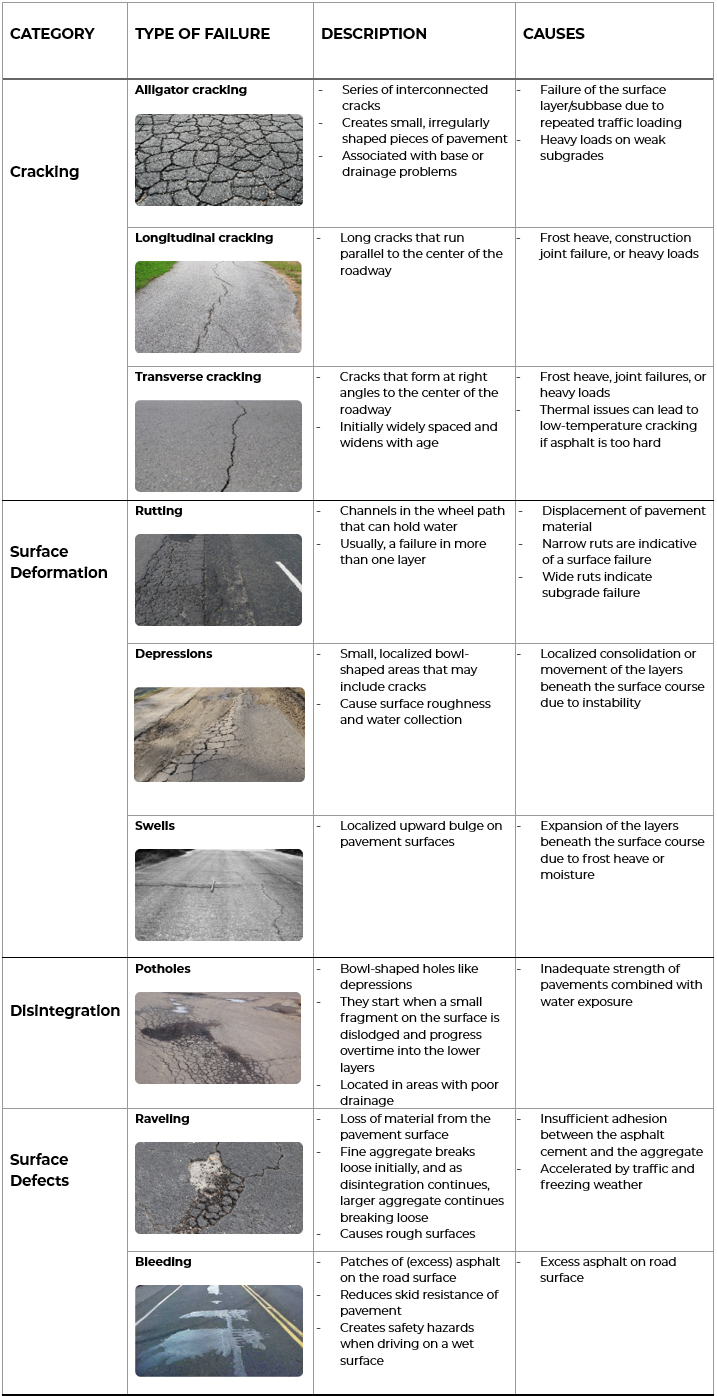
Pavement deterioration is usually a gradual process caused by traffic loading and environmental conditions. It includes many problems that reduce performance. Here are some common pavement failures and their causes.
Tough Cell® geocell roads take a proactive approach to enhancing road durability and mitigating pavement deterioration
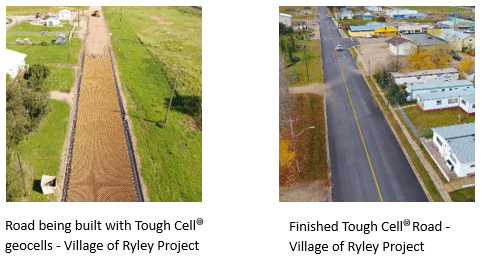
Tough Cell® geocells use 3D cellular confinement technology to solve many of the problems faced by conventionally built roads. Tough Cell® reduces the stress of traffic loads by distributing it more widely to increase pavement strength and reduce surface deformation and subsequent disintegration.
How do Tough Cell® geocells work?
- MORE EFFECTIVE LOAD DISTRIBUTION THROUGH THE BEAM EFFECT: The honeycomb structure of Tough Cell® geocells distributes vertical loads across larger areas, reducing the strain on weaker areas of the subgrade. This reduces surface and sub-surface deformation such as cracking, rutting, depressions, and potholes.
- INCREASED STRENGTH FOR MARGINAL MATERIAL INFILL: Cellular confinement technology acts as a ‘strength multiplier’ for aggregate used in roadbuilding. This allows for the use of marginal or lower-quality aggregate, which is not normally acceptable for load-bearing solutions. When infill materials are compacted within Tough Cell® geocells, they form a robust layer for high load-bearing capacity for paved, unpaved, and haul roads. This reduces surface defects such as raveling and bleeding through the confinement of particles.
- LOWER CREEP AND HIGHER FATIGUE RESISTANCE: Cellular confinement systems lock aggregates in place and significantly reduce creep. Due to the proprietary NPA material that Tough Cell® geocells are made of, they are significantly more creep-resistant than alternative HDPE geocells. Because of this, Tough Cell® roads have a longer performance life and require lower maintenance than traditionally built or HDPE geocell-reinforced roads. This saves on remediation costs in the long term. Tough Cell® roads also support heavier loads for a higher number of passes.
HIGH ELASTIC DYNAMIC MODULUS (HIGH DESIGN LOAD) AND LONG DESIGN LIFE: Tough Cell® roads can withstand harsh temperatures (-60oC to +60oC) without deformation of the geocells, thus reducing problems associated with freeze/thaw, such as swells, boils, frost heave and soft soils.
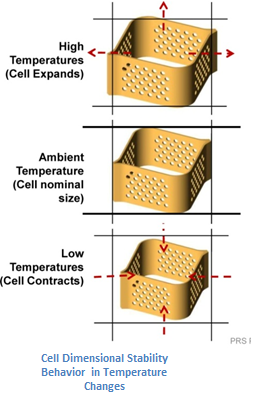
The honeycomb pocket structure does not change shape, and particles are not able to move. The geometry is held tightly due to the NPA (novel polymeric alloy) material that Tough Cell® is made of.
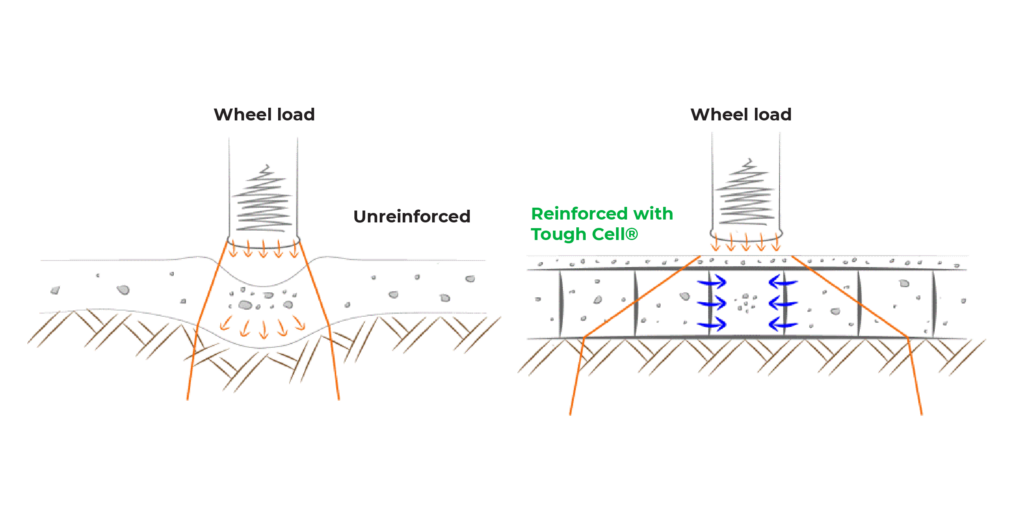
LOAD DISTRIBUTION OF CONVENTIONAL VS TOUGH CELL® ROADS
- GREEN SOLUTION: Tough Cell® geocells reduce the costs of hauling, trucking, labour, and infill by up to 50%. They also reduce maintenance cycles and the carbon footprint of building roads. Thus, Tough Cell® reduces a road’s total cost of ownership by up to 60%. The technology can also be filled with RAP (reclaimed asphalt pavement) and recycled materials, making it an eco-friendly alternative to traditionally built roads.
The adoption of geocell technology marks a significant, sustainable advancement in road construction that offers a robust solution to the problems of pavement failures. Through Tough Cell® technology, roads are built to last. Tough Cell® provides a resilient foundation that can withstand the rigors of heavy traffic loads and adverse environmental conditions. This innovative approach extends the lifespan of roads by reducing degradation problems at the surface and subsurface levels.
Ready to banish potholes and elevate your road-building capabilities? Fix or build your next road with Paradox. Call 1.877.MUD.UGLY.
Share This: