CDN NEWS |
  US NEWS







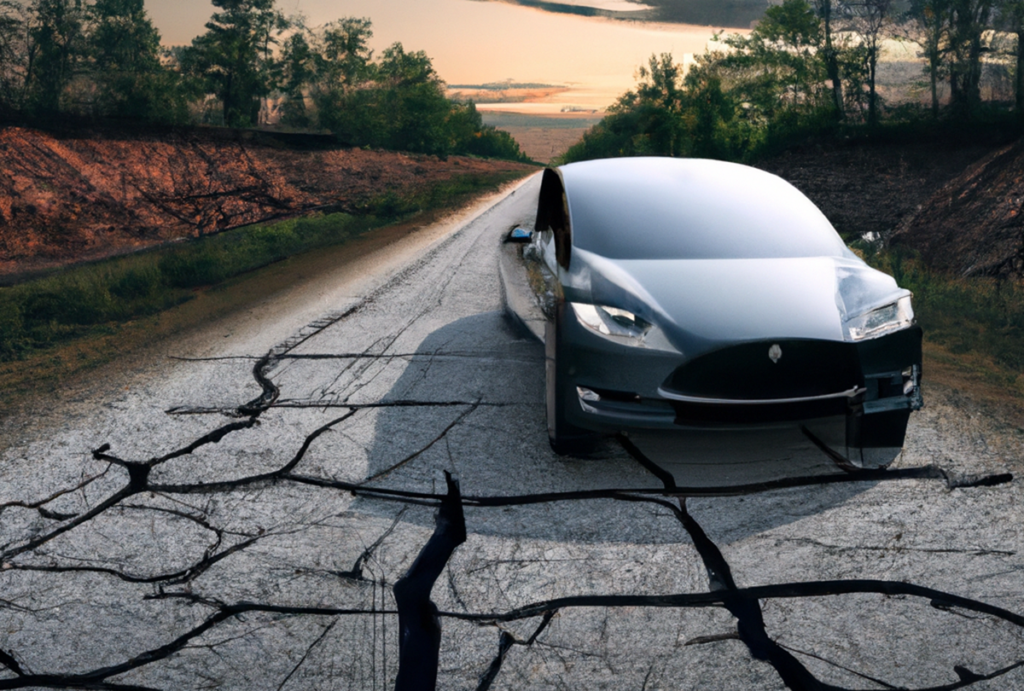
Image generated by DALLE-2
Courtesy of ENERGYminute
See more articles and infographics from ENERGYminute HERE
For those lucky enough to live in a place that experiences seasonal freeze-thaws, the month of May represents more than just the firing up of BBQs: it’s pothole season, baby.
It’s usually taken for granted that crews of tireless skilled labourers arrive every summer to fill cracks and potholes with asphalt and return roads to their former glory. But electric vehicles are on the verge of completely upending the entire model for roads and their maintenance.
Background: Baked into the price of every litre (or gallon) of gasoline and diesel sold are the very taxes used to build and repair roads. These are often referred to as motor fuel taxes and represent a meaningful chunk of the taxes collected by governments.
- According to the Chartered Professional Accountants of Canada, the federal government collects $6 billion CAD per year just in fuel excise taxes. In the US, more than $52 billion USD of revenue is generated from motor fuel tax, roughly 1.5 percent of all taxes.
Motor fuel taxes are collected and spent on a number of public goods, but their main use is for roads and public transit.
Where gas taxes go in California
percentage of fuel and vehicle taxes
[image]



Courtesy of the Mercury News
The dilemma: EVs don’t pay motor fuel taxes (freeloaders!) and as electric vehicles displace conventional vehicles on the road, there is a growing concern on how we’re going to pay for and repair roads in the future.
- Even just fuel-efficient gasoline cars have had an impact in collecting these taxes. The US Congressional Budget Office estimates by 2030, federal transport funding will exceed its budget by $180 billion unless the system adjusts and changes.
The way motor fuel taxes are setup now, it’s a pay-to-play system: whoever drives and wherever they’re driving typically pay through buying gasoline. Looking ahead, there isn’t broad support for a general tax, especially for those who mostly walk or bike.
Solutions being are trying to find ways to only charge drivers and users of raods, but…
There are no easy solutions
Can’t tax charging: According to the US Department of Energy, 80 percent of charging currently happens at home where it’s hard to tax. If only public chargers get taxed, those remaining miles get charged the full financial burden of road repair, which is unpopular and unfair to road warriors.
Can’t count odometers: In Hawaii, cars get an annual maintenance checkup that includes logging their odometers, which could be the basis of pay-to-play road taxes. Unfortunately, we don’t all live on a Hawaiian island and many drivers travel interstate. Counting odometer clicks won’t reflect where a car has driven.
Can’t track kilometers: Some have suggested using GPS tracking to figure out every taxable kilometer a vehicle travels. When you’re at your next Freedom Convoy truck rally, just ask the attendees how much they’d love to have the government track their every move.
One last thing: This also puts a dent in the notion that over their lifetime, electric vehicles are significantly cheaper to own than conventional cars. Studies ignore that conventional cars are paying for a tax today than EVs simply aren’t but will have to in the future. When that tax difference eventually goes away, the overall cost-benefit of EVs shrinks.
Share This: