


 CDN NEWS |
  US NEWS







By David Yager
Based on recent history, it is understandable why the oil industry is concerned that the Justin Trudeau Liberal administration will again put its own political success before the greater good of the economy and global energy supplies.
Continued announcements regarding last year’s unrealistically aggressive emission reductions for oil and agriculture are unsettling and dominate headlines. It is easy to be left with the impression that the current administration is disconnected from global reality.
In a world short of energy and food, forcing a major supplier of both to increase costs or cap output is difficult to comprehend.
When commodity prices started rising last year, fears returned that the Liberals would step in with more taxes like the bad old days of the National Energy Program. With the exception of Newfoundland and Labrador, there are no seats to be lost in the hydrocarbon producing regions of Canada. And there are lots to be gained in the urban Liberal fortresses of Montreal, Toronto and Vancouver.
The power sharing agreement with the NDP is another worry. Leader Jagmeet Singh is on the record as wanting to tax oil companies to offset higher consumer prices.
The fact that the UK and Italy have already brought in windfall profits taxes on producers – and US Democrats have publicly mused about a similar move – only fuels concerns.
But higher oil and gas prices are already resulting in significant tax flows to Canadian governments at multiple levels. The first references occurred in April 2022 before the federal budget. The Financial Post headline read, “Liberals set to spend oil windfall on social and climate programs in today’s budget.”
Thanks to the hydrocarbon price recovery, the deficit for the fiscal year ended March 31, 2022, was lower than forecast earlier, as will future deficits. Ottawa indeed sought more corporate revenue, but went after banks and insurance companies instead.
International events are forcing Ottawa to change course more quickly than is often recognized. Canada was of one the first western countries to offer more oil production when the boycott of Russian crude was first proposed, claiming crude output could rise by 300,000 b/d by the end of the year.
Then Ottawa jumped in with LNG from the East Coast. While neither Quebec nor Ottawa has mentioned the recent termination of Energie Saguenay, two smaller projects in Nova Scotia and New Brunswick could move forward.
The federal government recently admitted that the 2030 emission oil industry reduction targets are aggressive given that the framework won’t be ready before next year. This is unusual for an administration that rarely admits policy mistakes.
What has changed?
Big oilpatch cash is rolling in and perhaps Ottawa is finally sufficiently indebted to acknowledge the enormous contribution of investment spending, employment growth and tax income from the booming oil industry.
The industry’s vastly improved profitability is attracting attention in different ways. On July 19, RBC Capital Markets released a report titled, “Yahoo!! Fiscal Windfall Arrives.”
Investment bankers usually write about how much money companies and shareholders are going to make, and how governments policies too often screw things up. This report was unique because the focus was on how governments will be a big winner from the oil industry’s spectacular recovery.
Perhaps big business has finally learned that this type of messaging is necessary for Canada’s governing Liberal/NDP alliance to grasp that leaving industries alone that pay taxes, employ people and create wealth is better than grabbing and redistributing the money.
Or RBC was smarting from being a target in the last budget.
Either way, it was a great read for an industry more accustomed to being a target than a beneficiary.
RBC figured governments would collect about $48 billion in 2022 rising to $64 billion in 2023 if oil prices stay high. The bank wrote, “We present these figures to contextualize the ‘windfall tax’ which we see as already established, and to help frame the conversation as it relates to the impact on Canadian Energy Policy on Canadians.”
Explaining the use of the word “Yahoo!!,” it read, “Commodity tailwinds have rapidly increased fiscal take in the form of royalties and corporate tax, with those figures positioned to remain strong as robust commodity prices persist, volumes increase modestly, royalty incentives decline, and tax pools roll off. While these inputs meaningfully increase costs for the producer community, the offsetting (and very positive) effect will be felt by governments in the form of dramatically higher resource-related revenues.”
RBC covers the companies that produce about 70% of Canadian production, but not private producers nor the Canadian units of international operators.
The Financial Post followed on July 22 with the headline, “Who needs a windfall tax? Oil and gas companies poured $48 billion into government coffers this year, says RBC.” It opened, “Unanticipated revenue from energy royalties and corporate taxes are pouring into government treasuries, offsetting the needs for a Canadian version of a ‘windfall tax’ on oil and gas companies that is high on the political agenda and elsewhere…”
For 2022/23 the figure rises by one-third $64 billion. Over $22 billion of that will be corporate taxes, and the remainder will go to producing jurisdictions in the form of production royalties.
A key assumption is that WTI will average US$114 a barrel in 2023. While the average oil price for 2023 will remain the subject of continuous speculation until 2024, the figures deserve further analysis.
There is no question that Alberta will do well as more oil sands operations move from pre-payout to post-payout. The royalty rates are price sensitive. The pre-payout royalty rate is 1% at US$60 a barrel, rising in a straight line to 9% at US$120. Post-payout, the rate ranges from 25% to 40%.
The Alberta government annually posts a voluminous Excel spreadsheet that tracks 116 oil sands projects and where they are in the pre and post-payout process. The latest version is for 2020, which was a tough year. Only 27 paid the full post-payout rate of 25%, while 25 produced 10,000 barrels or less for the entire year. Thirteen had zero output.
This data reports production averaged 2.9 million b/d; the average price was only $24.48, and the royalties totalled $1.1 billion. In the last budget Alberta reported $2 billion. Fifty-six of the projects were still in the pre-payout period, and accounted for 48% of total production.
With the rise in oil prices and the reductions in operating costs, the projects paying post-payout royalty rates is rising fast. And royalty rates are rising with prices. Alberta had once forecast that for the fiscal year ended March 31, 2022, bitumen royalties would only be $1.5 billion. The actual figure was $9.5 billion.
Using a WTI average price of only US$70 for the fiscal year ended March 31, 2023, Alberta is projecting $10.3 billion in bitumen royalties. Total non-renewable resource revenue (including conventional oil and natural gas) is only forecast at $14 billion.
Using its more aggressive price deck, RBC projects this figure could in fact be $31 billion.
Wow. You can be assured that like all Alberta governments, the current administration will be quick to take the credit. And based on history, Edmonton will figure out lots of ways to spend the money.
Historically, when one province that doesn’t vote Liberal accumulates this much wealth, it becomes a political target. But corporate taxes are also rising significantly.
RBC wrote a section titled “Corporate Tax – A Whole New World.” The secret to the higher tax levels is the low rate of reinvestment. The bank wrote, “Historically, corporate taxation has taken a back seat within the Canadian Oil & Gas sector due to considerably high relative values of spending and higher levels of deferred taxes (less cash tax). With higher commodity prices, lower levels of capital spending, and considerable Free Cash Flow to be generated, producers’ tax pool balances are set to decline and accelerate the taxable horizon of many Canadian producers.”



Using a higher commodity price deck for next year RBC concludes, “Corporate taxation appears to be poised to deliver a windfall well ahead of what is projected within both provincial and federal budgets. Based on only our coverage (the 70% of production figure cited above), our 2022 corporate tax figure would exceed Alberta’s currently projected total corporate income tax figure of $4 billion in 2022/23 budget and represent roughly 13% of the Federal government’s total corporate income tax forecast of $68 billion.”
In an era where climate change alarmists continue to insist fossil fuels are heavily subsidized, surely these figures illustrate the absurdity of this often repeated but poorly researched allegation.
On top of the royalties and corporate taxes, oil and gas production also pays carbon taxes, fuel taxes, property taxes, surface rights leases, and payroll taxes. The industry’s enormous development, production, transportation, processing and distribution chain from the reservoir to the burner tip or gas pump also pays huge property taxes, payroll taxes and corporate taxes.
There is no possible comparable source of public sector income available from the energy sources that so many insist must replace oil and gas as soon as possible.
Regrettably, politics is about perception not reality. If the majority of voters paid any attention to finances, economics, physics, taxes and the success of the campaign pledges of the governments they elect, few of the current administrations in the western world would still be in office.
But they don’t. As producers release their second quarter financial results, record profits are the order of the day. ExxonMobil and Chevron reported their highest profits in history for the six months ended June 30, 2022.
These are the headlines that attract attention.
Of the Canadian companies which had released their Q2 results as this article is written, here’s a cross section of their higher royalties paid and reported profits. This data supports the RBC thesis that if commodity prices hold so will the huge increase in revenue flows to governments.
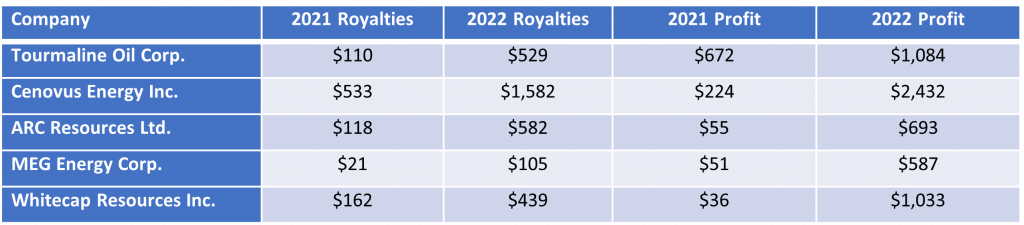
Source: Corporate financial statements to June 30, 2022
Stated in millions of Canadian dollars
This is spectacular after seven years in the trenches, and a strong foundation for those fortunate enough to not go broke, still have a job in the oilpatch, or who didn’t sell their E&P and OFS equities at the bottom of the cycle.
Nevertheless, the oil industry has always been a tempting target for politicians more interested in power than prosperity.
But when they make moves like the UK and Italy, they make matters worse, not better.
Economist Jack Mintz is a relentless advocate for economic common sense. In a Financial Post column on July 29 Mintz tried yet again to talk sense into the determined vote-seeking opponents of private-sector economic growth.
The title read, “We’ve got windfall taxes already. Main Street pays them. Governments already have relief, with torrents of new cash flowing in because of inflation.”
Mintz writes that with inflation rising there is growing pressure for more financial relief from voters. So “windfall taxes” are being invented all over the world. This includes the OECD which has concluded the best route to lower energy prices is higher taxes on utilities.
Besides Canada taxing banks and insurers, Spain, Greece, Hungary and India have piled on with higher corporate taxes.
But Mintz argues, “…windfall-like taxes are already built into our tax systems” through indexed personal and small business taxes rates. The more you make, the more you pay. Alberta’s royalty rates are a good example.
However, there are more and better reasons to leave taxation alone. “They deter investment by raising the cost of capital. They discriminate against cyclical and risky companies: windfall gains are taxed but there are no rebates for ‘windfall losses,” i.e., abnormally low profits.”
Worst of all, high profits occur because demand exceeds supply. Left alone, companies invariably hurt themselves by increasing output. Of windfall taxes Mintz concludes, “They’re also perverse: windfall gains generally occur when goods and services are in short supply – which is exactly the wrong time to put new taxes on suppliers.”
Mintz concludes, “Overall, windfall profit taxes are mostly paid by Main Street, either through higher consumer prices or deepening supply shortages. At a time when the world’s pressing need is greater supply of almost everything, they’re an especially bad idea.”
Ottawa’s determination to reduce emissions should be the best reason to leave the industry alone. Compliance by all the resource sectors will cost billions. Not reducing production of food and energy and minerals at this time is essential.
As the title asks, is another federal raid on oil industry profits inevitable?
No. The world is much different today than a year ago. Hopefully, the federal government’s fiscal policies and management will finally undergo a similar pivot.
David Yager is an oil service executive, oil and gas writer, energy policy analyst, and author of From Miracle to Menace – Alberta, A Carbon Story. Find the book to www.miracletomenace.ca. He is President and CEO of Winterhawk Well Abandonment Ltd. which has commercialized a new casing expansion technology for improving annular wellbore integrity.
Share This:






















BUYER BEWARE! OPINION: Iceland and Norway Keep Saying No to Europe. Canada Should Too – Tammy Nemeth