CDN NEWS |
  US NEWS







If policymakers want to reduce CO2 emissions in Canada, they should allow industry to do so in a way that imposes the least costs on society and not by imposing arbitrary caps on certain sectors since CO2 molecules are all identical regardless of their source, finds a new study released today by the Fraser Institute, an independent, non-partisan Canadian public policy think-tank.
“Put simply, all CO2 molecules are identical, whatever their source, so why is the federal government treating the oil and gas sector differently?” said William Watson, senior fellow at the Fraser Institute and co-author of CO2 is CO2 is CO2—the Implications for Emissions Caps.
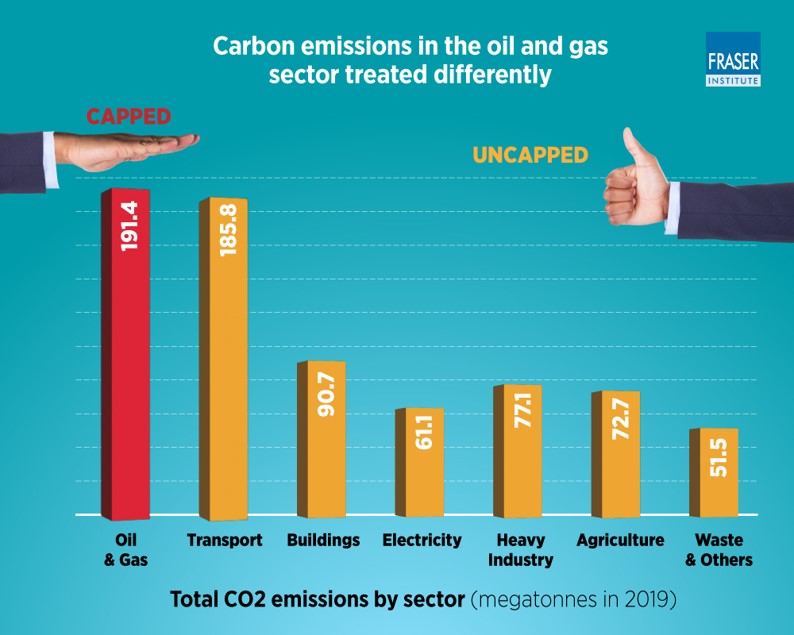
The study finds that the federal government’s proposed cap on emissions from Canada’s oil and gas sector is misguided for several reasons:
- The source of CO2, which causes a buildup of greenhouse gases (GHG) in the atmosphere, is irrelevant from an environmental perspective—the effect of each CO2 molecule is the same regardless of its origin.
- The federal government has already imposed a carbon tax, which is a mechanism for allowing emitters to achieve the least costly reduction in GHGs, making a cap on emissions from the oil and gas sector unnecessary.
In 2019, for instance, GHGs from the oil and gas sector represented 26.2 per cent of total emissions but the transport sector represented nearly the same amount (25.4 per cent) and buildings (12.4 per cent) about half. The cap announced on GHG emissions only applies to the oil and gas sector, meaning that the remaining 73.8 per cent of GHG emissions are exempted.
“There’s simply no rationale—scientific or economic—to treat one-quarter of greenhouse gas emissions differently than the remaining three-quarters,” commented Watson.
Arbitrary caps on individual sectors will reduce emissions at a greater cost than is necessary, and interfere with the mechanism of the carbon price, which the federal government has already imposed.
For example, the cost of keeping oil and gas emissions at 100 megatonnes (Mt) CO2 equivalent may be much greater than the cost of letting them go to 120 Mt and finding 20 Mt of emissions reductions elsewhere.



The effect on the atmosphere would be the same. “The government can’t have it both ways: If a government imposes a price on CO2 emissions, people and firms will go about finding the least costly way to reduce them and no further government intervention—like a cap on the oil and gas sector—is required,” Watson said.
Author:
Senior Fellow, Fraser Institute
More from this study
Read the News Release
Share This: