


 CDN NEWS |
  US NEWS







By David Yager
In only six months there has been a dramatic reversal in what the world thinks about fossil fuels.
For everyone who endured seven years of reduced commodity prices, reduced income, reduced employment, reduced wealth, reduced investor interest – and even reduced self-esteem after being branded a climate criminal – the change in tone and priorities is amazing.
And welcome.
It appears 21st century opposition to oil is price sensitive. Judging by recent events, the world only hated cheap fossil fuels. Because instead of doing everything to get rid of oil, gas and coal, the narrative has returned to ensuring that supplies continue and complaining about the price.
Just like the good old days.
A Bloomberg article February 11 was titled, “The Great Climate Backslide: How Governments are Regressing. From the US to China, harsh realities mean the political will for painful choices is evaporating fast.”
More governments are publicly stating that their primary goal is keeping the lights on and their citizens fed and moving. This means more fossil fuels at the lowest possible cost. Replacement by low-carbon alternatives can wait for another day.
Global energy markets have changed so much that it has become politically acceptable to admit that the current state of renewables has been horribly oversold, and that fossil fuels will be around a lot longer than people would previously publicly admit.
At the White House on February 8 spokeswoman Jan Psaki told reporters, “All options remain on the table. With oil producing countries, we’re talking about production increases. With oil consuming countries, we’re talking about releases from strategic reserves. Nobody should hold back supply at the expense of the American consumer…”
The American oil industry that Biden’s Democrats campaigned against in 2020 has been asked to resume drilling. On December 14 US Energy Secretary Jennifer Granholm said that the Biden administration supported increased oil production and was not “standing in the way” of US producers.
At the time this was evidenced by the recent approval of new permits on federal lands. But the Gulf of Mexico leases were later overturned in court on environmental grounds.
With mid-term elections set for later in 2022, what the Democrats are really saying is that they now dislike expensive oil more than their previous pledges to cut back or replace cheap oil.
The flip flop is global. In the UK, home of the Glasgow COP26 climate conference in November, all attendees agreed that fossil fuel subsidies should end.
Unless they are required for political reasons or economic survival.
Less than 90 days later the government announced, “The Energy Bills Rebate”, cash reductions dating back to October for 28 million households. The total was £9.1 billion or nearly C$16 billion.
And on it goes. The EU has amended its green rules to include natural gas as part of the energy transition until somebody figures out how to make renewables work 24/7/365. In the UK formerly uninterested citizens are wondering why that country refuses to develop its shale gas reserves, which appear to be geologically significant. The US has pledged to keep Europe supplied with LNG.
Although politicians in the American northeast have opposed new natural gas pipelines, the region is now augmenting electricity supplies by burning bunker oil. Europe and Japan are firing up mothballed coal fired electricity plants to keep supplies up and prices down.
The combination of the Russia/Ukraine crisis, OECD inventory numbers, and the realization that the additional capacity of OPEC+ is not as voluminous as advertised, is driving oil prices to new highs.
In its February oil market report the International Energy Agency reviewed its models and determined that actual oil consumption has been 800,000 b/d higher that previous estimates.
A Bloomberg article on February 12 noted, “The group published its latest monthly report…revising its historical oil demand numbers all the way back to 2007. Yes, that’s right, for the past 15 years the world has been using more oil than the primary monitoring agency that advises consumer governments thought.”
Inventories, as indicated by the charts below, are at their lowest levels in seven years.
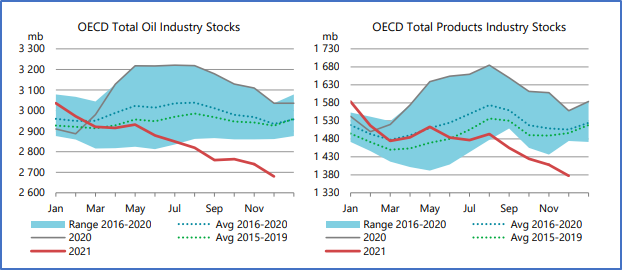
The IEA believes there is still extra capacity in OPEC, but that includes 1.3 million b/d from Iran which is only available if sanctions are lifted. But the report noted, “Chronic underperformance by OPEC+ in meeting its output targets and rising geopolitical tensions have propelled oil prices higher.” Others wonder how much extra capacity OPEC+ actually has.
The IEA’s recent report is confident that there’s another 2 million b/d of extra capacity available in 2022 at which point supply and demand would be in balance and stabilize prices. The following EIA chart anticipates an increase of a million b/d in US output by 2023 from 2021 levels.
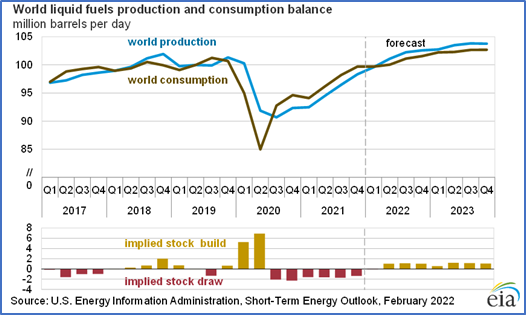
Drilling is certainly picking up in the US and Canada, but significant supply chain issues will temper the ability of operators to drill and frac wells at past levels. Underinvestment in new supplies also applies to OPEC members
But even if there are no oil supply issues from Ukraine/Russia conflict and Iranian oil returns to market, the fundamentals for oil prices remain bullish.
RBC Capital Markets released a research report on February 14 titled, “Oil Strategy: Welcome to the Super Cycle.” Looking through the aforementioned variables, RBC sees prices rising until the oil becomes unaffordable.
The note reads, “Historically, markets led higher by tightening product and crude inventories are difficult to solve absent a demand destruction event or a supply surge, neither of which appears to be on the horizon.”
**********
Considering all the foregoing, you’d think that financial markets would join the White House in “all options are on the table” and rethink the multi-year, multi-faceted plan to starve the fossil fuel industry for capital through divestment, ESG criteria, and the outright refusal to finance a growing list of fossil fuel developments and infrastructure.
All this was ostensibly for the greater good: combating climate change by making continued fossil fuel development more expensive or subjecting the remaining developers to rigorous commitments to emission reductions and decarbonization. Besides banks and investment funds, it has also expanded into insurance companies and assets like pipelines.
Initially, it was governments that led the charge on climate change. Capital markets were late to the party.
For historical context, in 2007 the US Supreme Court ruled that carbon dioxide was a pollutant. This decision is regularly described as one of the most important in US environmental law history.
It took another ten years before media tycoon Michael Bloomberg and the industrious former Bank of Canada chief Mark Carney invented the Task Force on Climate-Related Financial Disclosure. The TFCD introduced the future economic impacts of climate change into listed company risk disclosures.



This morphed into what is commonly called ESG investing, a form of “stakeholder capitalism” where companies would continue to try to do well (make money without breaking the law) plus also do good (make positive contributions to society).
Capital markets activism is hardly new. The most obvious example was using financial tools and oil supply to pressure South Africa to end apartheid thirty years ago.
By 2021, the voices of the climate emergency had drowned out all others. Uttering Net Zero by 2050 was so common most figured it was all but done. Except nobody actually knew how to do it, including its most vociferous proponents.
By the COP 26 climate conference in Glasgow in November, Mark Carney, now a pitch man for Brookfield Asset Management, had persuaded Canada’s big six banks to join the Net-Zero Banking Alliance. As COP 26 began, Carney had commitments from the managers of US$130 trillion in financial assets to ensure net zero targets were included in their corporate plans and financing practices.
In an October 15 article about Canada’s big six banks signing up, The Globe and Mail wrote, “Banks will play a central role in the transition to a greener global economy through their financing of energy companies and emerging clean technologies. Until that shift picks up speed, however, they remain major lenders to Canada’s oil sector, a pillar of the country’s economy – and a major emitter.”
Whatever advice banks get from many quarters on what they should be, don’t forget what they are. Banks are cash flow lenders. Credit risk is analysed on the ability of the borrower to pay back principal plus interest. The tough times of the past seven years have made it easy for banks to move away from oil and gas, particularly when oil completely collapsed in 2020 because of the pandemic lockdowns.
But it is not intuitive that these banks will actually be a source of growth capital for early stage clean-tech companies without some sort of backstop on risk.
Nor will they be able to ignore the incredible recovery in oilpatch cash flow in 2021 compared to the previous six years.
But as the governments of the world change direction on energy and fossil fuels faster than most could have imagined a year ago, if and when will capital markets change course?
A headline on oilprice.com on January 27 stated, “Are Activist Investors To Blame For High Oil Prices?” Are Mark Carney and the ESG investment phenomenon the problem or the solution?
This depends on the question, and who is asking.
It took 14 years from US declaring carbon dioxide a pollutant to when the Canadian banks agreed to materially change their lending practices to the oil and gas business. Even after multiple volatile cycles are considered, this is the same industry that has been the source of handsome profits for Canadian banks for decades.
A major ESG player who has modified his views on fossil fuels is Larry Fink, head of investment management giant BlackRock. Fink writes an annual letter extolling the importance of stakeholder capitalism, and assure readers they can make money and improve the world at the same time.
But Fink is successful because he is one of the world’s best salesmen. So he goes where the money is. Right now that is straddling the fence on climate change and decarbonization.
Dan Tsubouchi, who compiles and writes fact-packed energy reports for SAF Group, dissected Fink’s 2022 note and highlighted several quotes.
Fink wrote, “I believe that the decarbonizing of the global economy is going to create the greatest investment opportunity of our lifetime.” But he added, “We need to be honest that green products often come at a higher cost today. Bringing down this green premium will be essential for an orderly and just transition.”
Later in his missive Fink noted, “As we pursue these goals – which will take time – governments and companies must ensure that people continue to have access to reliable and affordable energy sources. This the only way we will create a green economy that is fair and just and avoid societal discord.”
It gets better. “And any plan that focuses solely on limiting supply and fails to address hydrocarbons will drive up energy prices for those who can least afford it, resulting in greater polarization around climate change and eroding progress…And BlackRock does not pursue divestment from oil and gas as a policy.”
But old habits die hard. There has been continuous pressure on insurance companies to make life difficult for pipeline builders and operators by withdrawing coverage and driving up costs. Last September environmental activist website www.theenergymix.com reported that Chubb was the 16th insurer to withdraw its support for the Trans Mountain Pipeline and its expansion project.
Even LNG is not safe, and LNG Canada at Kitimat remains under continuous assault. Attacking the Coastal GasLink pipeline on Twitter, environmentalists are going after its financial backers. A Tweet on February 9 from @leadnow.ca read, “RBC IS FUNDING GENOCIDE”. This position is apparently supported by 150 like-minded international environmental groups.
What does that mean to the industry in 2022?
After the drama of recent years, both sides of the oil and gas funding trade are apprehensive. Although cash flow from production is strong, companies remain nervous about access to debt and equity and the future of their companies. It seems like just the other day that many producers were defaulting on their production loans, their cost of capital through equity was huge and rising, and the doors were closed on loan renewals and new capital.
Capital budgets remain constrained compared to historic levels for good reasons. Many producers are wondering if their financial future will only be secure if they are debt free. Perhaps even self-insured.
Because the message from too many in capital markets until recently has been that the best fossil fuel business is no fossil fuel business.
The good news is that governments around the world are realizing that providing cheap and reliable energy to their citizens today remains paramount. And fossil fuels are the only game in town.
Oil, gas and coal prices are rising and will stay that way for some time because the world has been asleep at the switch in an era of unrealistically low energy prices in an economy supported by stimulative debt financing and ultra-low interest rates.
Massive public debt, inflation, interest rates and tax levels will have more impact on economic policy in 2022 and beyond than they have in years. The ability of government interventionist central planning to direct the economy will be much more limited compared to the ten years from 2009 to 2019.
This will drive the economy back to the basics, which is essential commodities. Capital providers will, by nature, eventually follow the money and the free cash flow. Emerging from the penalty box on many fronts after many years, fossil fuels will again be attractive.
Don’t crack the champagne just yet, but feel free to open a beer.
David Yager is an oil service executive, energy policy analyst, oil writer and author of From Miracle to Menace – Alberta, A Carbon Story. More at www.miracletomenace.ca
Share This:






















COMMENTARY: Varcoe: ‘Do No Harm’: Should Alberta Step in to Fix Gas System Constraints, Given Past Energy Interventions?