CDN NEWS |
  US NEWS








Stable Doesn’t Mean Optimized
Most plants don’t have obvious reliability problems. Equipment runs, production targets are met, and operators aren’t responding to constant alarms.
Yet many facilities are quietly losing millions of dollars each year—not from catastrophic failures, but from inefficiencies that have become accepted as normal.
Reactors may operate farther from optimum than necessary. Distillation columns may consume excess energy through over-refluxing and higher steam demand. Operators may make frequent manual adjustments to compensate for changing feed conditions. Product quality may consistently exceed customer requirements, creating unnecessary giveaway.
Individually, these losses can seem insignificant. Collectively, they erode margins.
The Real Problem: Too Much Variability
Manufacturing rarely involves optimizing a single variable. Product quality, energy consumption, throughput, equipment constraints, feedstock variability, inventory, raw material costs, and market conditions interact continuously.
Operators naturally create safety margins to protect production. But those margins can also leave significant profitability on the table.
The challenge is knowing where hidden margin exists—and how much it is worth.
Advanced Process Control (APC) helps address this challenge by coordinating multiple process variables simultaneously, allowing plants to operate closer to their economic optimum while remaining within operating constraints.
Where the Value Comes From
For the right processes, APC can turn small operational improvements into meaningful financial results, including:
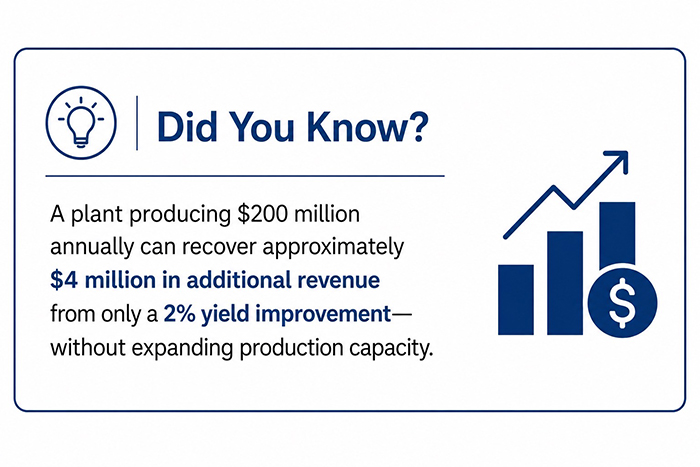
- 2–4% higher yield from existing assets
- 5–7% lower energy consumption
- 3–5% higher throughput
- 10–35% lower quality variability
- Less operator intervention, rework, and process excursions
- Fewer normal, standing, and flood alarms
- Longer control valve life
Typical projects can achieve payback in as little as two to twelve months when applied to high-value opportunities.
A Real-World Example
Shell Scotford’s MEG plant in Alberta was experiencing high steam consumption, process variability, and frequent operator intervention.
Yokogawa partnered with Shell to implement APC across critical process areas. The solution continuously optimized operation, reducing steam consumption, stabilizing the process, and maximizing TEG production. It also automated aqueous EO feed adjustments, reducing operator intervention during load changes.
The result was lower steam consumption, increased TEG production, and improved plant stability. A post-implementation estimate showed approximately 18% greater savings than originally projected.
From Optimization to Continuous Performance
The opportunity today extends beyond standalone APC projects. Manufacturers are increasingly combining advanced control with real-time optimization, process models, AI-assisted analytics, operator guidance, and performance monitoring.
The goal isn’t to replace operator expertise. It is to capture best practices, reduce variability, and help teams sustain optimal performance despite changing conditions and workforce turnover.
Importantly, APC can be integrated with existing control environments, helping manufacturers build on their current infrastructure rather than replace it.
Find the Margin Before You Invest
The first question shouldn’t be, “Where can we install APC?”
It should be, “Where are we already losing money?”
Analyzing process variability, controller performance, operating constraints, and economic drivers can reveal where hidden margin exists and quantify the potential business opportunity before implementation begins.
A plant variability and profitability assessment can identify:
- Hidden yield losses
- Excess energy consumption
- Operator-driven variability
- Capacity constraints
- Product giveaway
- High-value opportunities with faster payback potential
The result is a quantified business case that estimates potential financial return before investing in Advanced Process Control.
Your plant may already have the equipment, data, and infrastructure needed to improve profitability. The opportunity is finding the losses that have become “normal”—and turning them back into margin.
For more information about Advanced Process Control, contact Myles Guinta at [email protected].

Sponsored Content from Yokogawa
Share This: