


 CDN NEWS |
  US NEWS







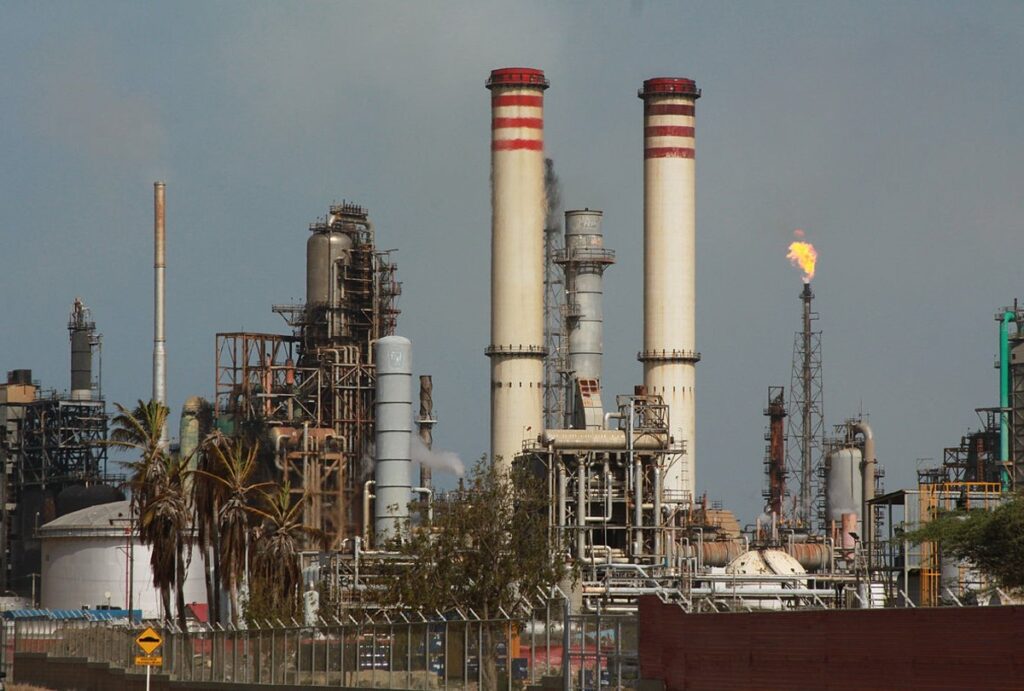
The Trump administration’s deepening involvement in Venezuela — first with the ouster of longtime leader Nicolás Maduro and now with a deal to take a stake in its oil industry — could complicate China’s strategy in Latin America.
Venezuela was one of the countries at the forefront of China’s push to expand its geopolitical and economic influence in the region. China was long Venezuela’s largest buyer of oil and its biggest creditor, offering support against US sanctions and isolation. While Chinese companies are expected to remain involved in the Venezuelan oil industry, the future of crude flows to China and the repayment of billions of dollars in outstanding loans is unclear.
Tensions with China over Latin America could increase as President Donald Trump refocuses US attention on its own backyard. He’s revived the 19th century Monroe Doctrine as inspiration for his national security strategy, which seeks to assert American dominance in the Western Hemisphere and ensure the region “remains free of hostile foreign incursion or ownership of key assets.”
What is China’s relationship with Venezuela?
China upgraded its relationship with Venezuela to an “all-weather strategic partnership” during Maduro’s state visit in 2023. This is the one of Beijing’s highest-level diplomatic designations.
Venezuela has consistently backed China’s position on Taiwan and Hong Kong. Chinese President Xi Jinping told Maduro during a meeting in Moscow last year that their countries have forged an “ironclad friendship” and said China would “firmly support Venezuela in safeguarding state sovereignty, national dignity and social stability.”
Maduro’s extraction by the US in January was somewhat of a diplomatic embarrassment for China as a high-level Chinese delegation had been in Caracas just the day before.
China and Venezuela have traditionally had strong economic and military ties. China has consistently been Venezuela’s top or second-largest trading partner for almost two decades, according to data from the International Monetary Fund compiled by Bloomberg. Their bilateral trade flows topped $7.4 billion last year.
Venezuela is among the biggest buyers of Chinese weapons in Latin America. It purchased $495 million of arms in the decade ending 2020, according to the Center for Strategic and International Studies, which cited data from the Stockholm International Peace Research Institute.
How important is Venezuela’s oil to China?
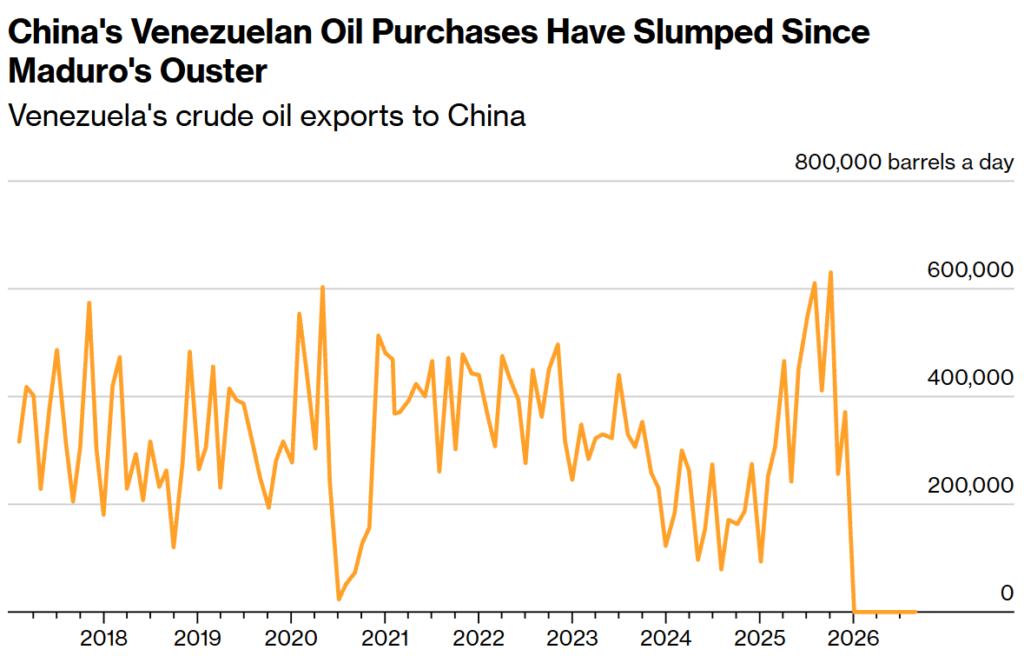
China had been the largest importer of Venezuelan crude, purchasing around 80% of the Latin American country’s exports last year. But it hasn’t bought any barrels since the US ouster of Maduro in January, according to data compiled by Bloomberg.
Venezuela’s flagship Merey oil is used to produce bitumen, which is vital for construction and road building. Deep discounts versus comparable crude grades from elsewhere made Merey popular with China’s independent refiners. There are alternatives — from Canada, for example — although they’re more expensive, which could put pressure on the margins of the so-called teapot refiners.
Still, the lost volumes aren’t a huge blow overall to China as just 4% of its oil imports last year were from Venezuela. The shipments are less about China securing energy supply and more about recouping its oil-backed loans.
Source: Vessel tracking data compiled by Bloomberg
What are China’s financial ties to Venezuela?
China became a key lender to Venezuela in 2007, during the regime of late President Hugo Chávez, when it first provided funds for infrastructure and oil projects. China’s support filled a vacuum left by the decades-long estrangement between the US and Venezuela. Areas of collaboration included highways, bridges, power plants and food processing factories, although many were never finished or are no longer in use.
China has lent the country more than $100 billion in state-backed loans since 2000, according to US research lab AidData, making Venezuela the biggest recipient of Chinese financial support in Latin America. The majority of the loans were structured to be repaid through oil shipments.



China’s lending has been curtailed in recent years as Venezuela’s oil industry struggled under the weight of sanctions, corruption and underinvestment. Estimates of the outstanding debt vary, with some ranging from $10 billion to $20 billion.
What does the US involvement in Venezuela’s oil industry mean for China?
The US said it has struck a deal that gives it majority control of around a fifth — or more than 65 billion barrels — of Venezuela’s proven oil reserves.
Venezuela’s interim government has granted 100-year concessions to develop 17 oil fields to North American Blue Energy Partners (NABEP) — a privately held company run by Venezuelan businessman Alejandro Betancourt — which, in turn, has granted the US government a 35% stake in its parent company. NABEP has also given the US the right to purchase 20% of all current and future output at production cost, as well as the right of first refusal over the remaining 80%.
The Trump administration has cast the agreement as a way to limit the influence of China and Russia in the region, in line with its “Donroe Doctrine.” The White House said that the majority of the oil fields that will be tapped by NABEP were previously controlled or operated by Chinese and Russian firms or “corrupt cronies of Maduro and Chavez.”
However, it’s smaller companies from China and Russia that have been displaced by the deal. And Venezuela has so far left Chinese oil assets largely untouched during a broader renegotiation of contracts that has shifted fields and ventures to new partners.
While state-run Chinese firms have developed oil and gas projects in the Orinoco belt and elsewhere, they’re not major producers. Chinese-linked oil production accounts for less than 10% of Venezuela’s output, whereas Chevron Corp.’s operations represent more than 25%.
Chinese companies were entitled to a portion of Venezuela’s reserves under arrangements that predated the Trump administration’s new deal. The claims of state-owned China Petroleum & Chemical Corp., better known as Sinopec, and China National Petroleum Corp. amount to around 4.4 billion barrels, analysts at Morgan Stanley wrote earlier this year, citing data from consultancy Wood Mackenzie.
The new US purchase agreement could complicate China’s efforts to recover its loans to Venezuela. US Energy Secretary Chris Wright told Bloomberg TV that China won’t have any debt claims to the revenue from Venezuela’s new oil production.
China has said that its cooperation with Venezuela is protected by international and domestic law, and that it “does not concern any third party and should not be subjected to interference by any third party.” It added that its “lawful rights and interests in Venezuela must be protected.”
One option for China would be to try to recoup what it’s owed as part of Venezuela’s broader restructuringof its sovereign debt.
How could this affect China’s broader Latin America strategy?
A more interventionist US could put a wrinkle in China’s efforts to make further inroads in Latin America.
“Venezuela isn’t necessarily a precedent for direct expropriation, but it may be a precedent for coerced exclusion,” said Christian Reyes, a Beijing-based political risk analyst originally from Ecuador. “The United States is increasingly willing to define parts of the region’s economic relationship with China as a security concern and to leverage considerable influence to enforce those red lines.”
That said, the level of China’s economic entanglement across Latin America means its influence would be hard to unwind, and Trump would likely struggle to replicate the scale of his actions in Venezuela elsewhere.
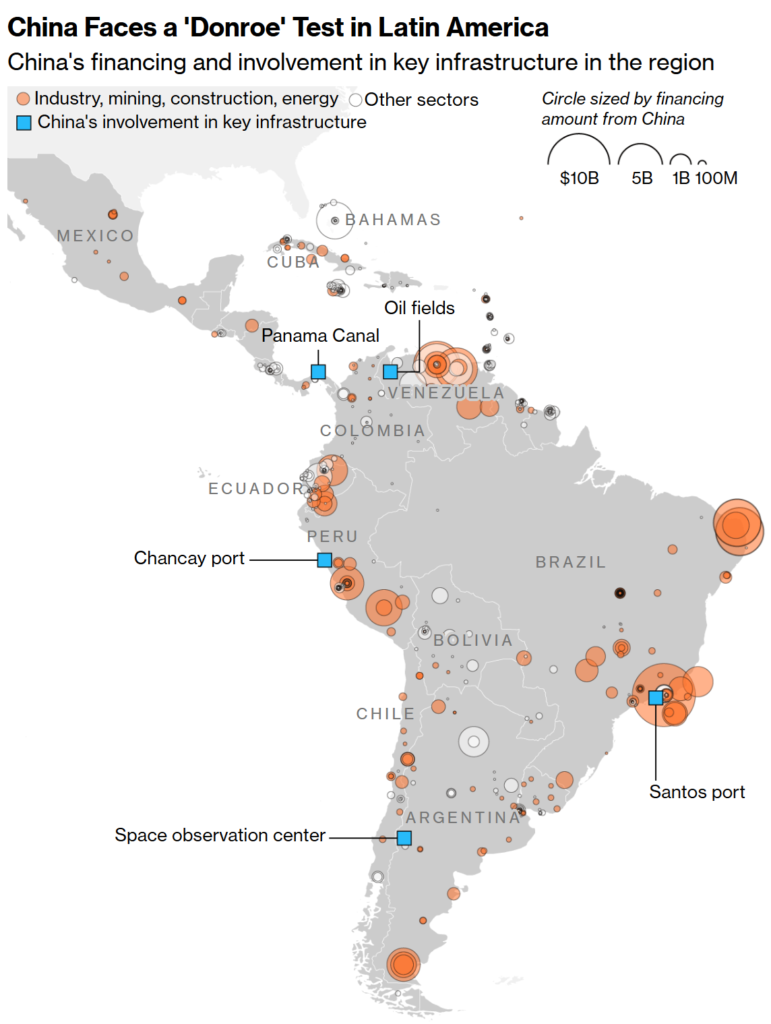
Note: Map shows projects with known approximate locations. The dataset includes Chinese loans and grants from 2000 to 2021. Financing values are in constant 2021 US dollars.
Source: AidData’s Geospatial Global Chinese Development Finance Dataset
China is the region’s second-largest trading partner after the US and Chinese companies are deeply embedded in sectors ranging from power grids and mining to electric vehicles and infrastructure.
Share This:






















On The Verge: Energy Sector Primed for New Wave of Growth – ATB Economics