


 CDN NEWS |
  US NEWS







By Ron Wallace
“In the past 10 or so years Canada has made policy mistakes that have caused the country to lose billions of dollars, by turning away from economic prosperity in favour of failing battery plants and other unprofitable green energy fantasies. Politics over economics has cost us dearly; we cannot miss the opportunity and the message again.” A. Pankratz
Situational Analysis
U.S. Secretary of State Marco Rubio and Secretary of War Pete Hegseth recently announced an “historic transaction” with Venezuela’s Interim President Delcy Rodriguez in a deal reportedly crafted to secure a majority U.S. control of more than 65 billion barrels of proven oil reserves in Venezuela. Some commentators considered this to be a “bombshell” announcement, but it was, in fact, a logical continuation of policies long enacted by the Trump administration designed to secure and expand U.S. oil reserves.
The, as yet unclear, but much-touted, transaction has been described as a “rebirth” or “renacimiento” of the Venezuelan oil sector, reportedly grants the U.S. a controlling stake in a massive portion of Venezuela’s oil reserves in order to accelerate the development of 17 strategic oilfields with an investment estimated at USD $100 billion to potentially generate USD $209 billion in revenue for Venezuela. Other reports indicate that the U.S. Defense Department, through its Office of Strategic Capital (OSC), will oversee the funding of oil field licenses, to “accelerate and scale private investment in critical supply chain technologies.”
In an earlier article, we argued that a U.S.-revived Venezuelan oil industry, even if the refurbishment takes years to complete, could eventually represent a serious threat to Alberta’s oil industry because it could potentially displace Canadian oil with lower-cost alternative supplies located closer to U.S. refiners. The very real, yet unassessed, potential of this seismic geopolitical shift has now arrived. These announcements compel a careful re-examination of Canadian, mostly Albertan, energy strategies and policies.
The 2025 Canada-Alberta Memorandum of Understanding (MoU) committed Alberta to produce “decarbonized” oil with massive carbon capture projects like Pathways Plus and Carbon Pricing Equivalency Agreements. These commitments represent policies that will clearly undermine Canadian price competitiveness as compared with other global producers, most certainly to include unsanctioned, Venezuelan crude oil.
While the federal government talks about making Canada into an “energy superpower” the US-Venezuelan agreement potentially introduces an entirely new factor into the competitive internationally oil marketplace for Canada – one that has the potential to influence, if not shape, Alberta’s economic future. In a continuing, uncertain regulatory environment, one in which Ottawa maintains an insistence of “Net Zero” policies, the onerous regulatory environment has diminished the attractiveness of Alberta oil projects to international investors. These policies consider Net Zero to be not only attainable but desirable.
Since 2015, Canada has witnessed a flight of investment capital approaching CAD$650 billion due to lost, or deferred, resource projects. The creation of a Major Projects Office (MPO) under the Building Canada Act (BCA), enacted to streamline or accelerate energy projects, has not yet demonstrated material progress to advance major pipeline proposals. By maintaining inconsistent regulatory measures, the Canada-Alberta MoU cements significant economic and tax penalties on western Canadian oil producers while allowing a free pass for eastern Canadian refiners.
The long-term prospects of U.S.-controlled Venezuelan oil production unquestionably represents a sea-change in the marketplace for Canadian producers. It should result in a re-examination of the ways that these producers are regulated along with considerations about diversifying and expanding Alberta’s access to international markets with new Canadian pipelines.
A Brief History
The historic U.S.–Venezuela oil trade was a highly integrated system that was seriously disrupted by politically-motivated policies for nationalization that ultimately triggered U.S. sanctions. Following the unprecedented U.S. military operation in January 2026, that resulted in the capture of Nicolás Maduro, the Trump administration’s support for vice-president Delcy Rodríguez has marked the beginning of a new era of bilateral cooperation. While the Maduro regime largely remained intact, Venezuela’s interim authorities introduced new hydrocarbon laws that materially reformed their oil industry with the stated intention to rebuild oil production through closer ties with US companies and to re-open Venezuelan oil fields to private investment.
The U.S. Gulf Coast (USGC) refinery complex, among the most highly developed in the world, is the result of billions in investments for coking, desulfurization and hydrocracker units, each specifically designed to process heavy, sour Venezuelan crude. In 2025, the USGC refiners scrambled to replace lost, sanctioned Venezuelan oil with Canadian Cold Lake, Mexican Maya and Brazilian heavy grades. Alberta offered a supply of oil that was stable, pipeline‑connected and geopolitically low‑risk – being the only producer with sufficient supplies of heavy crude that could meaningfully offset Venezuelan supplies sanctioned by the U.S.
In 2025–2026, Alberta supplied the U.S. Gulf Coast (USGC) with roughly 3.8–4.0 million barrels per day (b/d) of heavy crude (mostly WCS‑type bitumen blends). This made Alberta the single largest source of heavy crude for USGC refiners, representing approximately 55–60% of all heavy crude delivered to the Gulf Coast. USGC refineries typically run 6.5–7.0 million b/d of crude, of which approximately 6 million b/d is medium/heavy sour. Hence, Alberta’s present contribution represents a larger share than Mexico, Colombia, Brazil, and the Middle East combined as a heavy‑crude supplier to USGC
A Rapidly Changing Marketplace
However, following the removal of U.S. sanctions, shipments of U.S‑bound Venezuelan crude has quadrupled since late 2025. To enable this accelerated heavy-crude output, the U.S. has reportedly exported more than 100,000 bpd of naphtha that allowed major trading houses (Vitol, Trafigura) to redirect up to 392,000 bpd through Caribbean hubs into U.S. markets. As a result, Venezuelan crude shipments to the U.S. Gulf Coast (USGC) now slightly exceed 500,000 barrels per day. The increase over the past six months is roughly 365,000–400,000 bpd, representing a tripling to quadrupling of U.S‑bound flows that is approximately half of Venezuela’s national output (~1.25 million bpd). These are volumes that are unprecedented since sanctions were imposed in 2019.
There are, however, complications that will affect future growth of that production. Although Venezuelan estimates of crude oil reserves are well-established, there remain significant technical and legal barriers that will work to prevent a quick rebound in Venezuelan oil production. For instance, after having been expropriated in 2007, ExxonMobil won an international arbitration award against Venezuela with terms yet unconcluded. Meanwhile, many experts consider that the entire Venezuelan energy system, including PDVSA, must be restructured before international oil companies could entertain multi-billion capital commitments. With approximately $170 billion in creditor claims, including arbitration awards for expropriation and outstanding sovereign bond defaults, the resolution of financial and legal claims may constitute the single largest barrier to achieving production recoveries at the scale proposed by the Trump administration. As a result, one should probably not expect an accelerated restocking of the U.S. Strategic Petroleum Reserve (SPR) (which has fallen to approximately 290 million barrels, close to its lowest level in 44 years) because of negotiated oil production from Venezuelan sources.



Nonetheless, as Richard Masson, the former CEO of the Alberta Petroleum Marketing Commission has cautioned: “If the U.S. is able to revive production in Venezuela, it could compete directly with (Canada’s) production. That could mean lower prices for heavy oil in North America, which would reduce industry revenues, investment and taxes and royalties.”
In face of these geopolitical shocks, the Canadian federal government nonetheless remains committed to achieving reductions in emissions with the improbable national goal of Net Zero. The terms of the Canada-Alberta MoU will require material capital expenditures to produce “decarbonized” oil, objectives that ignore many significant financial and technical concerns that have been raised about this approach not the least of which centers upon policies that would require Alberta to be the only geopolitical producer of “decarbonized” oil. Alberta and Canada would be wise to recognize that these geopolitical sea-changes are happening in “real time” throughout the international energy marketplace. These changes will affect not just prior assumptions about Canadian oil production (and MoU’s) but the fundamental economic assumptions that underpin future global oil economics.
These rapidly developing events should be of material interest to Albertans, especially as they may affect longer-term capital investments that may be predicated on agreements like the MoU. As Kaplan noted:
“Not surprisingly, the Alberta government effectively boxed themselves in right at the start of negotiations with the Ottawa Liberals on implementation of the MOU by a ridiculous commitment to NZE. In fact, Premier Danielle Smith has been enthusiastically pitching her Alberta NZE agenda since July 2022, reaffirming it in the 2023 climate change strategy, talking about it extensively to Ottawa MPs, and officially signing on to it, along with the Carney federal Liberals, as the headline item of the Canada-Alberta MOU.”
Emerging Market Realities
In 2025, Canada supplied 63.4% of all U.S. crude oil imports while importing 506,000 barrels per day (b/d) of crude oil and 485,000 b/d of refined petroleum products (RPPs). Most of both streams, 75.6% of crude and 79.6% of RPPs, arrived in Canada from the U.S. While some political observers have suggested that Canada should attempt to tax or restrict energy exports as part of current trade dispute negotiations, clearly the cross-border integration of Canadian-U.S. trade makes that a highly questionable approach – one that would bring considerable risk to Canadian suppliers – most certainly to Alberta. The forces that are currently re-shaping the international oil markets are forcing significant changes to long-standing market assumptions. Geopolitical shocks, structural supply losses, refinery disruptions and inventory depletion now require a fundamental rewrite of assumptions that have governed international oil markets for decades.
The Trump administration’s international oil policy strategy is actively reshaping the global energy marketplace. It appears to be designed to weaken OPEC while expanding U.S. control over Western Hemispheric oil production and has altered long‑standing assumptions about global hydrocarbon supply, pricing and geopolitical leverage. The U.S. State Department and the Pentagon also appear to be leveraging their vast global network of indirect financial resources in ways designed to bolster a new realm of U.S. geopolitical power. Whether or not this policy gambit succeeds few could criticize its boldness.
The Trump administration’s apparent effort to reshape U.S. “Energy Dominance” has positioned the United States as a “hydrocarbon superpower” by expanding access to fossil fuels, LNG, coal and nuclear power while pressuring competitors and allies to align with U.S. priorities for energy. This marks a significant structural policy shift: U.S. energy policy appears now to be a tool of global political influence, not merely domestic economics. Washington effectively holds direct or indirect influence over oil production that extends from Canada to Iran, Iraq, Guyana and Venezuela – representing roughly 20% or more of global output. This provides the U.S. with an unprecedented geopolitical leverage at a time when it has also made clear that it holds unfavourable views about global efforts to shift energy production toward renewables. This is a clear divergence of opinion between the U.S. administration and the stated philosophies of Prime Minister Carney and his government.
Meanwhile, the vast expansion of U.S. global energy dominance have forced other countries to carefully reassess their policies. The Trump administration’s push to make the U.S. a hydrocarbon hyperpower is already prompting U.S. allies such as the EU, Japan, and South Korea to pledge long‑term purchases and investments in U.S. energy. Some analysts argue that America’s pro‑energy growth strategy “will force other countries to reconsider their own policies or face economic decline.” The Trump administration’s foreign-policy interventions, particularly in Venezuela and Iran, have weakened OPEC’s ability to control, or to stabilize, international markets. The U.S. intervention in Venezuela alone has made that countries’ adherence to OPEC quotas not merely unlikely, but effectively impossible.
Reconsidering Canadian and Albertan Energy Policies
Canada’s current national energy strategy is dual‑track, built around assumptions for the achievement of Net Zero using mass electrification and a long‑term role for oil and gas that assumes a “managed decline of hydrocarbon resources” with “a need for decarbonization”. That strategy, anchored in two federal flagship documents: Powering Canada Strong (2026) and Powering Canada’s Future: A Clean Electricity Strategy (2024–2026), sets out the federal plan for Canada to secure energy reliability, competitiveness and sovereignty through 2050.
In addition to vast, subsidized federal programs for Net Zero, in December 2025 Prime Minister Carney formed a group to draft a Canadian sustainable “green sustainable finance taxonomy” designed to steer private capital according to a net-zero orthodoxy. Tammy Nemeth, of the Nemeth Report, has argued that this proposed taxonomy is antithetical to a free-market system, one that undermines the basic economic principle that investment decisions properly belong to the owners of the capital. Such forms of central planning, without resorting to an explicit ban, effectively substitute bureaucratic control in the allocation of private capital in ways that could diminish capital investment into core Canadian energy producing assets. One could argue that these policies appear to be diametrically opposed to the core economic principles of the Trump administration’s energy policies. Will they be in the best interests of the Alberta’s, or Canada’s energy sector?
The energy transition pursued by Canada between roughly 2015 and 2022 assumed a global energy system in which oil demand would decline markedly, as electrification replaced, or at least reduced, that demand. Having largely ignored concerns for energy security, this vision is increasingly recognized as having been not just unsustainable but unattainable.
As for Canada and the U.S., it is regrettable that some have allowed pivotal trade negotiations to descend into derogatory name-calling, a situation that has besmirched a mutually beneficial marketplace that required generations to construct. Annual trade between Canada and the U.S. totals USD $715 billion, an economic trade alliance supported by deeply embedded supply chains. For Canada, any diminished access to one of the world’s largest markets would unquestionably result in disproportionate harm.
Given the enormity of recent geopolitical developments, and the emerging energy strategies of the Trump administration, current Canadian energy policies need to be critically, and urgently, re-examined. Citing concerns about the potential for “economic self-destruction”, Alberta’s Premier Smith has argued against export taxes on energy, recommending instead that Canada needs to develop an “alternate reality” for Alberta oil producers, one that includes an accelerated completion of international export pipelines. What with the hemispheric changes occurring throughout the industry, this reasoning has become not only compelling, but urgent. A reconsideration of Net Zero policies along with measures to expedite new export pipelines would increase Canada’s contribution to global energy security and maintain, or possibly increase, Canadian oil production and exports.
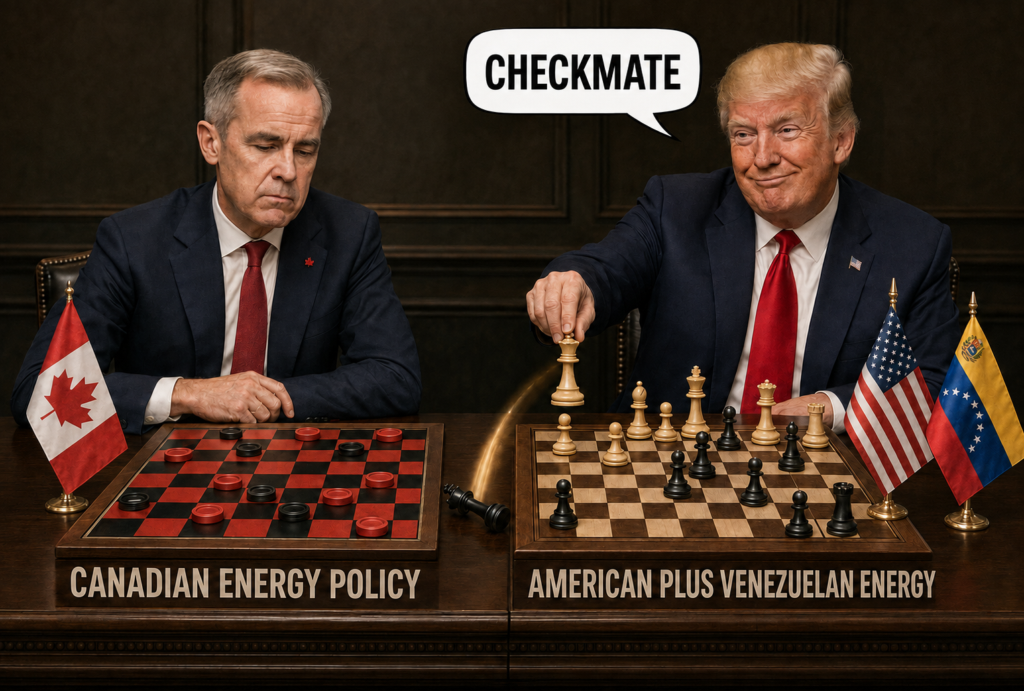
At a time of mounting national deficits, Canada has an opportunity to effectively, and competitively, secure its standing among ever-more competitive international markets. In face of events like those in Venezuela, with long-term effects that need to be carefully considered by Canadian policy makers, those objectives are compromised by policies that would force Alberta to produce “decarbonized” oil or which restrict shipments from Alberta to national, or international, destinations. Canada cannot afford to continue to play checkers while the world plays chess.
_________________________________________________________________________________________________________________
Dr. Ron Wallace is a former member of the National Energy Board with experience in the Venezuelan heavy oil sector.
Share This:




















SETTING OFF ALARM BELLS: Carney’s EU Deal Threatens Alberta, Energy, & Sovereignty – 170,000 Reasons to Reject Canada’s EU “Associate Membership” – The Nemeth Report