


 CDN NEWS |
  US NEWS







EnergyNow Media
Alberta prepares new oil and gas investment incentives as Ottawa’s regulatory and tax changes begin to line up behind major energy development
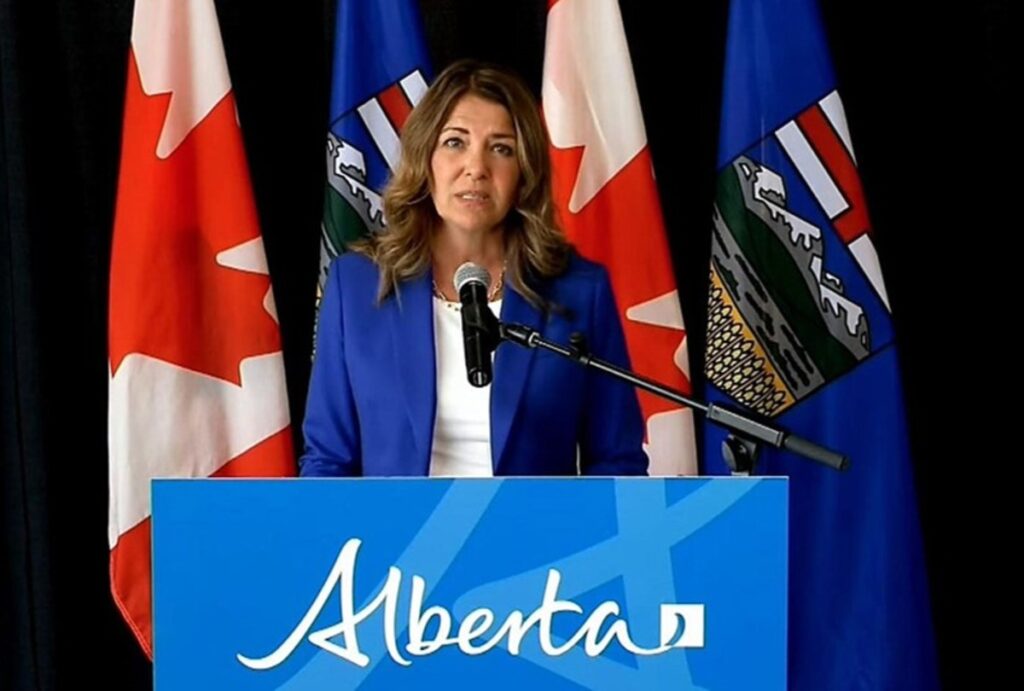
Alberta Premier Danielle Smith says she remains confident Ottawa will take a pivotal step by October 1 toward advancing the proposed West Coast Oil Pipeline – a project designed to move one million barrels per day of Alberta crude to Pacific tidewater and Asian markets.
Speaking to Calgary’s business community last week, Smith said Alberta expects the federal government to move ahead with listing the pipeline as a project of national interest under the Building Canada Act, a designation that would place the proposal within Ottawa’s accelerated major-projects framework.
“We’re closer than ever to a new oil pipeline carrying more than a million barrels a day to the West Coast and on to a fast track to the growing Asia-Pacific markets,” Smith told the Calgary Chamber of Commerce.
“We’re expecting to have an interim decision, sort of conditional approval by Oct. 1st, with final approval by [next] September.”
Federal documents make an important distinction. The October 1 milestone is not final regulatory approval to construct the pipeline. The federal Major Projects Office says Canada intends to publish notice in the Canada Gazette by October 1 if the government plans to list the West Coast Oil Pipeline as a project of national interest. Detailed regulatory reviews, Indigenous consultation and permitting would still follow.
But politically and commercially, the designation would be a significant step.
The pipeline was formally referred to the Major Projects Office on July 2, and Ottawa says consultations have been underway with Indigenous communities, provincial governments and federal permitting departments.
Federal Energy and Natural Resources Minister Tim Hodgson has stopped short of predicting the decision.
“There is a clear target that we will do all of the work necessary so that we can hopefully get to a decision by Oct. 1,” Hodgson said recently.
“I have every reason to believe they’re working to that deadline.”
More Than One Million Barrels a Day
The proposed pipeline would run from the Bruderheim area northeast of Edmonton to a deep-water terminal on British Columbia’s southwest coast, largely following the existing Trans Mountain corridor.
Its planned capacity is approximately one million barrels per day of heavy crude, substantially expanding Canada’s ability to reach overseas customers without relying primarily on the United States.
Alberta estimates the project will cost between $35.2 billion and $43.7 billion, including contingencies. The province’s major-project database currently lists the estimated cost at the upper end of that range.
The current ownership proposal also makes the project unusual.
Trans Mountain Corporation, the Alberta Petroleum Marketing Commission and Pembina Pipeline Corporation are expected to form a jointly owned company. Pembina would have a 10 per cent economic interest during construction, with an opportunity to increase that stake by another 10 per cent once the pipeline is operating. Trans Mountain and Alberta would divide the remaining ownership, while space is also being created for meaningful Indigenous equity participation.
Trans Mountain would lead construction, regulatory filings and operation of the pipeline.
Pipeline Depends on More Production
For Alberta, the pipeline is only one part of a much larger strategy.
Smith’s government wants provincial oil production to rise substantially over the next decade, with a stated goal of increasing oil and gas output and exports to more than eight million barrels per day by 2035.
That means companies including Canadian Natural Resources, Suncor Energy, Cenovus Energy, Imperial Oil and ConocoPhillips would need to sanction billions of dollars in new production and expansion projects if sufficient additional barrels are to be available for the pipeline.
The province is therefore preparing a new royalty incentive framework intended to encourage more upstream investment.
Smith indicated the plan is expected to be released later this fall.
The timing could be important because several federal and provincial measures are now converging around the same objective: making large capital projects more economically attractive and reducing the time needed to get them approved.
Ottawa’s New Tax Incentive Changes the Economics
One potentially significant development came this month when Ottawa announced its new Productivity Mega Deduction.
Under the proposal, most eligible depreciable capital property acquired on or after September 15, 2026, can be immediately expensed rather than deducted gradually over many years through the capital cost allowance system.



Canadian development expenses incurred after September 15 would also qualify for immediate expensing.
For capital-intensive industries such as oil and gas, the change can materially improve near-term cash flow and lower the after-tax cost of investment.
That matters because a new export pipeline has value only if producers are prepared to commit enough capital to generate the additional barrels necessary to fill it.
Imperial Oil Chairman, President and CEO John Whelan told the Calgary Chamber that the investment environment is beginning to improve.
“With a supportive fiscal and regulatory framework, Imperial has the potential to double our gross operated upstream production, while also advancing additional downstream biofuel production,” Whelan said.
In comments published by Imperial following the event, Whelan said there is growing momentum around major opportunities that could strengthen Alberta and Canada’s economy for decades.
Regulatory Reform Could Be Just as Important
Ottawa has also introduced Bill C-39, the Building Canada Strong Act, which proposes major changes to federal project approvals.
The legislation would establish a maximum one-year timeline for many federal reviews after a proponent submits a comprehensive application, while creating a single lead federal authority to coordinate assessments, permits and consultation.
For pipelines regulated by the Canada Energy Regulator, the CER would become the primary federal assessment authority, coordinating other federal approvals around its process.
The government describes the approach as “one project, one review, one year.”
Those changes do not eliminate environmental assessment, permitting or Indigenous consultation, but they are intended to eliminate overlapping federal processes that have historically added years of uncertainty to major projects.
Pathways Remains Part of the Equation
Oil production growth is also linked politically and economically to the proposed Pathways carbon capture and storage project.
In July, Ottawa, Alberta and the Oil Sands Alliance signed an agreement tying expanded market access and production growth to major emissions reductions.
The framework calls for six million tonnes per year of net emissions reductions from the Pathways CCS project by 2035, along with another 10 million tonnes annually from additional emissions-reduction projects over subsequent years.
The Alberta government describes Pathways and the West Coast pipeline as complementary projects: one aimed at increasing the industry’s ability to reach global markets and expand production, the other designed to reduce emissions associated with that growth.
Indigenous Participation Will Be Critical
Another major issue will be Indigenous consultation and ownership.
Ottawa says it began consultations in July with potentially affected Indigenous communities before making any decision on whether to list the project under the Building Canada Act.
The proposed ownership structure also reserves an opportunity for Indigenous equity participation, while Alberta says the Alberta Indigenous Opportunities Corporation could help communities finance ownership positions in both the pipeline and Pathways projects.
That process could ultimately be as important to the project’s timetable as engineering or financing.
October 1 is a Milestone, Not the Finish Line
For the Alberta government, an October 1 national-interest designation would provide a significant political and investment signal.
But several large pieces would still have to fall into place.
The project would require detailed engineering, regulatory approvals, consultation with Indigenous communities, continued engagement with British Columbia, commercial commitments from producers and a financing structure capable of supporting a project currently estimated at up to nearly $44 billion.
It would also require confidence from oil sands companies that long-term global demand, commodity prices, fiscal policy and transportation economics justify billions of dollars of additional upstream investment.
Ottawa and Alberta nevertheless appear to have moved substantially further toward a new West Coast pipeline than at any point in recent years.
The federal government has formally placed the project before the Major Projects Office. Trans Mountain and Pembina are involved. Ottawa and Alberta have proposed an ownership framework. Indigenous equity participation is being developed. The federal government has introduced accelerated capital write-offs and regulatory reforms. And the Pathways negotiations are being tied directly to the broader strategy of growing Canadian oil production and exports.
That makes October 1, 2026, an important test.
If Ottawa lists the West Coast Oil Pipeline as a project of national interest, attention will quickly shift from whether governments support the concept to the much harder questions. How quickly it can be approved, how it will be financed, how Indigenous partnerships will be structured and whether Canada’s oil producers are prepared to invest enough money to produce the additional barrels needed to fill it.
Share This:






















COMMENTARY: What’s Up With Gas Prices, Anyway? – Grady Semmens