


 CDN NEWS |
  US NEWS








Tackling the age-old question of why Canadians pay full price at the pumps
This week I was at a screening of the excellent documentary ‘Help Is On The Way,’ a new film by Calgary film maker Mathew Embry and his team at Muster Point Productions that aims to build energy literacy across the spectrum from oil and gas to renewables.
The film does an admirable job addressing key issues related to the benefits and impacts of all energy sources and shines a big spotlight on something most Canadians don’t think much about: energy poverty. Much of the film features the extraordinary work of Calgary-based NGO Light Up The World, which has staff and volunteers enduring grueling conditions installing solar power and satellite internet connections in some of the most remote communities on earth.
I highly encourage everyone to watch the show. (Full disclosure: I am a member of LUTW’s volunteer board of directors.)
In the Q&A session after the screening, one brave audience member took the opportunity to ask a common question many Canadians have in times of skyrocketing fuel prices: If we produce so much oil here, why do we have to pay so much for gasoline?
The question prompted some head-scratching and speculation, but no clear answers. Since I have tackled this issue in the past, I thought I’d take a run at it here…
At first glance, it feels like it shouldn’t work this way. Canada is one of the world’s top oil-producing nations (#4, in fact), so shouldn’t cheap gas come with the territory?
The quick answer is No. And the reasons are Economics and Politics. But that’s not very helpful, so let’s dig into it a little further.
Economics: Alberta’s Oil Is Sold Into a Global Marketplace
The first thing to understand is that crude oil is a globally traded commodity. Like most democratic nations, Canada follows a market-based approach to oil and gas pricing rather than having governments set prices. Alberta producers don’t simply sell oil to Alberta gas stations. Instead, they sell their products into North American and international markets where prices are determined by global supply and demand.
A useful analogy is wheat farming. Just because Saskatchewan grows a lot of wheat doesn’t mean local bread prices are disconnected from global grain markets. The same principle applies to oil.
When oil companies can sell their crude at the highest available market price, they generate more revenue. The theory behind a free-market economy is that this creates broader benefits: companies pay taxes and royalties, invest in new projects, hire workers, and support businesses throughout their supply chains. Those economic benefits ripple through society.



The flip side is that Alberta drivers are exposed to the same forces affecting drivers around the world. Wars in the Middle East, a hurricane affecting Gulf Coast refineries, decisions by the OPEC+ cartel, pipeline failures, or shifts in global demand can all affect gasoline prices. That is why prices often move dramatically even when nothing obvious has changed here at home.
In fact, gasoline prices are generally lower in Western Canada than the rest of the country, in part because our own crude oil is overwhelmingly used in our refineries to meet local demand. Thus, crude oil shipping costs are minimal, and our own crude is actually worth less than the world benchmarks due to a lack of pipeline capacity to get it to international markets. The same is not as true in Eastern Canada, where many refineries do import foreign crude, again due to lack of pipelines spanning the Great White North.
In short, Alberta may produce the oil, but the price of that oil is largely influenced by what is happening in the world. And perhaps you can take some solace in knowing that your expensive fill-up is supporting the broader economy.
Politics: Governments Can Choose to Make Fuel Cheaper
If paying less for gasoline is a really high priority for you, the best solution is to move or travel to another country to fill up.
The rulers of Saudi Arabia, for instance, choose to keep domestic fuel prices well below international market levels by subsidizing gasoline for their citizens. Filling up in Riyadh will cost you a lot less than Calgary – about 85 cents per litre right now compared to more than $1.70 here at home. In simple terms, some governments use public revenues, often generated from oil exports, to cover part of the cost so consumers pay less to fill up their luxury SUVs.
Like most free-enterprise countries, Canada has chosen a different path. Rather than heavily subsidizing fuel prices, governments allow market prices to flow through to consumers. Of course, Canada has flirted with state control of oil and gas – recall the disastrous National Energy Program of the 1980s that kneecapped our economy and sparked political resentment that lingers today.
But Canada’s economy is not totally guided by the invisible hand of the market. Political influence is often felt, and taxes make up a meaningful portion of what you pay every time you fill up. Gasoline prices include a combination of federal and provincial fuel taxes, along with GST or HST depending on where you live. Alberta’s regular provincial fuel tax rate is 13 cents per litre.
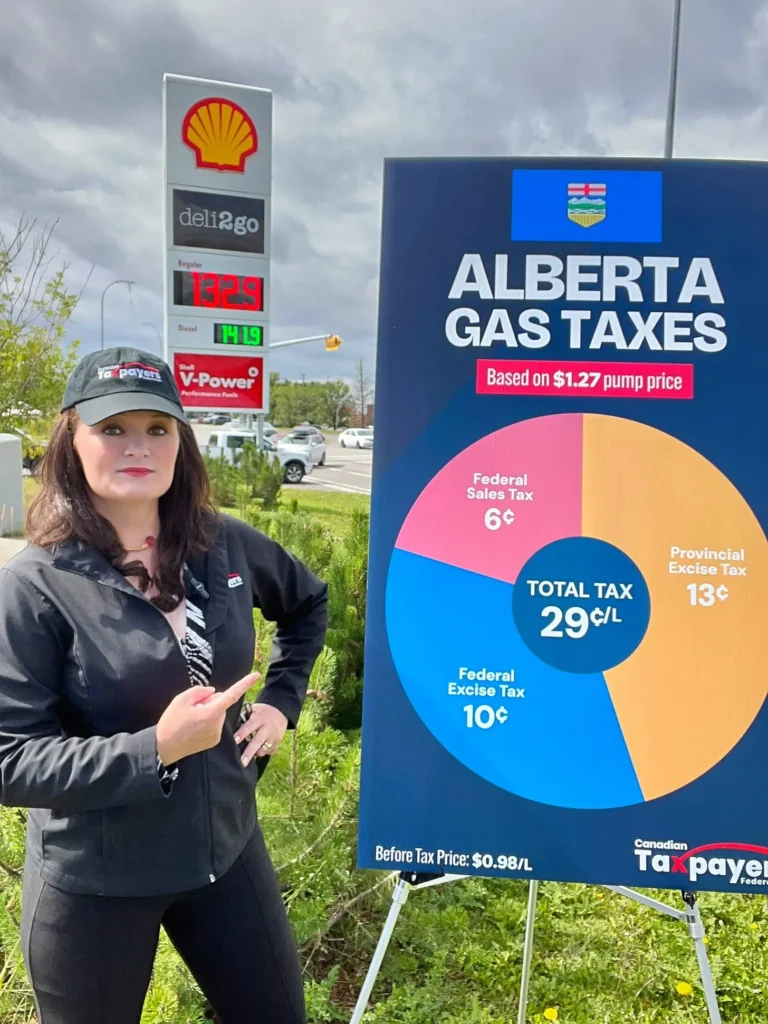
Photo courtesy of the Canadian Taxpayers Federation
This is why fuel purchased on many First Nations reserves can be less expensive than at urban gas stations. Depending on the circumstances and eligibility rules, some taxes do not apply on First Nations, reducing prices at the pumps. I live close to the Tsuu T’ina Nation that borders Calgary’s western edge. The new gas stations that have sprouted up on the along newly built Stoney Trail freeway are now typically 20 cents per litre lower than neighbouring gas stations in the city.
So, if you’re not planning to move overseas or drive out of your way to buy gas in another political jurisdiction, the best thing to do if you live in Alberta is wait a few days before filling up your car. Beginning October 1, the Alberta government has declared a holiday on its 13-cent-per-litre provincial fuel tax through the end of the year, a move that should be reflected accordingly in petrol prices in the province.
I hope that helps, thanks for reading!
Share This:






















COMMENTARY: What’s Up With Gas Prices, Anyway? – Grady Semmens