


 CDN NEWS |
  US NEWS







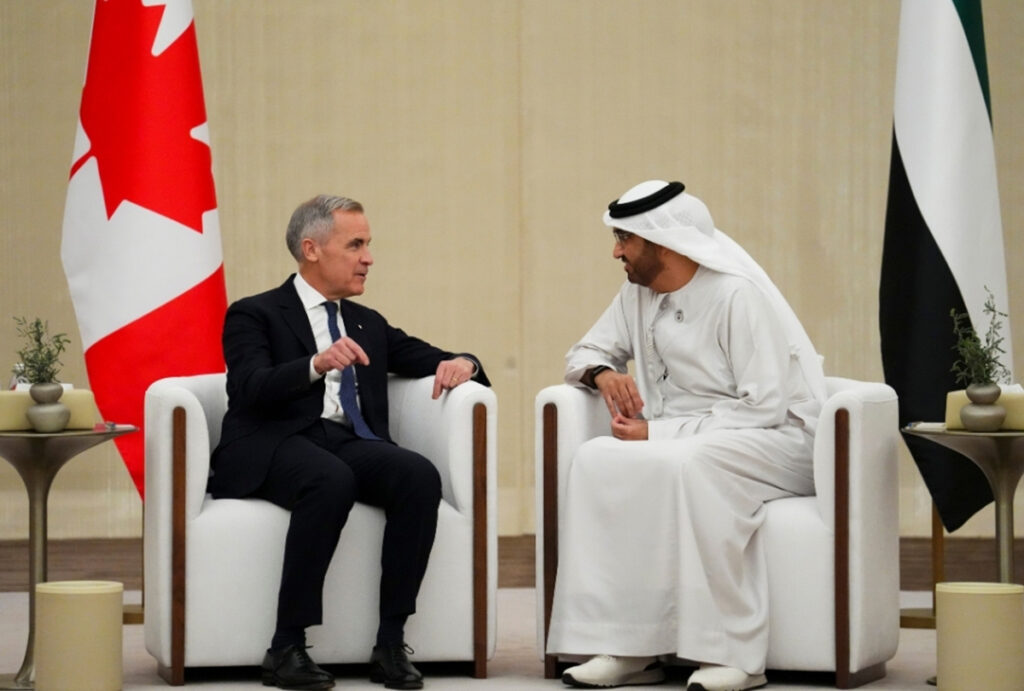
Prime Minister Mark Carney, left, meets with UAE Minister of Industry and Advanced Technology and Managing Director of state-run Abu Dhabi National Oil Co. (ADNOC) Sultan Ahmed al-Jaber as he arrives in Abu Dhabi, Wednesday, Nov. 19, 2025. THE CANADIAN PRESS/Sean Kilpatrick
When Prime Minister Mark Carney returned from the United Arab Emirates in November 2025 with a commitment of up to $70 billion in new investment for Canada, it appeared to be one of the most significant foreign-capital announcements in Canadian history. The proposed investment was directed toward sectors Canada urgently wants to expand: energy, critical minerals, ports and transportation logistics, artificial intelligence, and digital infrastructure. Yet the announcement contained no detailed allocation of the capital, no binding deployment timetable, and no list of projects that the UAE’s sovereign funds and state-backed companies had committed to finance. Now, in light of the escalating trade war between Canada and the US, the need for new foreign partners, investors and buyers has become even more important.
The problem is not that the UAE lacks either the money or the institutional capacity to invest it. Abu Dhabi controls some of the world’s largest and most experienced pools of capital, including Mubadala, the Abu Dhabi Investment Authority, ADQ, ADNOC’s international investment arm XRG, and the AI-focused organizations G42 and MGX. These institutions have already financed multibillion-dollar energy facilities, ports, power systems, data centres, mines, industrial companies, and infrastructure projects across the United States, Europe, Asia, Africa, and Latin America. If attractive projects exist, the UAE has repeatedly demonstrated that it can move capital at extraordinary scale.
Canada’s difficulty is more fundamental: too few major projects are simultaneously permitted, commercially viable, supported by Indigenous partners, connected to sufficient power and transportation infrastructure, and genuinely open to outside investment. Rescuing the $70-billion commitment therefore cannot mean producing another aspirational list of mines, pipelines, terminals, and technology campuses. It must mean converting diplomatic goodwill into completed agreements, final investment decisions, construction starts, and productive assets that employ Canadians, increase exports, and strengthen the country’s long-term economic capacity.
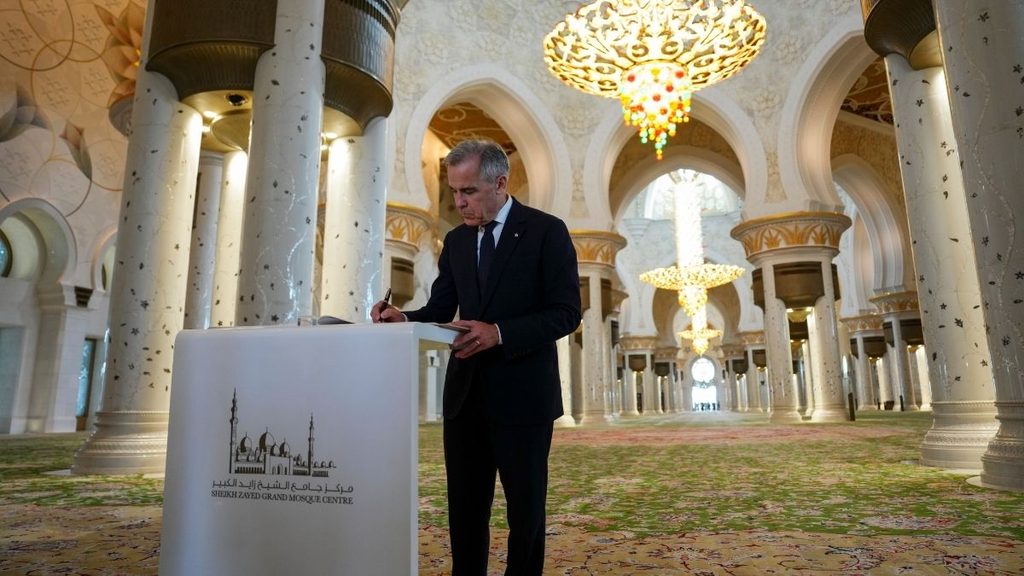
Prime Minister Mark Carney signs the guest book as he visits Sheikh Zayed Grand Mosque Centre in Abu Dhabi, UAE, on Thursday, Nov. 20, 2025. THE CANADIAN PRESS/Sean Kilpatrick
Canada’s unbuilt project graveyard
Canada does not suffer from a shortage of ambitious project proposals. It suffers from a shortage of projects that make the difficult journey from press release to production. A review of 30 major energy, infrastructure, mining and industrial developments cancelled, rejected or indefinitely shelved over the past two decades produces a gross announced value of roughly $390 billion. That figure is not a precise calculation of investment “lost”: some projects competed for the same customers, some cost estimates were preliminary, and others may never have secured financing under any policy environment. But the scale still matters. It represents hundreds of billions of dollars in productive capacity that companies once considered building in Canada and ultimately did not.
| Rank | Project | Location | Announced value | Outcome |
|---|---|---|---|---|
| 1 | Pacific NorthWest LNG | Lelu Island, B.C. | $36B | Petronas and its partners cancelled the large LNG terminal in 2017, citing prolonged weak market conditions. (resourceworks.com) |
| 2 | Kitimat LNG and Pacific Trail Pipeline | Kitimat, B.C. | $30B | Chevron and Woodside shelved the terminal in 2021 after failing to advance the project commercially or find replacement ownership. (resourceworks.com) |
| 3 | Aurora LNG | Digby Island, B.C. | $28B | Nexen/CNOOC and partners cancelled it in 2017, concluding that it was not economically competitive. The environmental assessment was subsequently terminated. (CityNews Vancouver) |
| 4 | Darlington two-reactor procurement—original configuration | Ontario | Up to $26B | Ontario suspended procurement in 2009 after receiving unexpectedly costly bids and amid uncertainty over AECL. This particular large-reactor procurement ended, although the Darlington site is now being developed with a different SMR design. (Ontario Newsroom) |
| 5 | WCC LNG | Prince Rupert, B.C. | $25B | ExxonMobil and Imperial Oil abandoned the proposed LNG terminal in 2018. No detailed public explanation was offered, but the project faced difficult global LNG economics. (resourceworks.com) |
| 6 | Frontier oil-sands mine | Northern Alberta | $20.6B | Teck withdrew the project in February 2020, shortly before a federal decision, citing the absence of a clear national framework reconciling resource development and climate policy. Market conditions were also challenging. (Teck Resources Limited) |
| 7 | Énergie Saguenay and Gazoduq system | Quebec and Ontario | About $20B combined | The LNG terminal and associated pipeline were rejected by Quebec in 2021, followed by a negative federal decision on the terminal in 2022, principally over environmental and emissions concerns. (resourceworks.com) |
| 8 | Kwispaa LNG | Vancouver Island, B.C. | $18B | The Huu-ay-aht First Nations and Steelhead LNG stopped advancing the project in 2019. Its federal environmental assessment formally terminated in 2022 after required studies were not supplied. (IAAC) |
| 9 | Mackenzie Gas Project and Mackenzie Valley Pipeline | Northwest Territories–Alberta | $16.2B | Imperial Oil and the consortium abandoned the revived project in 2017. Cheap shale gas, weak northern-gas economics, escalating cost and the lengthy development timeline undermined it. (Wikipedia) |
| 10 | Energy East Pipeline | Alberta to New Brunswick | $15.7B | TC Energy cancelled it in 2017 after regulatory changes, falling oil prices, other pipeline developments and deteriorating project economics. (Canada) |
| 11 | Honda Canadian EV value chain | Ontario | $15B | Honda indefinitely suspended its proposed battery, materials and vehicle-manufacturing complex in May 2026 amid changing EV-market conditions and capital priorities. This is a suspension rather than a definitive legal cancellation. (Honda News) |
| 12 | Goldboro LNG | Nova Scotia | $10B–$13B | Pieridae abandoned the original LNG development model in 2021 after financing and gas-supply challenges. The associated site was later sold, effectively ending the original proposal. (The Energy Mix) |
| 13 | Voyageur oil-sands upgrader | Alberta | $11.6B | Suncor and Total cancelled the upgrader in 2013 after major expenditures, concluding that processing bitumen at the site was no longer economically justified. (TotalEnergies.com) |
| 14 | Prince Rupert LNG | Ridley Island, B.C. | $11B | The BG Group/Shell proposal was discontinued in 2017 amid consolidation and weak LNG-market economics. (SAFETY4SEA) |
| 15 | Joslyn North oil-sands mine | Alberta | $11B | Total and its partners suspended it indefinitely in 2014, citing escalating costs and unfavourable oil-sands economics. (Canadian Mining Journal) |
| 16 | Conawapa hydroelectric project | Manitoba | About $10.7B | Manitoba Hydro shelved the 1,485-MW development in 2014 after reassessing domestic demand, export opportunities, cost and its broader capital program. The site remains a theoretical long-term option. (Wikipedia) |
| 17 | Pacific Future Energy refinery | Northwest B.C. | About $10B | The proposed bitumen refinery and export complex never reached an investment decision. The proponent withdrew it from B.C.’s process in 2024, and the federal assessment was terminated in 2025. (EPIC) |
| 18 | Grassy Point LNG | Northwest B.C. | About $10B | The project was shelved in 2018 after failing to achieve sufficient commercial progress. (resourceworks.com) |
| 19 | Westcoast Connector Gas Transmission | Northeast to northwest B.C. | $9.6B | The pipeline was originally intended to supply Prince Rupert LNG. Following the terminal’s cancellation, the pipeline remained dormant and its environmental certificate ultimately expired. (resourceworks.com) |
| 20 | Keystone XL | Alberta–United States | Approximately $8B in its earlier configuration | The cross-border pipeline was terminated in 2021 after the U.S. presidential permit was revoked. TC Energy formally ended the project afterward. (Reuters) |
| 21 | Northern Gateway pipelines and terminal | Alberta–Kitimat, B.C. | $7.9B | The approval was quashed by the Federal Court of Appeal over inadequate Indigenous consultation. The federal government rejected the project in 2016, ending the proposal. (Financial Times) |
| 22 | Northvolt Six battery factory | Quebec | About $7B | Northvolt’s financial collapse and bankruptcy process halted construction. Quebec ended further financial support in 2025, leaving the original project effectively dead. (CityNews Halifax) |
| 23 | Aspen oil-sands project | Alberta | About $7B | Imperial Oil placed the approved project on hold in 2019, citing production constraints, market-access problems and uncertainty. It remains shelved rather than formally cancelled. (resourceworks.com) |
| 24 | Alberta First Nations Energy Centre refinery | Alberta | $6.6B | The First Nations-backed bitumen refinery proposal was effectively ended in 2012 after Alberta declined the requested multibillion-dollar loan guarantee. (APTN News) |
| 25 | Wolfe Island Shoals offshore wind project | Lake Ontario | About $5.2B contract value | Ontario’s 2011 offshore-wind moratorium prevented the project from proceeding. It later generated a lengthy investment-treaty dispute, resolved in Canada’s favour in 2026. (Newswire) |
| 26 | Slave River hydroelectric project | Alberta–Northwest Territories | About $5B | The approximately 1,500-MW project was shelved in 2010 after preliminary studies, amid uncertain demand, high cost and environmental considerations. (Factor This™) |
| 27 | Carmon Creek oil-sands project | Alberta | More than $3B | Shell stopped construction in 2015, taking a major impairment charge. Low oil prices, costs and infrastructure constraints weakened the project. (MINING.COM) |
| 28 | Cliffs Black Thor/Ring of Fire development | Northern Ontario | $3.3B | Cliffs suspended the chromite mine, transportation corridor and processing plant in 2013 after infrastructure, negotiation and market difficulties. It subsequently sold its mineral interests. Other Ring of Fire proposals continue, but this particular integrated development ended. (ontario.ca) |
| 29 | Ajax copper-gold mine | Kamloops, B.C. | $1.3B–$1.5B | B.C. refused an environmental certificate in 2017, and the federal government rejected the project in 2018 because its significant adverse effects could not be justified. The owners have occasionally discussed a redesigned proposal, but the assessed project was rejected. (BIV) |
| 30 | E-One Moli battery-cell factory expansion | Maple Ridge, B.C. | $1B | The company halted the expansion in December 2024, saying it would concentrate production investment in Taiwan. Ottawa said none of its pledged funding had been disbursed. (Electric Autonomy Canada) |
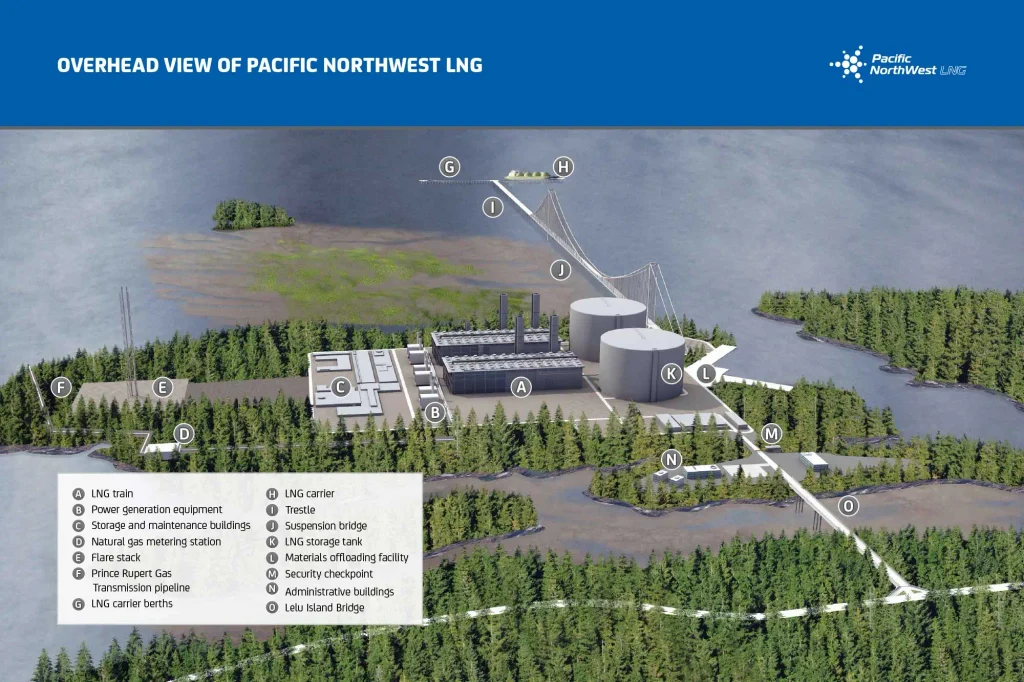
The proposed Pacific NorthWest LNG plant on Lelu Island, next to Prince Rupert.
Nowhere was the gap between promise and execution greater than on British Columbia’s coast. During the LNG boom of the 2010s, proponents advanced Pacific NorthWest LNG at up to $36 billion, Kitimat LNG at approximately $30 billion, Aurora LNG at $28 billion, WCC LNG at $25 billion, Kwispaa LNG at $18 billion, and Prince Rupert LNG at roughly $11 billion. Almost all disappeared before construction began. The reasons varied, but the result was extraordinary: an entire generation of proposed export terminals vanished while competitors in the United States, Australia and Qatar moved ahead. Pacific NorthWest LNG had even received federal approval before its owners concluded that market conditions no longer justified the investment.
The pattern extended far beyond B.C. Teck withdrew its $20.6-billion Frontier oil-sands mine. The $15.7-billion Energy East pipeline, the $16.2-billion Mackenzie Gas Project, the $7.9-billion Northern Gateway pipeline, and the earlier approximately $8-billion Keystone XL proposal all failed to reach operation. Manitoba placed the approximately $10.7-billion Conawapa hydroelectric project on the shelf. Together, these projects would have represented new mines, generating stations, pipelines, processing facilities, export routes and decades of associated employment. Their disappearance narrowed Canada’s options at precisely the time the country needed greater productivity, export diversification and economic resilience.
It would be convenient, but inaccurate, to blame every failure on the government. Oil and natural-gas prices fell. American shale production transformed North American energy markets. Construction costs rose, customers proved difficult to secure, and companies redirected capital toward projects with better expected returns. Corporate mergers also eliminated competing proposals. But commercial risk did not operate in isolation. Investors also confronted overlapping federal and provincial reviews, approval processes that could outlast commodity cycles, shifting carbon and environmental requirements, court challenges, jurisdictional disputes and infrastructure bottlenecks. Indigenous consultation was too often treated as a late-stage regulatory obligation rather than the foundation for an early economic partnership. Meanwhile, potentially viable mines and terminals waited for transmission lines, access roads, pipelines, port capacity and other enabling infrastructure that no single proponent could economically build alone.
The regulatory uncertainty became impossible to dismiss in 2023, when the Supreme Court of Canada found the designated-project portion of the federal Impact Assessment Act to be largely outside federal jurisdiction. That ruling was not an argument against environmental assessment; credible reviews are essential to public confidence and durable investment. It was evidence that Canada had constructed a system whose constitutional boundaries were uncertain even after it became law. Ottawa now acknowledges the problem. The Building Canada Act, the Major Projects Office and emerging “one project, one review” agreements are intended to reduce duplication and deliver federal decisions within two years. The urgency is economic as much as administrative. The OECD identifies sluggish business investment as a central cause of Canada’s weak productivity, while the Bank of Canada has warned that years of underinvestment have restrained wages, competitiveness and living standards. Canada’s unbuilt-project graveyard is therefore not merely a collection of missed construction opportunities. It is part of the explanation for why Canadians are working with less capital, producing less value per hour and becoming poorer relative to their international peers.
The UAE institutions that could put the capital to work

Photo source: https://enterpriseam.com/
The C$70-billion commitment was presented as a broad UAE investment intention, not as a publicly disclosed allocation among specific sovereign funds or state-owned companies. Any division of responsibility is therefore necessarily analytical rather than official. Even so, the institutional fit is fairly clear. Abu Dhabi has built a network of investors and operating companies with distinct mandates, allowing it to match different pools of capital to different types of assets. Canada should not approach them as though they were interchangeable sources of financing.
Mubadala Investment Company is the most plausible overall coordinator. It combines the scale of a sovereign investor with experience in acquisitions, infrastructure, energy, technology, private credit and investment platforms. The Abu Dhabi Investment Authority, or ADIA, would more likely participate as a patient financial co-investor, taking minority positions in mature utilities, transmission systems, ports, real estate and operating infrastructure. ADQ occupies a more strategic position. Its portfolio is concentrated in logistics, power, food, health care and essential supply chains, and it can invest through operating companies such as AD Ports Group where capital can be paired with technical expertise and commercial relationships.
The sector specialists are even easier to identify. ADNOC and its international investment arm, XRG, are the natural candidates for Canadian LNG, natural gas, petrochemicals, carbon-management systems and export infrastructure. They would probably seek more than a passive financial return, favouring ownership rights, operating influence, access to supply and long-term purchase agreements. In artificial intelligence, G42 could provide cloud, computing and technical capabilities, while MGX—the investment company established by Mubadala and G42—is the more likely source of capital for AI campuses, data centres, high-performance computing and the power systems needed to support them. Together, these institutions give the UAE the ability to finance nearly every component of a serious Canadian growth strategy, from mines and pipelines to ports, power plants and digital infrastructure.
A proven capacity to invest at scale
A C$70-billion commitment is enormous in a Canadian context, but it is not implausible when distributed among several UAE institutions and deployed over five to ten years. Abu Dhabi’s investment system was built precisely for this kind of undertaking: combining sovereign wealth, strategic state-owned companies, specialized operating expertise and international financing partners. The amount would not arrive as a single cheque. It would more likely be assembled through acquisitions, project equity, infrastructure partnerships, private credit, long-term purchase contracts and debt raised alongside UAE capital. The institutions under consideration have repeatedly demonstrated that they can execute transactions measured in the tens of billions.
Mubadala’s record offers the most immediate Canadian precedent. Its acquisition of CI Financial took the Canadian wealth-management company private at an enterprise value of approximately C$12.1 billion, proving that Abu Dhabi capital is already prepared to complete a major transaction within Canada’s regulatory and financial system. Elsewhere, Mubadala has proposed a US$13.5-billion biofuels investment program in Brazil, combining refineries, agricultural production and supporting infrastructure across multiple development modules. Its acquisition of a controlling interest in Fortress Investment Group also gave it an established international platform for private credit, real estate and alternative assets. These investments foreshadow several possible Canadian roles: acquiring operating companies, creating dedicated infrastructure funds, financing industrial developments and assembling portfolios rather than relying on a single megaproject.
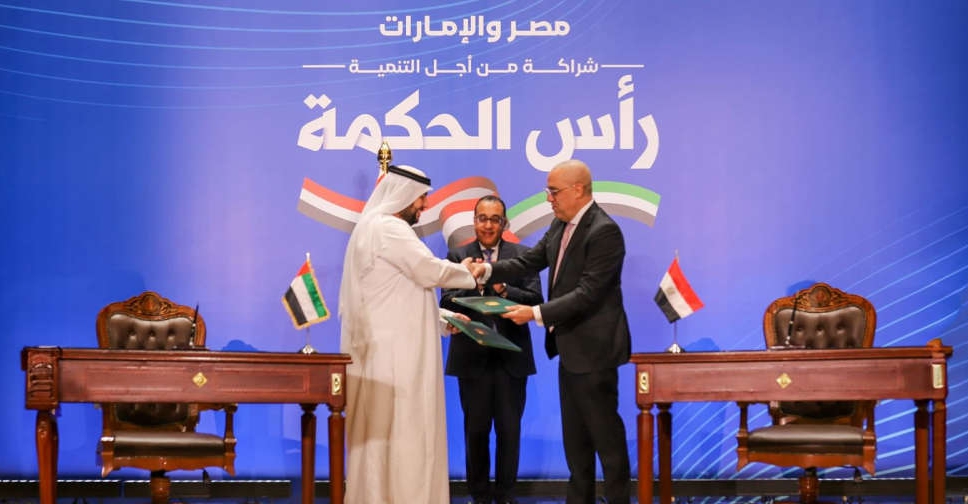
Photo source: www.arnnewscentre.ae
ADQ has shown an even greater willingness to connect capital deployment with broader national and commercial strategy. It led a US$35-billion investment in Egypt, centred on the Ras El-Hekma development and accompanied by investment in other Egyptian assets. In the United States, it established a proposed US$25-billion power-generation partnership intended partly to meet the enormous electricity requirements of new data centres. The model is relevant to Canada. ADQ could combine sovereign capital with companies from its portfolio to develop ports, logistics systems, electricity generation, food infrastructure or industrial corridors. Rather than investing in a transmission line or terminal as an isolated asset, it could help assemble an integrated system linking power, transportation, industrial customers and export markets.
XRG and ADNOC provide the clearest preview of what UAE participation in Canadian energy could look like. XRG completed the approximately €14.7-billion acquisition of German chemicals producer Covestro and followed it with a €1.17-billion capital injection. It also acquired an indirect 11.7% interest in the first three trains of the Rio Grande LNG project in Texas before expanding its exposure to the fourth and fifth trains. These were not passive financial purchases. They formed part of a wider strategy connecting gas production, liquefaction capacity, petrochemicals and global marketing. The same logic could be applied in Canada through ownership in an LNG terminal, investment in associated pipelines or gas supply, and long-term agreements giving XRG the right to purchase and market Canadian LNG overseas.

Photo source: www.covestro.com/



The pattern is equally visible in digital infrastructure. MGX and its partners acquired Aligned Data Centers at an enterprise value of approximately US$40 billion, while the wider AI Infrastructure Partnership aims to mobilize US$30 billion in equity and as much as US$100 billion once debt financing is included. ADIA, meanwhile, has spent decades taking patient minority positions in infrastructure such as Australia’s WestConnex toll-road system, as well as fibre networks, data centres, energy assets, real estate and private equity. Its role usually begins after an asset has been substantially de-risked, making it a natural potential investor in Canadian transmission, ports, utilities and operating infrastructure once the permits, revenue arrangements and construction plans are settled.
None of this capital should be mistaken for foreign aid or a diplomatic favour. These are sophisticated and disciplined investors that will demand competitive returns, credible partners and enforceable rights. Some will seek board seats or significant control. Energy investors may require long-term purchase agreements, while infrastructure funds will look for predictable regulated or contracted revenues. Every Canadian opportunity will be compared with alternatives in the United States, India, Europe, Latin America and Australia. The UAE’s investment history shows that it has the ability to deploy billions. It also shows that Canada will receive that capital only if its projects are as investable as the projects being offered elsewhere.
Canada’s investable project pipeline
Canada’s problem is not a complete absence of large projects. It is that too few have reached the point where investors can confidently commit billions of dollars and expect construction to follow. Several nationally significant developments still require major equity commitments, project debt, customers, enabling infrastructure or final investment decisions. These are precisely the kinds of opportunities that could absorb UAE capital but only if Canada distinguishes between projects genuinely seeking strategic investors and projects whose existing sponsors already possess the financial capacity to proceed.
The most natural starting point is the emerging LNG corridor on British Columbia’s northwest coast. There are increasingly calls made to designate the Montney formation as national strategic assets critical for turning Canada into an energy superpower as laid out by the prime minister. Mark Carney is acutely aware of the importance of LNG in powering the energy transition and in rebalancing Canada’s trading relationships. Ksi Lisims LNG, together with the Prince Rupert Gas Transmission pipeline and associated electrical infrastructure, represents more than C$30 billion in prospective investment. The Indigenous-led project has secured its principal environmental approvals and has begun signing long-term LNG purchase agreements, but it has not yet reached a final investment decision. It still requires terminal equity, project financing, additional customers, pipeline capital and access to as much as 600 megawatts of electricity. That makes it a plausible candidate for XRG or Mubadala: investors capable of contributing capital while also providing LNG marketing, operating experience and long-term offtake. LNG Canada Phase 2, meanwhile, could attract another C$33 billion and double the capacity of an operating facility. Its risk is lower than that of a greenfield terminal, but its existing shareholders—Shell, PETRONAS, PetroChina, Mitsubishi and KOGAS—are already financially powerful. UAE participation would therefore be supplementary, or would require an existing owner to sell or dilute its interest. Canada shouldn’t ask: “Can Ksi Lisims get electricity?” It should ask: “What power, pipeline, road and port system would allow five or ten North Coast projects to proceed?”
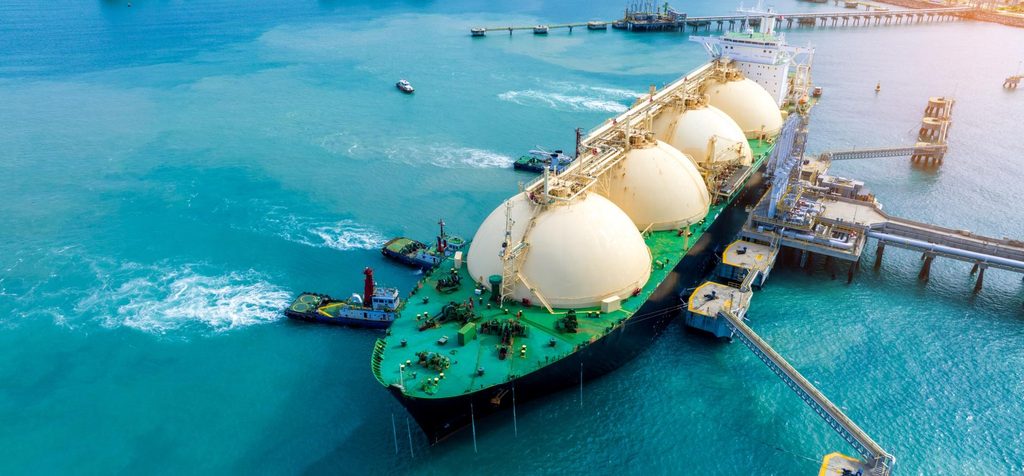
Photo source: https://ieefa.org/
Ontario’s Crawford Nickel Project presents a different opportunity. The proposed development is expected to attract approximately C$5 billion, create about 5,000 construction jobs and 1,300 operating jobs, and establish a major domestic source of nickel, iron, cobalt and chromium. Its proponents also argue that the mine’s geology could support large-scale carbon storage, potentially giving Crawford one of the lowest emissions profiles in the global nickel industry. Even with federal and provincial support, Indigenous investment and strategic shareholders, the project must still assemble the financing needed for construction and downstream processing. A UAE investor could participate through project equity, long-term debt, royalties or mineral-purchase agreements, structures already familiar to Abu Dhabi’s critical-minerals investors.
Artificial intelligence creates the largest potential opportunity and the greatest danger of speculative excess. Alberta’s proposed Wonder Valley AI Data Centre Park carries an estimated $12-billion first phase and a theoretical full build-out approaching $70 billion. But a data-centre announcement is not the same thing as an investable project. Wonder Valley or a comparable Canadian sovereign-compute campus would need firm customers, enormous quantities of reliable power, project equity, construction debt, computing equipment, water and cooling systems, and clarity around data security and access to advanced chips. MGX and G42 have the capital and sector expertise to participate, while ADQ could help finance dedicated generation.
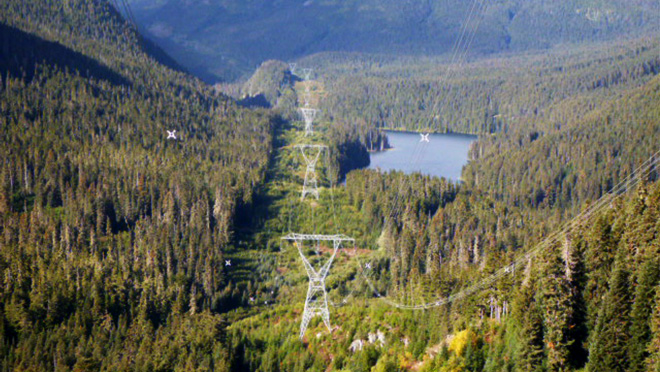
Transmission towers and lines running through a forest past a lake. Photo source: bchydro.com
Some of the most valuable opportunities are not export facilities or mines themselves, but the infrastructure that allows many projects to proceed. British Columbia’s approximately C$6-billion North Coast Transmission Line would more than double electrical capacity between Prince George and Terrace, providing power for LNG facilities, critical-mineral mines, ports and First Nations communities. Its regulated returns may appear modest beside an LNG terminal or technology campus, but its larger value is catalytic: B.C. estimates that the industries it enables could contribute nearly $10 billion annually to GDP. The project also offers the possibility of First Nations co-ownership alongside BC Hydro. Roberts Bank Terminal 2, a multi-billion-dollar expansion of the Port of Vancouver, could similarly unlock more than $100 billion in annual trade capacity, increase west-coast container capacity by more than 30 per cent and support thousands of supply-chain jobs. Yet it is not simply waiting for an outside investor. The port authority is advancing the landmass and wharf through a structured procurement process and exploring an operating partnership with Global Container Terminals, meaning UAE involvement would probably need to occur through financing, equipment, logistics facilities or a partnership with the selected operator.
Beyond these headline projects lies a much wider investable pipeline: Atlantic offshore wind and interregional transmission corridors; First Nations-owned wind, solar and storage projects; critical-mineral refining and processing; carbon capture and storage; district-scale power systems for AI campuses; and the roads, ports and communications infrastructure needed to develop Canada’s North. Not all should receive public subsidies, and not all will withstand commercial scrutiny. But they demonstrate that Canada has no shortage of physical resources or development possibilities. The task is to turn the strongest of them into bankable propositions with permits, customers, power, Indigenous ownership, credible operators and transparent routes to financial return.
Where UAE capital fits best
The strongest match is Ksi Lisims LNG. A UAE commitment of approximately C$5 billion to C$10 billion could provide project equity, support pipeline and terminal financing, and help secure the long-term sales contracts needed to reach a final investment decision. XRG is the most natural lead investor because it could contribute not only capital, but LNG expertise, access to global customers and long-term purchase agreements. Mubadala or ADIA could participate through preferred equity or infrastructure investments alongside the operating partners. The closest precedent is XRG’s participation in the Rio Grande LNG development in Texas, where Abu Dhabi capital was combined with liquefaction capacity, project financing and access to global gas markets. Ksi Lisims offers Canada a rare chance to attract the same model into an Indigenous-led export project.
The second priority should be the Crawford Nickel Project, where a UAE investment of roughly C$750 million to C$1.5 billion could help close the gap between regulatory advancement and construction. ADQ, Mubadala or ADIA could invest through ordinary equity, subordinated debt, royalties, mineral streams or long-term purchase agreements. The more ambitious opportunity would be to extend the investment beyond the mine itself. UAE capital could help finance Canadian refining, alloy production or battery-material processing, allowing Canada to export higher-value products rather than simply shipping unprocessed ore. That would connect the UAE’s interest in strategic minerals with Canada’s need to build more complete industrial supply chains. In light of recent developments and the need for more UAE- Canada engagement, a new organization is being launched as the bridge between Canadian mining and the GCC. The Canada Gulf Mining Alliance CGMA will be advocating for Canadian mining projects in the region and will be educating Gulf investors on potential benefits of investing in Canada. The CEO Of CGMA Jay Rana in a statement said “this is a once in a lifetime opportunity for the Canadian resource sector to take advantage of this investment. This is the first time in many decades that Canada has engaged with the Gulf countries at this level and now we as a country need to step up to present investable projects to the investors in the region.”
A third pillar could be a Canadian sovereign-AI and data-centre platform, backed initially by C$5 billion to C$10 billion from MGX, G42 and Canadian institutional partners. Rather than placing the entire amount into one speculative campus, the platform could develop several phased projects supported by firm customer contracts, dedicated power generation and Canadian data-governance requirements. Canadian pension funds, utilities and telecommunications companies could participate alongside the UAE investors. MGX’s role in the approximately US$40-billion acquisition of Aligned Data Centers demonstrates the scale at which Abu Dhabi is prepared to operate, but Canada should insist that each phase proceed only when customers, electricity and financing are firmly in place.
The remaining initial portfolio should focus on enabling infrastructure. ADIA and Mubadala could invest C$2 billion to C$4 billion in the North Coast industrial-power corridor through bonds, preferred equity or a dedicated investment vehicle, while Canadian or B.C. public ownership and regulatory authority remain intact. ADQ or AD Ports could contribute another C$1 billion to C$3 billion to Roberts Bank-related terminal equipment, intermodal facilities, logistics parks or the eventual concessionaire, rather than attempting to purchase the port authority itself. LNG Canada Phase 2 should remain a reserve opportunity: it is attractive, advanced and relatively low-risk, but its multinational owners are capable of financing it without a rescue investor.
Canada should therefore resist the temptation to force all C$70 billion into five projects at once. A more credible strategy would begin with a C$20-billion to C$30-billion Canada–UAE investment portfolio, released in stages as projects secure permits, contracts, Indigenous partnerships and construction milestones. Successful execution would create a record of Canadian reliability and make subsequent investment easier. The objective is not to exhaust the diplomatic commitment as quickly as possible. It is to prove that Canada can convert foreign capital into completed infrastructure, productive industry and durable economic growth.
From investment promise to construction
The first requirement is administrative discipline. Ottawa should create a dedicated Canada–UAE Investment Deployment Office inside the Major Projects Office, with a single senior federal lead empowered to coordinate departments, provinces, Indigenous governments and project proponents. Its mandate should be practical: identify barriers, assign responsibility, impose deadlines and report quarterly on whether priority investments are moving toward financial close. Investors committing billions of dollars should not be expected to navigate a maze of agencies that cannot provide a consistent answer on approvals, taxation, national-security review or infrastructure access.
Canada must also fully implement the principle of one project, one review. A major project should face one coordinated environmental assessment, binding decision timelines and permits processed in parallel rather than one after another. Federal, provincial and municipal agencies should be prohibited from repeatedly examining the same issue unless genuinely new evidence emerges. This is not a call to weaken environmental standards or Indigenous rights. It is a demand for competent government: clear rules, firm deadlines and final decisions that investors can rely upon. Every priority project should be accompanied by an investment-ready data room containing engineering estimates, outstanding permits, Indigenous agreements, power and water requirements, transportation access, customer contracts and a proposed capital structure.
Long-term fiscal and regulatory certainty is equally important. Investment tax credits available when construction begins should not disappear halfway through a project, and refundable or transferable credits should be considered where they materially improve financing. Governments should avoid retroactive changes to royalties, depreciation rules or carbon-policy obligations. Foreign-investment reviews should include transparent pre-clearance pathways for sovereign investors, with clear guidance on where minority ownership is acceptable and where Canadian control must be preserved. Legitimate protections for sensitive data, telecommunications and defence-related minerals are necessary; open-ended political discretion is not. Capital will go where the rules are understandable and durable.
Public financial institutions should be used selectively to unlock projects, not to conceal weak economics. The Canada Infrastructure Bank, Canada Growth Fund and Export Development Canada can provide loans, guarantees, revenue support or first-loss capital for enabling infrastructure that private proponents cannot efficiently build alone. Indigenous participation should be treated in the same spirit. Expanded loan guarantees, meaningful equity and early partnership negotiations can make projects more durable and investable while ensuring that host communities share directly in the benefits. Indigenous ownership should be presented to foreign investors as a competitive advantage that reduces long-term project risk.
Finally, Canada needs a pro-growth power and workforce strategy. Data centres and industrial projects should finance their own incremental generation, transmission and grid connections rather than shifting costs onto residential ratepayers. Projects that bring new power, storage or transmission should receive accelerated treatment. Apprenticeships, skilled-trades training, credential recognition and targeted specialist immigration should be coordinated with each investment. Canadian procurement, domestic mineral processing, cybersecurity, Indigenous equity and measurable environmental performance can all be required—but they must be designed carefully enough that the investment still earns a competitive return. The offer to the UAE should be straightforward: Canada will provide faster decisions, stable rules and enforceable conditions in exchange for capital that creates Canadian jobs, infrastructure and productive capacity.
What $70 billion could mean for Canadian jobs and public revenues
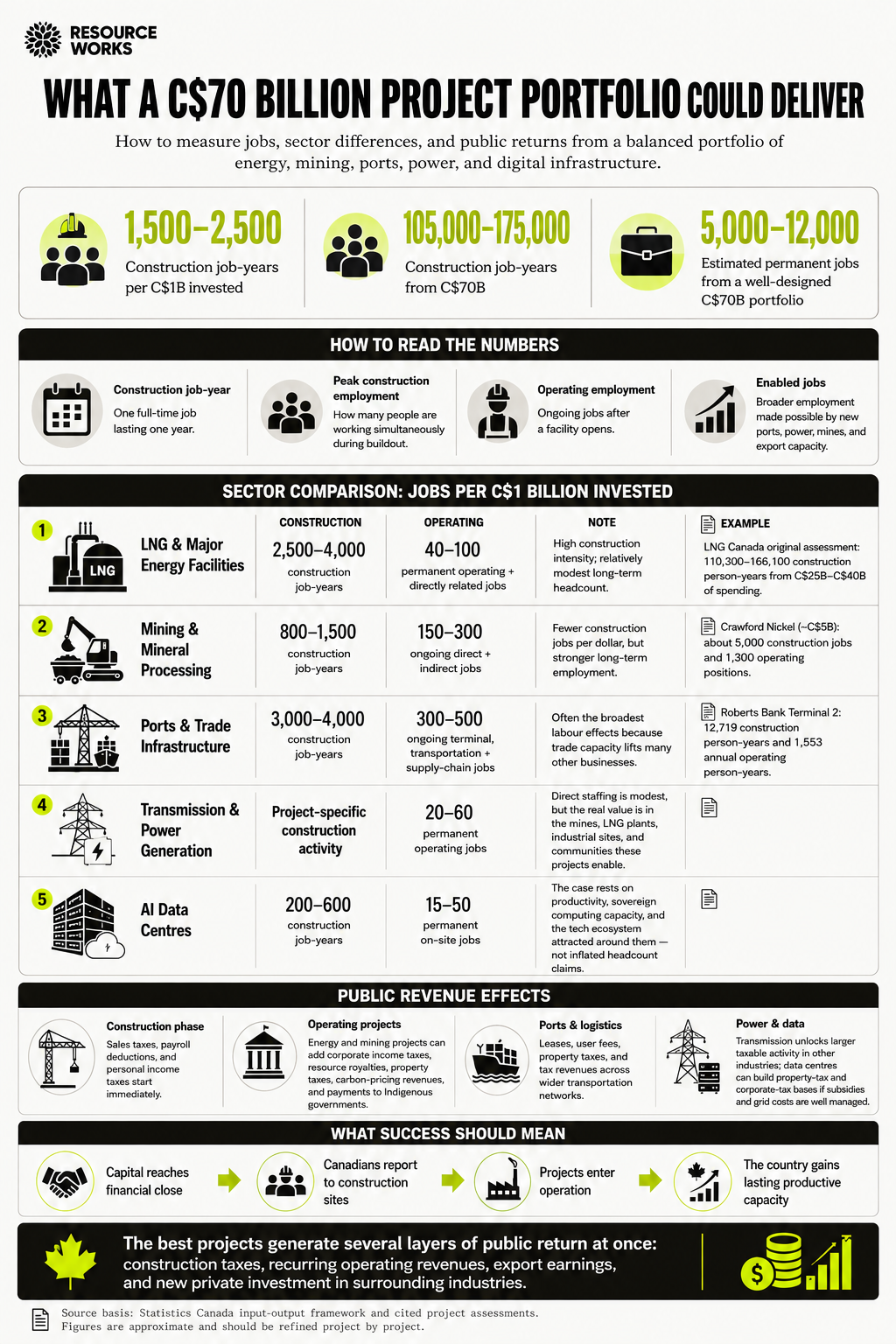
The economic value of the UAE commitment should be measured carefully. A construction job-year means one full-time position lasting one year; it is not the same as a permanent job. Peak construction employment measures how many people are working simultaneously, while operating employment continues after a facility opens. Enabled jobs are broader still: the miners, manufacturers, logistics workers and service businesses made possible by a new transmission line, port or export terminal. Using Statistics Canada’s input-output framework, a balanced portfolio of energy, mining, port, power and digital projects could support approximately 1,500 to 2,500 Canadian construction job-years for every C$1 billion invested. At full deployment, C$70 billion could therefore generate roughly 105,000 to 175,000 construction job-years over several years.
The employment intensity would vary widely by sector. LNG terminals and major energy facilities could support approximately 2,500 to 4,000 construction job-years per $1 billion, followed by roughly 40 to 100 permanent operating and directly related positions. LNG Canada’s original assessment projected between 110,300 and 166,100 construction person-years from C$25 billion to C$40 billion of spending. Mining and mineral processing generally create fewer construction positions per dollar but substantially more permanent employment: approximately 800 to 1,500 construction job-years and 150 to 300 ongoing direct and indirect jobs per $1 billion invested. The roughly C$5-billion Crawford Nickel development, for example, has been associated with approximately 5,000 construction jobs and 1,300 operating positions.
Ports and trade infrastructure can have even broader labour effects. Every $1 billion invested could support approximately 3,000 to 4,000 construction job-years and 300 to 500 ongoing terminal, transportation and supply-chain jobs, before counting the businesses made more competitive by expanded trade capacity. Roberts Bank Terminal 2 has been associated with an estimated 12,719 construction person-years and 1,553 annual operating person-years. Transmission and generation projects may produce only 20 to 60 permanent operating jobs per C$1 billion, but their real contribution lies in the mines, LNG facilities, industrial plants and communities they make possible. AI data centres sit at the other extreme: perhaps 200 to 600 construction job-years and 15 to 50 permanent on-site positions per C$1 billion. Their case therefore rests on productivity, sovereign computing capacity and the technology companies attracted around them, not exaggerated claims about permanent employment inside server buildings.
The public-revenue effects would also differ by sector. Construction generates sales taxes, payroll deductions and personal income taxes immediately. Operating mines and energy projects can later produce corporate income taxes, resource royalties, property taxes, carbon-pricing revenues and payments to Indigenous governments. Ports generate leases, user fees, property taxation and tax revenue throughout wider logistics networks. Transmission projects may provide modest direct tax returns but unlock much larger taxable activity in the industries they serve. Data centres can create substantial property-tax and corporate-tax bases, although governments must ensure that public power subsidies and grid costs do not outweigh those revenues. The best projects are those that produce several layers of public return at once: taxes from construction, recurring operating revenues, export earnings and new private investment in surrounding industries.
A reasonable preliminary estimate is that a well-designed C$70-billion portfolio could support 5,000 to 12,000 permanent jobs, in addition to its construction employment and the much larger number of positions enabled by new power, ports, mineral processing and export capacity. Those numbers should be refined project by project rather than inflated for political announcements. Mark Carney should measure success not by whether the C$70-billion pledge generated a good news day, but by how much capital reaches financial close, how many Canadians report to construction sites, how many projects enter operation and how much permanent productive capacity the country has created when the diplomatic celebration is over.
Siavash Tahan can be reached at [email protected].
Share This:




















SETTING OFF ALARM BELLS: Carney’s EU Deal Threatens Alberta, Energy, & Sovereignty – 170,000 Reasons to Reject Canada’s EU “Associate Membership” – The Nemeth Report