


 CDN NEWS |
  US NEWS







B.C.’s single most consequential piece of enabling infrastructure just moved from press release to construction site. Here’s what the North Coast Transmission Line actually unlocks—and the one test that’s left.
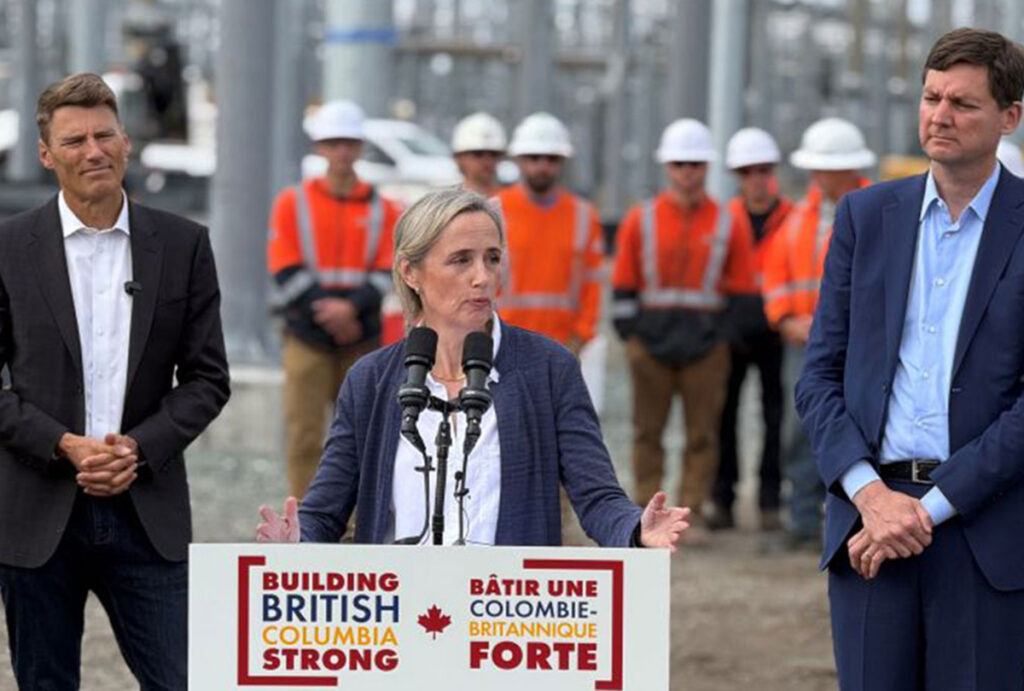
B.C minister of finance Josie Osborn speaks at a press conference alongside B.C. Premier, David Eby, and President and CEO of BC Hydro, Chris O’Riley. Photo source: BC Hydro on LinkedIn.
By Resource Works
More News and Views From Resource Works Here
Every so often a project comes along that everyone agrees is essential and almost no one can picture. The North Coast Transmission Line (NCTL) has spent years in exactly that category—a line on a map, a funding headline, a permitting file thick enough to prop open a door. As of today, it is something far more useful: a construction site.
On Sept. 3, Premier David Eby, federal Energy and Natural Resources Minister Tim Hodgson and B.C. Energy Minister Adrian Dix—with federal Infrastructure Minister Gregor Robertson also on hand—broke ground in Prince George on Phase 1 of the NCTL, a new 500-kilovolt line running from the Williston Substation near Prince George to Glenannan, west of Fraser Lake. BC Hydro confirms construction is now underway: site preparation, access roads, vegetation clearing, laydown areas — the unglamorous, load-bearing work that separates a project that is happening from one that is merely announced.
There’s a reason this is big news. We have all sat through the ribbon-cuttings for things that never got built. This is not one of those. As Resource Works’ Stewart Muir puts it, this is “what ‘get it built’ looks like when the pieces actually come together.” The moment a transmission concept stops being a slide deck and starts being poured concrete.
Why a power line is the whole ballgame
If that sounds like a lot of enthusiasm for some towers and wire, stay with me, because the wire is the point.
Northern B.C. has a supply problem hiding inside an opportunity. Electricity demand from mining, LNG and port projects has now outrun the existing 500-kV line between Prince George and Terrace, and the smaller stopgap capacity BC Hydro has been able to add is already effectively spoken for. You cannot run a modern industrial economy on a grid that is full. Phases 1 and 2 will add roughly 440 kilometres of new 500-kV transmission between Prince George and Terrace and more than double the power available on the North Coast.
Think of it as widening the only road into a boomtown. It isn’t the reason people want to move there, but nobody arrives until it’s done.



What the line actually plugs in
The list of projects waiting on that road is long. The most direct connection is LNG: Ksi Lisims LNG, a roughly $30-billion project on Nisg̱a’a Treaty Lands, has an MOU for up to 600 megawatts of BC Hydro supply once the line is expanded, and Ottawa explicitly names the NCTL as the infrastructure enabling both Ksi Lisims and mining in the Golden Triangle. And there are more projects, and more jobs, that require a steady source of electricity outside of the LNG space, like copper, critical minerals and port expansions.
The federal and provincial governments are treating it accordingly. Canada and B.C. have committed $3.9 billion toward Phases 1 and 2, the federal Major Projects Office has designated the line as a “nation-building” project, and it is moving through B.C.’s streamlined permitting regime rather than the usual decade of process. On the government’s own numbers, the industrial development the NCTL enables is projected to support about 9,700 direct full-time jobs, add nearly $10 billion a year to B.C.’s GDP and generate roughly $950 million annually in provincial and local revenue, with as many as 1,400 workers on site at peak construction. Phase 1 is due by mid-2030; Phase 2 is expected to start in 2027 and finish by winter 2032.
This is enabling infrastructure that pays for itself several times over if the projects behind it proceed.
The genuinely new part: ownership, not just consultation
Here is the piece that should also get attention. The government is not offering First Nations along the corridor the usual clipboard-and-open-house version of consultation. BC Hydro says 14 First Nations and eight Wet’suwet’en Houses are involved across the first two phases, with BC Hydro offering participating Nations the chance to become 50/50 equity partners in the transmission infrastructure itself. Co-ownership agreements the Province expects to finalize by the end of this year.
That is a structurally different proposition from a benefits agreement. Equity means a share of the returns for as long as the line runs, and it aligns everyone’s incentives toward the same outcome: getting it built and keeping it running.
Stellat’en Chief Robert Michell was pointed even while marking the day: First Nations “are not against projects in the national interest,” he said, but “all our conditions to build haven’t been addressed by the Crown,” and he expects them in the agreements finalized this fall. Nadleh Whut’en Chief Beverly Ketlo, citing a Yinka Dene-led review, said her Nation will keep working to ensure its concerns are “addressed and accommodated.” That is not opposition. It is what genuine partnership sounds like when the partners still have leverage—and it is a good sign, not a bad one.
The only question left
So this is the part where a columnist is supposed to warn you that it could all go wrong. It could. But let’s be accurate about what’s actually at stake, because it isn’t whether the North Coast needs the power, (it does) or whether the projects are waiting (they are).
The test now is execution. Phase 1 is under construction; Phase 2 doesn’t break ground until 2027, Phase 3 isn’t yet funded, and the equity agreements still have to be signed. Governments are good at groundbreakings and historically less good at the four years that follow one. If Canada can hold the remaining phases to schedule and turn this arrangement—fast permitting, federal-provincial co-funding, Indigenous co-ownership —into a repeatable template rather than a one-off, it will have done something more valuable than build a power line. It will have remembered how to build.
For a country that has spent a decade forgetting, that would be worth every kilometre. Today, at least, the shovels are in the ground. Now keep them there.
Share This:






















On The Verge: Energy Sector Primed for New Wave of Growth – ATB Economics