


 CDN NEWS |
  US NEWS







EnergyNow Media
Origins CCS Hub expected to begin operations in January 2027 with initial capacity to permanently store 1.5 million tonnes of CO₂ annually
CLIVE, Alberta – September 9, 2026 – Construction has begun on what is expected to become Canada’s largest carbon capture and storage project, marking another significant expansion of Alberta’s growing carbon-management infrastructure.
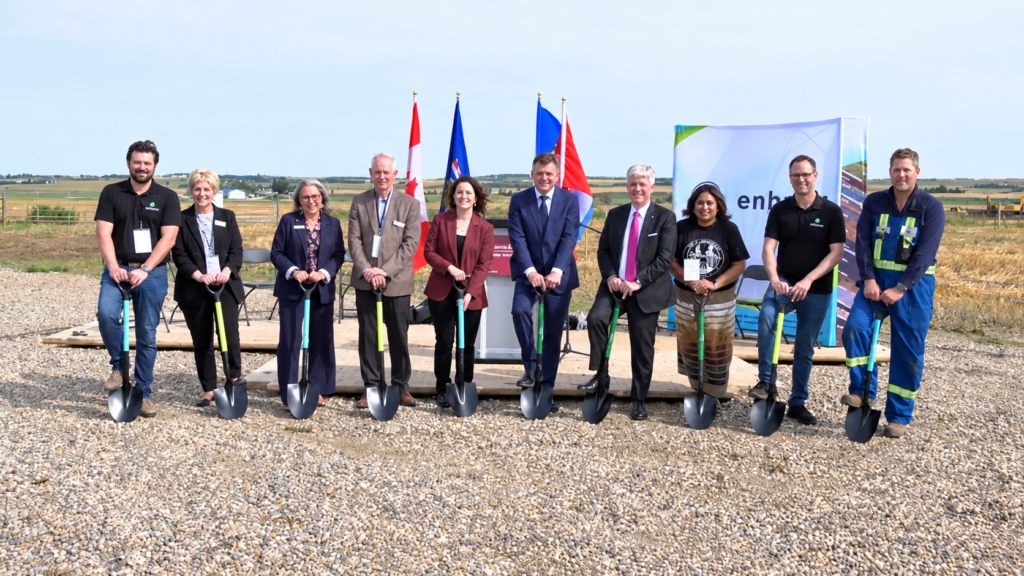
The federal and Alberta governments joined Enhance Energy on Wednesday to mark the start of construction of the Origins Carbon Capture Storage Hub near Clive in central Alberta. Bloomberg also reported Wednesday that the project is scheduled to begin operations in January 2027.
At startup, Origins will have capacity to permanently store as much as 1.5 million tonnes of carbon dioxide annually, which the federal government estimates is equivalent to removing more than 500,000 vehicles from the road each year. The project has been designed to expand as additional industrial customers connect to the system.
While frequently described as a carbon capture and storage project, Origins will primarily provide the transportation and permanent geological storage side of the CCS chain. Industrial companies capture CO₂ at their facilities before it is transported by pipeline to a storage hub and injected deep underground.
Connected to Alberta’s existing CO₂ network
Origins will connect through pipeline infrastructure to Alberta’s existing CO₂ transportation network, allowing it initially to receive carbon dioxide from large industrial facilities in the Alberta Industrial Heartland.
Enhance says the hub could eventually serve hard-to-abate industries throughout the Edmonton-Calgary corridor, including oil and gas, cement, petrochemicals, hydrogen and power generation, as well as future carbon-removal projects.
The project received regulatory approval from the Alberta Energy Regulator in July 2025. Unlike Enhance’s existing Clive operation, which has incorporated enhanced oil recovery, Origins is designed for permanent storage in a saline aquifer. Federal technical support for the project has examined the use of a pressure-depleted saline aquifer in a carbonate reservoir as a commercial-scale permanent storage option.
That distinction could be important for the next generation of Canadian CCS development because it demonstrates how carbon storage can be developed independently of enhanced oil recovery.
Building on more than nine million tonnes already stored
Enhance is not starting from scratch at Clive.
The company already operates the nearby Clive CO₂ Sequestration Facility and says it has permanently stored more than nine million tonnes of industrial CO₂ since operations began in 2020.
Enhance says those activities have generated approximately $586 million in economic activity in central Alberta, created more than $800 million in carbon-credit value and helped support more than $1 billion in investment across Alberta’s carbon capture and sequestration supply chain.
That operating experience gives Origins something many proposed CCS projects do not yet have: a nearby commercial track record involving CO₂ transportation, injection, reservoir management and monitoring.
Enhance Vice President of Corporate Affairs Candice Paton called Origins a “game changer for both Alberta and Canada,” saying the project can combine emissions reductions with Canadian expertise and industrial competitiveness.



Federal and Alberta governments back CCS expansion
Ottawa and Alberta have increasingly identified carbon capture and storage as an area where their energy and emissions policies overlap.
Federal Energy and Natural Resources Minister Tim Hodgson said Origins demonstrates how Canada can expand conventional energy production while lowering emissions and attracting investment.
Alberta Energy and Minerals Minister Brian Jean said the province’s geology, technical expertise and investment environment have positioned Alberta as a global CCS leader, with projects such as Origins supporting rural jobs and continued oil and gas competitiveness.
Enhance says Origins has received two $5-million grants from Natural Resources Canada’s Energy Innovation Program. Federal records also show support for technical and regulatory work required to advance the project.
How large could Origins ultimately become?
The initial 1.5-million-tonne annual capacity may only represent the first stage.
When Enhance originally proposed Origins, the company envisioned a much larger open-access sequestration complex. In 2022, Enhance said that, working with industrial companies across Alberta, the broader system could ultimately have the potential to capture, transport and permanently store as much as 20 million tonnes of CO₂ annually.
The company has not committed to that 20-million-tonne figure for the current construction phase, and Wednesday’s announcement emphasizes the initial 1.5-million-tonne capacity with expansion possible over time.
That expansion potential may ultimately be as significant as the project’s opening capacity. A large common-carrier storage hub can allow multiple industrial emitters to share transportation and sequestration infrastructure rather than requiring every company to develop its own standalone storage project.
For Alberta, that could become particularly important if proposed hydrogen, petrochemical, cement, natural gas processing and oil sands projects require access to verified carbon storage to meet emissions targets or maintain access to increasingly carbon-conscious export markets.
A significant test for Canadian CCS
Origins will arrive at a time when Canada is debating how large a role CCS should play in keeping its oil, natural gas and heavy industries competitive while reducing emissions.
The project will provide an important real-world test.
Rather than another multi-billion-dollar concept awaiting a final investment decision, Origins is now moving into construction with a scheduled startup only months away.
If the January 2027 commissioning remains on schedule and additional industrial customers follow, the Clive area could become one of the most important carbon-management centres in North America.
And for Alberta, it would provide further evidence that the province’s decades of expertise in geology, pipelines, drilling and reservoir engineering can increasingly be applied not only to producing hydrocarbons — but also to permanently putting industrial carbon back underground.
Share This:






















On The Verge: Energy Sector Primed for New Wave of Growth – ATB Economics