


 CDN NEWS |
  US NEWS







Natural gas, LNG and liquids are moving from promise to steel, contracts and export cargoes. Oil is producing at record levels too – but its next large wave of growth is waiting for Ottawa and Alberta to turn their July bargain into rules durable enough for billion-dollar decisions.
By Stewart Muir
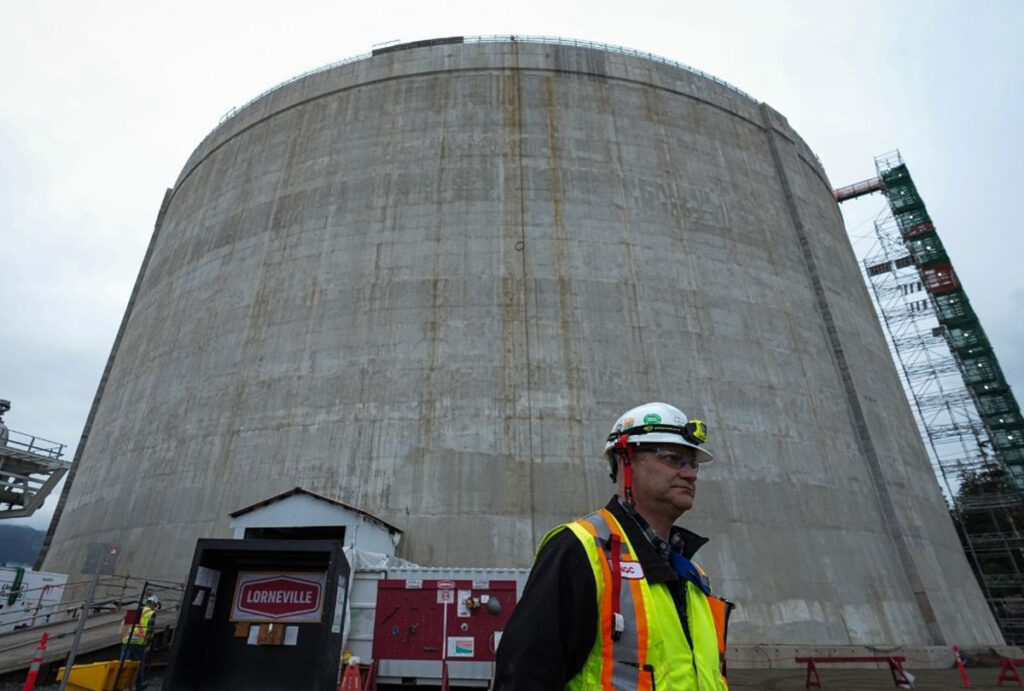
An LNG storage tank under construction at LNG Canada’s Kitimat export terminal on September 28, 2022. THE CANADIAN PRESS/Darryl Dyck
At the half-year mark of 2026, I’ve been reflecting on about a dozen quarterly reports from the companies that produce, process and move Western Canada’s energy. It is not exactly beach reading, but taken together the reports tell a better story than any single earnings call does. The interesting part is not merely who beat guidance or raised a dividend. It is where executives are prepared to put real money, where they are still keeping the cheque book closed – and, in the oil sands, how different the companies holding that cheque book now are from a decade ago.
Companies tell you a surprising amount by the verbs they use when real money is involved. Pembina Pipeline spent the second quarter using two very different sets of them. On the natural-gas and liquids side of its business, it completed, sanctioned and connected. At its Redwater complex near Edmonton, a new fractionator went into service on time and under budget, adding 55,000 barrels a day of propane-plus capacity. Pembina and its partners reached a positive final investment decision on the 932-megawatt Greenlight Electricity Centre, a C$4.6-billion gas-fired power project built around a Meta data centre. It sanctioned a C$570-million extraction plant backed by a long-term ethane agreement with Dow. At Cedar LNG in British Columbia, the feeder pipeline is mechanically complete and the floating LNG vessel is more than 70 per cent built.1
Then came the proposed West Coast Oil Pipeline, and the vocabulary changed. Pembina agreed to participate on a non-binding basis. It would hold a 10 per cent economic interest through construction, with an option to increase that later. But the company reserved full discretion over its own final investment decision and stipulated that it would put no at-risk development capital into the project before making it. In the energy business, that is not a semantic distinction. It is the difference between being interested and being invested.1
Same company. Same quarter. Same capital-allocation discipline. Two very different levels of commitment. If you want a one-company snapshot of what Western Canada’s second-quarter earnings are saying about the next energy investment cycle, this is a pretty good place to start.
Two potential booms are taking shape. The first – natural gas, LNG and natural-gas liquids – has moved a considerable distance from forecast to execution. The second – another large increment of oil-sands production and export capacity – is technically plausible and potentially enormous, but some of the country’s most important producers are not yet prepared to authorize it. The issue is not whether Canadian oil can grow. Of course it can. The question is whether the rules governing that growth will be durable enough to finance projects whose lives can be measured in decades.
The boom already being built
The gas story starts with a rather old-fashioned thing: demand. TC Energy now estimates North American natural-gas demand will grow by about 51 billion cubic feet a day between 2025 and 2035, driven primarily by LNG exports, gas-fired power generation and industrial growth. Deliveries on its U.S. systems to LNG facilities averaged 3.9 Bcf/d in the second quarter, 13 per cent higher than a year earlier. In Western Canada, the company is marketing delivery and receipt opportunities representing as much as another1 Bcf/d of system throughput, supported by data centres, industrial development, LNG demand and oil-sands consumption.2
Forecasts are cheap. Final investment decisions are not. TC Energy sanctioned C$700 million of low-risk corridor expansions in the quarter and said it had announced about C$3 billion of growth projects so far in 2026. Two U.S. gas expansions approved in June are backed by 20-year take-or-pay contracts. In Canada, the Greater Edmonton Area offering for up to 0.26 Bcf/d was fully subscribed.2
Enbridge provides another large Canadian example. In July it began construction on the C$4-billion Sunrise Expansion Program on its Westcoast system in British Columbia. Sunrise will add roughly 140 kilometres of 42-inch pipeline looping plus new compression, increasing T-South transportation capacity by about 300 million cubic feet a day, with service targeted for late 2028. It is Enbridge’s largest current project in B.C. and a substantial commitment to the gas side of this story.3
The pull is visible upstream in northeastern British Columbia. Tourmaline Oil says the first 25 wells in its NEBC Montney complex to reach their 90-day production benchmarks in the first half of the year performed 28 per cent better than the prior five-year average. Five of six connector pipelines in the first phase of its regional infrastructure program are complete and the Aitken plant expansion is due to start in the fourth quarter.4
Tourmaline also signed a long-term agreement with AltaGas to increase propane and butane exports through the REEF terminal, raising its exposure to premium LPG export markets by about 55 per cent. Those volumes are to move through a new rail-loading facility beside Tourmaline’s Groundbirch-Monias deep-cut plant. This is where geography starts becoming a business model: Montney wells, processing, rail logistics, a contracted export terminal and buyers in higher-value markets.4
AltaGas provides the other end of that chain. It exported a record 144,420 barrels a day of LPG to Asia in the second quarter on 23 very large gas carriers. It raised its 2026 capital budget to C$1.8 billion, partly because of higher spending on REEF and positive FIDs on two northeast B.C. growth projects. The company says 91 per cent of its remaining expected 2026 global export volumes are either tolled or financially hedged. In other words, the export strategy is not simply a directional bet on commodity prices; much of the commercial risk is being contracted or hedged before the capital is spent.5
Keyera is moving in the same direction through a different part of the value chain. It closed the acquisition of Plains’ Canadian NGL business in May, bought the remaining half of the KAPS pipeline system in June and sanctioned the ACE rail terminal, which links Keyera infrastructure to CN’s rail network and AltaGas’s West Coast export platform. Keyera reported record fee-based margins in both gathering and processing and liquids infrastructure in the quarter, with long-term contracted volumes supporting utilization.6
Fortis is easy to overlook in an oil-and-gas earnings roundup because most of the parent company is a regulated electric and gas utility business. This quarter it deserves a place. Fortis reported second-quarter net earnings of C$396 million and said its C$5.6-billion annual capital plan remains on track, with C$2.7 billion invested in the first half. The more revealing development came just after the quarter closed. On July 24, British Columbia approved Phase 1B of FortisBC’s Tilbury LNG expansion in Delta, including a cost allowance of up to C$2.2 billion and approval to bring the Tilbury Marine Jetty into the regulated utility. The order also enables an equity partnership with the Musqueam Indian Band and includes mechanisms intended to protect utility customers from project-related rate impacts. Construction could begin as early as mid-2027, with service as early as 2031, subject to remaining approvals and permits.7
That is technically an early-Q3 signal rather than a Q2 operating result, although Fortis was able to flag it in its July 31 results. It matters because Tilbury has long been a Metro Vancouver storage and liquefaction asset; direct marine access changes the range of customers it can serve. The provincial environmental approval for the jetty describes a facility able to load LNG carrier ships for export as well as bunker vessels that refuel other ships. If the remaining pieces fall into place, the lower Fraser River becomes not simply a local-gas utility location but part of a marine-fuelling and export chain. That is a significant signal about the adoption of LNG for bunkering – and about the commercial uses being imagined for a Metro Vancouver LNG asset.7
Ovintiv’s Montney program adds another piece of evidence – and one of the nicest engineering anecdotes in the whole stack of reports. In the second quarter it completed what it says was Canada’s first 100 per cent domestic wet-sand pad. Hydraulic fracturing needs enormous quantities of sand to hold tiny fractures open. Imported dry sand has to be dried, moved and handled. Ovintiv’s Canadian wet-sand approach cut sand costs by about 20 per cent versus imported dry sand. At the same time, its Montney completions were averaging about 4,900 feet a day in 2026 – roughly 20 per cent faster than in 2023 and about 40 per cent faster than the peer group shown in its investor presentation. Montney production averaged 374,000 BOE/d in Q2, while the company raised full-year production guidance without increasing its overall capital budget.8
ARC Resources, meanwhile, produced 390,465 BOE/d in the quarter, 61 per cent of it natural gas, while realizing an average gas price 67 per cent above the AECO benchmark. The company is also in the process of being acquired by Shell. Whatever the eventual capital plan under its new owner, the transaction puts one of the largest Montney positions inside a global company already deeply involved in Canada’s LNG value chain.9
Not quite a gas free-for-all
None of this means natural gas has escaped commodity cycles or that every available drilling dollar is being deployed. Tourmaline is the useful corrective to any easy boom narrative. Weak second-quarter gas prices led it to defer activity and inject more gas into storage. Its 2026 exploration-and-production budget remains C$2.55 billion after a C$350-million reduction announced in March. It has also inserted a one-year pause between the first and second phases of its northeast B.C. infrastructure buildout so it can harvest free cash flow and reassess global supply, demand and pricing.4
That restraint strengthens rather than weakens the underlying story. Nobody in Calgary has repealed the commodity cycle. The gas and liquids companies are distinguishing between capital that has contracted demand, infrastructure or premium market access behind it and capital that can wait. The buildout is advancing, but under the same discipline shareholders have demanded since the last commodity supercycle.
Oil is already booming – mostly inside the fence
The contrast with oil is easy to misstate because Canadian oil itself is anything but stagnant. Quite the opposite. Canadian Natural Resources produced a record 1.677 million BOE/d in the second quarter, including 1.249 million barrels a day of liquids. Its oil-sands mining and upgrading operations averaged 625,000 barrels a day, also a company record, with 106 per cent upgrader utilization. The company raised its annual production guidance for the second time this year.10
Cenovus Energy told a similar operating story. Upstream production averaged 970,400 BOE/d in the quarter and oil-sands production reached a record 786,400 BOE/d. The company raised full-year production guidance by 25,000 BOE/d and cut its oil-sands operating-cost guidance while leaving capital guidance unchanged. It returned C$1.4 billion to shareholders in the quarter. Its much-discussed million-barrel milestone is properly described as the company moving toward sustained production of one million barrels of oil equivalent a day – not as the first Canadian producer ever to reach one million barrels of crude.11
Suncor’s second quarter produced another version of the same theme. Upstream production averaged 761,000 barrels a day despite maintenance, while first-half upgrader utilization hit a record 94 per cent. Its refineries processed a record 471,000 barrels a day in the quarter and product sales reached a record 655,000 barrels a day. Imperial Oil earned C$2.19 billion while producing 414,000 gross BOE/d, including 149,000 barrels a day at Cold Lake.12
Nor does “waiting” mean conventional oil development has stopped. Whitecap Resources, for example, has continued a large 2026 drilling program while using the cash generated by a larger post-merger asset base to strengthen its balance sheet. Across the sector, sustaining capital, infill drilling, debottlenecks, brownfield additions and technology improvements continue to add barrels. The next question is the expensive one: when do companies commit billions to new long-lived increments of oil-sands capacity and the export infrastructure required to carry them?



The oil sands came home
There is another change in the oil story that quarterly production tables tend to hide. The ownership map has been redrawn. A decade ago, the oil sands were still populated by the big international names that had helped build the modern industry. Then came the price crash, pipeline paralysis and a long stretch in which Canada became a difficult place to justify giant new commitments. Foreign majors sold down. Canadian companies bought.
The hinge year was 2017. Canadian Natural acquired a 70 per cent interest in the Athabasca Oil Sands Project and associated assets from Shell and Marathon in a transaction valued at about C$12.5 billion. Cenovus paid roughly C$17.7 billion for ConocoPhillips’s remaining half of Foster Creek and Christina Lake plus most of its Western Canadian Deep Basin assets. Those were not small portfolio tidies. They transferred enormous producing systems, reserves and decades of future development into Canadian-headquartered companies.13
The consolidation kept going. Cenovus combined with Husky in 2021. Suncor bought out Teck and then TotalEnergies at Fort Hills, taking the project to 100 per cent ownership in 2023. Canadian Natural completed the purchase of Chevron’s 20 per cent interest in AOSP in late 2024. The result is not ‘Canadian-owned’ in the literal sense that every shareholder is Canadian – these are public companies with global investors – but the operating control and capital-allocation centre of gravity of the oil sands has shifted decisively homeward. 13
I find that more consequential than it first sounds. This was a commercial repatriation, not a government program. Canadian firms bought assets as others reduced exposure, then spent years paying down acquisition debt, integrating operations, lowering unit costs and learning how to coax more barrels from infrastructure already in the ground. Cenovus’s million-BOE milestone is part of that story: scale assembled through acquisitions and optimization rather than a return to the old megaproject model.11,13
And there is a nice twist. Shell, one of the companies that sold down its oil-sands position in 2017, is now expanding its Western Canadian exposure again through its acquisition of ARC Resources and the Montney-LNG chain. Capital has not lost interest in Western Canada. It has become choosier about the route back in. 9
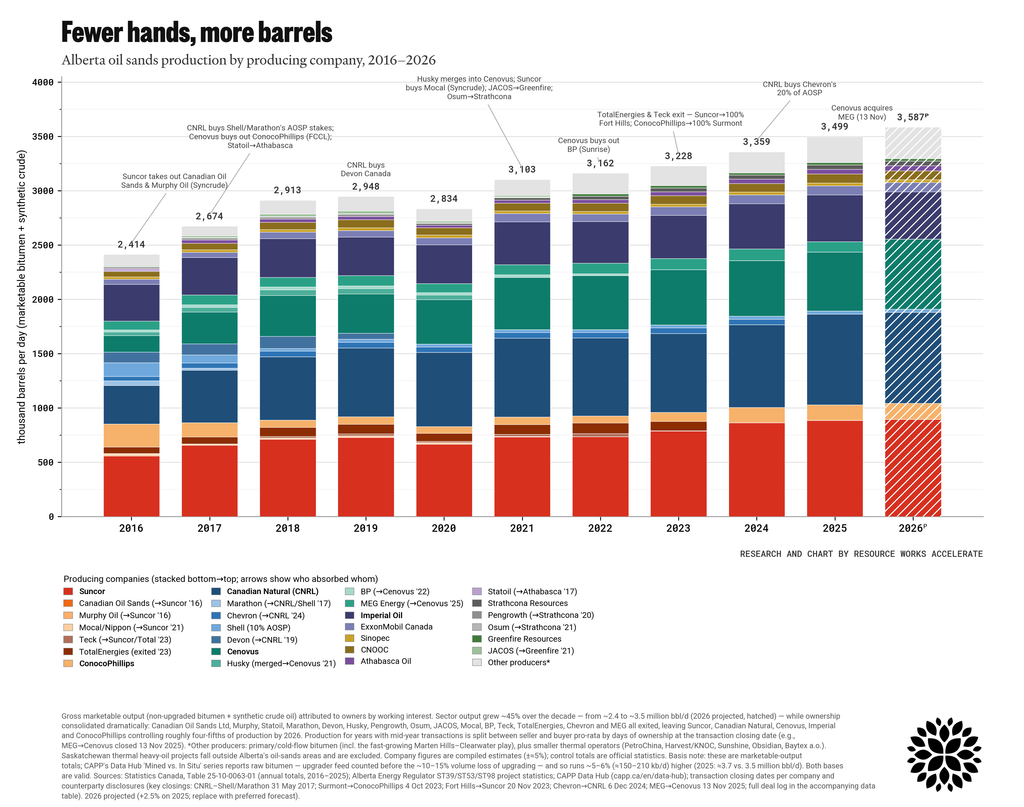
A decade of dealmaking shifted much of the oil-sands operating base from global majors to Canadian-headquartered operators.
And then comes the next cheque
This is where the story gets interesting. On August 6, Canadian Natural said it would not proceed with its mid- and long-term oil-sands expansions until the July agreement among Ottawa, Alberta and the Oil Sands Alliance is converted into binding definitive agreements. The projects include a roughly C$650-million, 30,000-barrel-a-day Jackfish expansion, a roughly C$2.5-billion, 70,000-barrel-a-day Pike 2 project and the longer-term 150,000-barrel-a-day Jackpine mine expansion. Engineering work had been expected to advance. Instead, one of the strongest operators in the sector is waiting.14
A day earlier, Suncor chief executive Rich Kruger said his company had not accelerated beyond the growth plan it laid out in March. Suncor still expects to add roughly 100,000 barrels a day by 2028 and retains the ability to move faster. But Kruger said the effect of the July memorandum on Suncor’s plans remains to be determined because the document still has to be turned into definitive agreements and legislation.15
Enbridge has arrived at the same issue from the transportation side. It is proceeding with the first phase of its Mainline optimization, which is supported by long-term take-or-pay commitments. But it has postponed the 250,000-barrel-a-day second phase amid insufficient producer commitments to major output growth. Colin Gruending, the company’s liquids-pipelines president, said Enbridge does not expect producers to make the binding commitments needed for pipeline FIDs until there is greater policy and regulatory certainty. The contrast is unusually clean: the same company is putting C$4 billion to work on Sunrise in B.C. natural gas while holding back the next major Mainline oil expansion because the producer commitments are not yet there.3
That sequence matters because one company’s caution becomes another company’s missing customer. Producers cannot justify new export pipe without confidence in additional production. Pipeline companies cannot finance additional egress without producers prepared to sign for the capacity. The proposed million-barrel-a-day West Coast line therefore cannot be separated cleanly from the investment decisions at the oil-sands plants that would supply future barrels.
November 15: when the verbs have to change
There is a small but consequential phrase in the July 2 agreement: “Definitive Agreements.” The memorandum among Canada, Alberta and the Oil Sands Alliance is deliberately a bridge document, intended to guide those future binding agreements, targeted for signature on or before November 15. It states that all commitments are conditional on those agreements being signed. It then says explicitly that the memorandum itself creates no binding legal agreement and has no legal effect.16
The package tries to join several difficult pieces into one investable whole: industrial carbon pricing, financial and regulatory support for the Pathways carbon-capture system, faster project approvals, higher oil-sands production and new export capacity to the Pacific. That interdependence is not just a political narrative. It is a financing problem. A producer considering a project that will operate through multiple governments needs a credible view of carbon costs, capture obligations, permitting timelines, fiscal support and market access. A pipeline developer needs committed barrels. Governments, in turn, want emissions reductions and Indigenous participation to advance alongside production growth.
November 15 is therefore not an oil-sands FID deadline. Nobody sensible should expect Jackfish, Pike 2, Jackpine or a West Coast pipeline to be sanctioned the morning after governments sign something. It is better understood as the first serious capital-allocation credibility test of the policy reset. If the definitive agreements establish durable economics and workable regulatory terms, the industry will have considerably more information with which to decide whether the second boom moves from engineering to construction. If the date slips, or the agreements leave key economics unresolved, the option value remains – but so does the wait.
Then someone else said it out loud
Just as the half-year earnings season was drawing to a close, I had one of those useful moments when a journalist begins to distrust his own pattern recognition. I had spent enough time with earnings calls to wonder whether I was finding a pattern because I wanted one to be there. Then a report I had somehow missed when it appeared June 30 was drawn to my attention: Unlocking an Energy Superpower, by Arash Golshan and Tim Harper at the Public Policy Forum.17
They describe the Western Canadian Sedimentary Basin and the Montney as ‘nothing short of a geological colossus’ – a resource base large enough, they argue, to meet Canadian needs for more than a century while supplying allies. More interesting to me was the prescription: formally deem the Montney and broader WCSB ‘national strategic assets,’ while respecting provincial ownership, and back that designation with a natural-gas and LNG strategy with clear development and investment targets.17
I think they are onto something. Formal recognition is not a magic wand. It does not replace price, contracts, permitting, infrastructure or Indigenous partnership. But capital does notice whether a country behaves as though an asset is strategically important or merely tolerates it from one cabinet meeting to the next. A national designation would not by itself unleash capital, but it could help create the durable signal around which capital gets organized. That is the report’s point, and the quarter’s results suggest the companies are already capable of doing their part.17
That may be the other lesson in this stack of reports. Western Canada is not short of executive competence. The companies examined here have shown an almost unnerving ability to adapt: store gas when AECO collapses, reach premium markets, consolidate assets, cut unit costs, squeeze more production from existing plants and wait when the policy economics do not pencil. They have learned how to operate through adverse conditions. What Canada may be short of is something more basic: an understanding of how rare the assets themselves are.
There is a public-understanding point here that goes beyond reserves and capital budgets: trust. The industry regularly asks Canadians to believe that innovation will make resource development faster, safer, cheaper and cleaner. The reasonable response is to ask for evidence with hard edges. This earnings cycle supplied some. Ovintiv’s wet-sand pad is one. Canadian Natural is operating a commercial-scale solvent-SAGD pad at Kirby North and testing related approaches at Primrose and Kirby South, with the stated objective of increasing bitumen recovery while lowering steam-to-oil ratios and greenhouse-gas emissions. Cenovus has sanctioned its first commercial diluent-solvent-aided process project; fabrication and earthworks were underway in Q2 and it expects 5,000 to 10,000 barrels a day of additional production by 2028. Suncor now moves all ore at its Base Plant with autonomous haulage, using a fleet approaching 120 ultra-class trucks to improve safety, reliability and operating efficiency. And Tourmaline reported that the first 25 NEBC Montney wells to reach 90-day benchmarks in the first half were performing 28 per cent above the prior five-year average while second-quarter operating costs fell 10 per cent year over year.4,8,10-12
There is an important caution. Those five examples are not all the same kind of proof. An autonomous fleet operating every day is different from a solvent pilot, and a lower emissions intensity does not necessarily mean lower absolute emissions if production is rising. Some promising technologies will fail to scale. That is exactly why the trust standard should be high: measured field performance, transparent baselines and repeatable results – not adjectives. The innovation story is strongest when it earns belief rather than asks for it.
Gas may lead this quarter and oil may lead the next. Commodity cycles will see to that. The durable advantage is the geology, the infrastructure already in place and an operating class that has learned how to turn both into value.
As summer comes to a close, that is the question I keep coming back to. If 2026 and 2027 are not used to build decision-maker literacy and public understanding of the Montney, the Western Canadian Sedimentary Basin and the oil sands – not simply as industries to regulate, but as strategic assets of unusual scale and durability – we risk missing another window while arguing over the weather inside it.
The quarter therefore leaves two different investment cycles in view. Gas and liquids projects are moving through contracts, construction and export growth, while the next large oil-sands expansion cycle remains contingent on agreements still being negotiated. The longer-term task is broader than either cycle: building enough public and decision-maker understanding of the resource base to make informed choices when the next investment window opens.
Stewart Muir is the president and CEO of Resource Works Society.
Resource Works News
- Pembina Pipeline – Q2 2026 results – RFS IV; Cedar LNG construction; C$3B net sanctioned growth projects; Heartland; Greenlight; non-binding WCOP participation and no at-risk capital before Pembina FID. ↩︎
- TC Energy – Q2 2026 results – 51 Bcf/d demand forecast; LNG deliveries; NGTL service offerings; C$0.7B Q2 sanctions; long-term take-or-pay support. ↩︎
- Enbridge – Q2 2026 results and Sunrise Expansion Program; Reuters – Mainline Phase 2, July 31 – Sunrise construction/status plus management-call comments on producer commitments and the 250,000-bpd Phase 2 postponement. ↩︎
- Tourmaline Oil – Q2 2026 results – NEBC Montney well outperformance; Q2 operating-cost reduction; infrastructure schedule; one-year Phase 1/2 pause; low-price activity deferrals; AltaGas/REEF export agreement. ↩︎
- AltaGas – Q2 2026 results – Record 144,420 bbl/d LPG exports; C$1.8B capital budget; REEF and NEBC FIDs; hedged/tolled export volumes. ↩︎
- Keyera – Q2 2026 results – Plains NGL acquisition; KAPS consolidation; ACE terminal; record fee-based margins and contracted volumes. ↩︎
- Fortis Inc. – Q2 2026 results – C$396M Q2 net earnings; C$2.7B first-half capital; C$5.6B annual plan; July 24 B.C. OIC approving Tilbury Phase 1B, up to C$2.2B cost allowance, regulated-utility treatment for the marine jetty, Musqueam equity-partnership approvals and customer-protection mechanisms. FortisBC / B.C. sources describe the jetty’s intended LNG bunkering and export functions. ↩︎
- Ovintiv – Q2 2026 results and investor presentation – Montney production, capital program and rig/well count; higher guidance at unchanged total capital; first 100% domestic wet-sand pad in Canada; approximately 20% sand-cost savings versus imported dry sand; 2026 YTD completion pace. ↩︎
- ARC Resources – Q2 2026 results – Q2 production mix and gas price realization; Shell transaction progression. ↩︎
- Canadian Natural Resources – Q2 2026 results plus Q1 2026 interim report – Record corporate, liquids and oil-sands mining production; raised guidance; commercial-scale and pilot solvent-enhanced thermal recovery work aimed at lowering steam-to-oil ratio and GHG emissions while increasing recovery. ↩︎
- Cenovus – Q2 2026 results – 970.4 MBOE/d Q2 production; record oil sands; raised guidance; unchanged capital; correct framing of million-BOE milestone; first commercial DilSAP project under fabrication/earthworks, targeting 5–10 Mbbls/d by 2028. ↩︎
- Suncor – Q2 2026 results + Suncor autonomous-haulage operating update; Imperial Oil – Q2 2026 results – Suncor operating records and autonomous ore-haulage deployment at Base Plant; Imperial Q2 net income, upstream production and Cold Lake performance. ↩︎
- Oil-sands ownership consolidation – Canadian Natural 2017 AOSP acquisition (70% interest; about C$12.5B purchase consideration); Cenovus 2017 ConocoPhillips acquisition (about C$17.7B); Cenovus-Husky combination (2021); Suncor consolidation of Fort Hills through Teck and TotalEnergies interests (2023); Canadian Natural acquisition of Chevron’s 20% AOSP interest (completed 2024). ‘Canadian-controlled’ refers to corporate/operator control, not the nationality of every shareholder. ↩︎
- Reuters – Canadian Natural expansion decisions, Aug. 6 – Management-call confirmation that Jackfish, Pike 2 and Jackpine remain on hold pending binding agreements; project cost and capacity figures. ↩︎
- Reuters – Suncor growth posture, Aug. 5 – Rich Kruger comments on not accelerating beyond existing plan until policy framework becomes concrete. ↩︎
- Government of Canada – Oil Sands Alliance MOU – Target date of Nov. 15 for binding Definitive Agreements; commitments conditional; MOU itself non-binding and without legal effect. ↩︎
- Public Policy Forum – Arash Golshan and Tim Harper, Unlocking an Energy Superpower: How to harness Canada’s LNG and natural gas advantage, released June 30, 2026 – WCSB/Montney resource scale; more-than-100-years domestic-supply framing; recommendation to designate the Montney and broader WCSB as national strategic assets within provincial jurisdiction and back that recognition with a Natural Gas and LNG Strategy. ↩︎
Share This:




















GRETCHEN WHITMER IS AT IT AGAIN: The Michigan Governor has Threatened to Shut Down Line 5 “Within Months” – Jim Warren