


 CDN NEWS |
  US NEWS







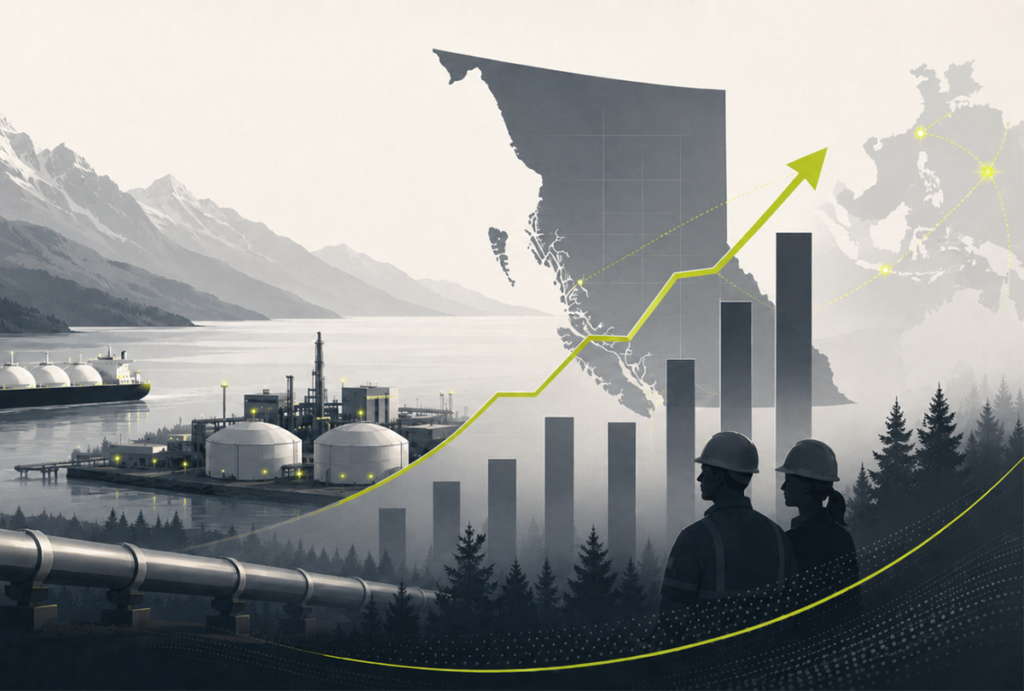
A new study by economist Philip Cross finds that a decade of pipelines, LNG and upstream investment nearly doubled B.C.’s real oil and gas output, opened new export markets and created the province’s highest-paid jobs.
By Resource Works
For years, the economic case for British Columbia’s major energy projects rested largely on forecasts.
Now we can count what actually happened.
A new Resource Works study by economist Philip Cross measures the results of the province’s completed oil and gas build-out using published Statistics Canada data. It covers LNG Canada, the Trans Mountain expansion, Coastal GasLink and the associated expansion of natural gas production in northeast B.C.
The results are striking: investment surged, real production nearly doubled, B.C. became a much larger part of Canada’s energy industry, exports shifted toward Asia and oil and gas employment grew to more than three times its level at the beginning of the century.
And those investments proved particularly valuable when Canada’s trade relationship with the United States came under pressure.
Download the Full Report (PDF) | Download the Media Backgrounder (PDF)
From forecast to record
Cross, a former chief economic analyst at Statistics Canada and now senior research fellow at Resource Works, has studied B.C.’s resource economy for more than a decade.
Until now, however, assessments of projects such as LNG Canada and the Trans Mountain expansion necessarily relied on economic models because the infrastructure had not yet been completed.
That has changed.
“We now have clear and incontrovertible evidence on the benefits of producing more oil and gas, building pipelines to transport this oil and gas to domestic users or export terminals, and constructing terminals to liquefy gas for shipment overseas,” Cross writes.
The new study examines two sides of the build-out: the enormous wave of capital investment required to construct the infrastructure, and the longer-term gains in production, exports, employment and income that followed.
Investment surged — and production followed
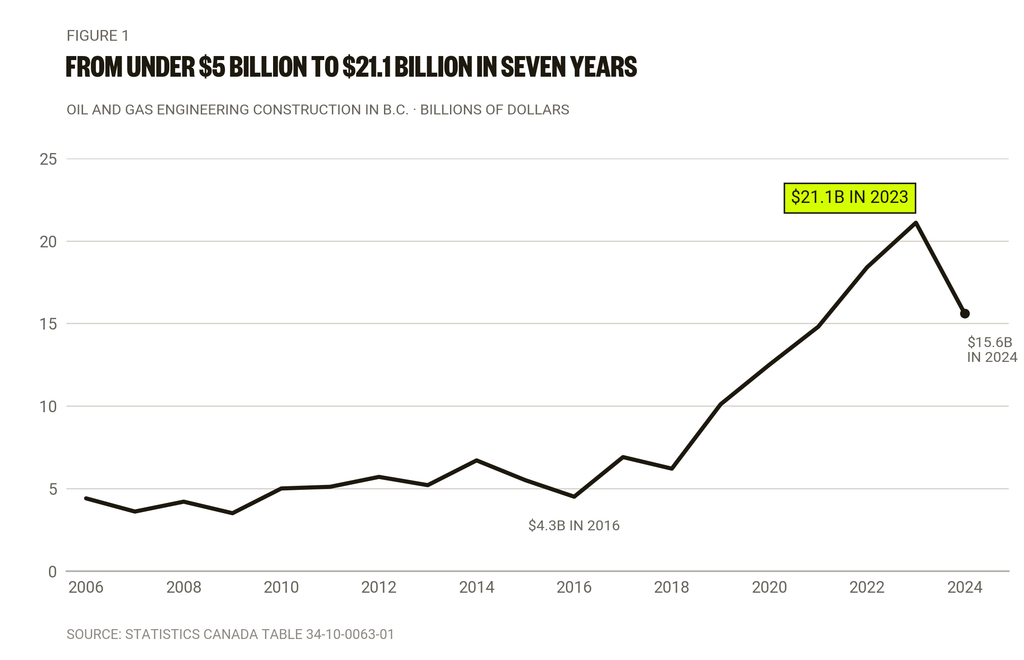
Oil and gas engineering construction in B.C. rose from less than $5 billion in 2016 to a peak of $21.1 billion in 2023.
As investment accelerated in B.C. while declining elsewhere in Canada, the province’s share of Canadian oil and gas engineering construction rose from less than 10 per cent in 2014 to about 30 per cent in 2024.
Pipeline construction changed even more dramatically. By 2024, B.C. accounted for 59 per cent of all pipeline construction in Canada, compared with less than 10 per cent in 2009.
That infrastructure translated into substantially greater output.
After adjusting for prices, B.C.’s combined oil and natural gas production increased 92.2 per cent between 2015 and 2025. The province’s share of Canadian natural gas output climbed from 25.3 per cent a decade ago to 37.5 per cent in 2026.
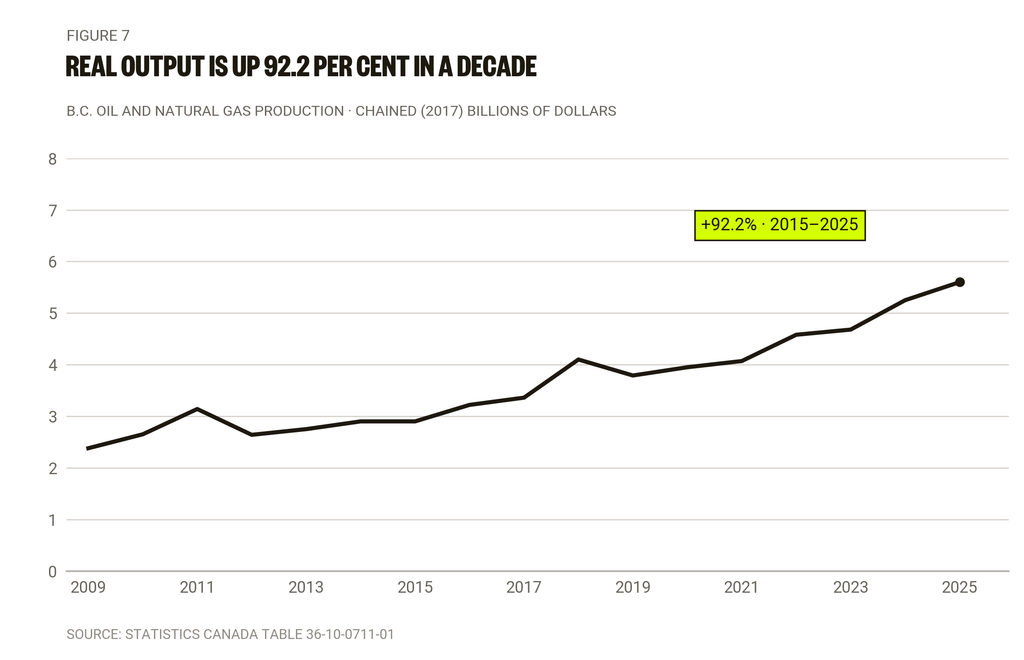
The physical build-out did what proponents said it would do: it allowed substantially more Canadian energy to reach substantially more customers.
LNG gave B.C. a second customer
For decades, geography largely confined Western Canadian energy producers to the North American market.
LNG exports and expanded Pacific oil capacity changed that.
Canadian energy exports to China more than tripled from $3.2 billion in 2023 to $9.7 billion in 2025. Over the same period, energy exports to the United States declined from $166.1 billion to $159.4 billion.
The increase in Chinese sales almost exactly offset that decline.



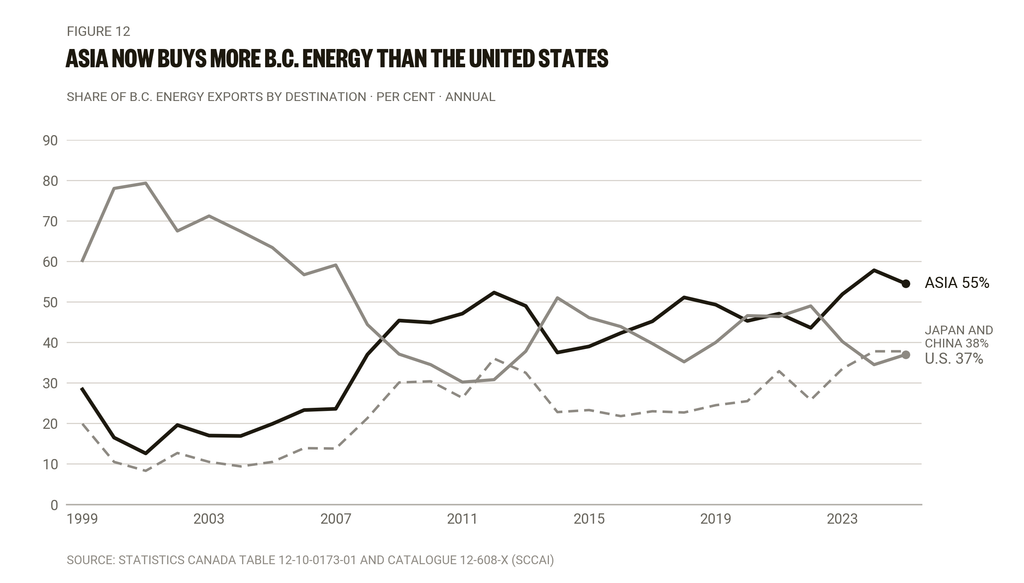
B.C.’s energy trade has consequently undergone a structural shift: Asia now buys a larger share of the province’s energy exports than the United States.
This is what trade diversification looks like in practice. It requires more than signing agreements or identifying prospective customers. Pipelines, liquefaction plants, terminals and port capacity have to exist before a producer can choose between markets.
Some of B.C.’s best-paying jobs
The expansion has also changed the industry’s workforce.
Oil and gas employment in B.C. increased from 3,604 workers in 2001 to 11,328 in April 2026. B.C.’s share of Canadian oil and gas employment more than doubled over the same period.
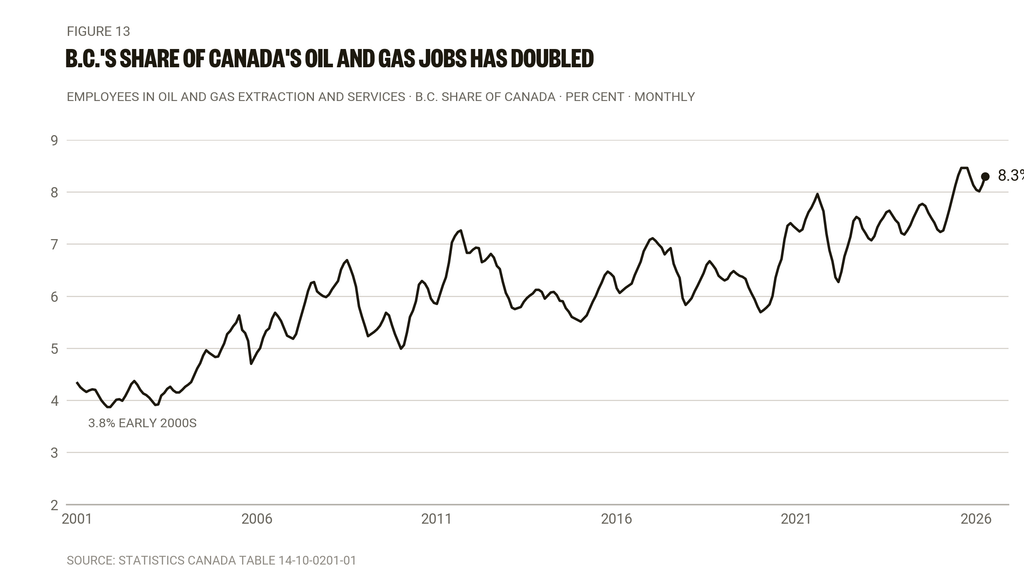
Those jobs also carry unusually high wages.
Average weekly earnings in B.C.’s oil and gas industry reached $2,755.11 in April 2026 — the highest of any industry in the province and more than twice the B.C. average of $1,356.36.
The distinction matters because the long-term economic effect of a major project does not end when construction crews leave. Production, drilling, maintenance, transportation and associated services continue generating employment and income long after the initial infrastructure has been built.
An economic shock absorber Canada built years in advance
The study also places B.C.’s energy expansion in a much larger Canadian story.
Since January 2023, output from Canada’s mining sector — including oil and gas — increased by $16.2 billion, while manufacturing output declined by $21.6 billion, with tariff-exposed industries including autos, steel and aluminum under particular pressure.
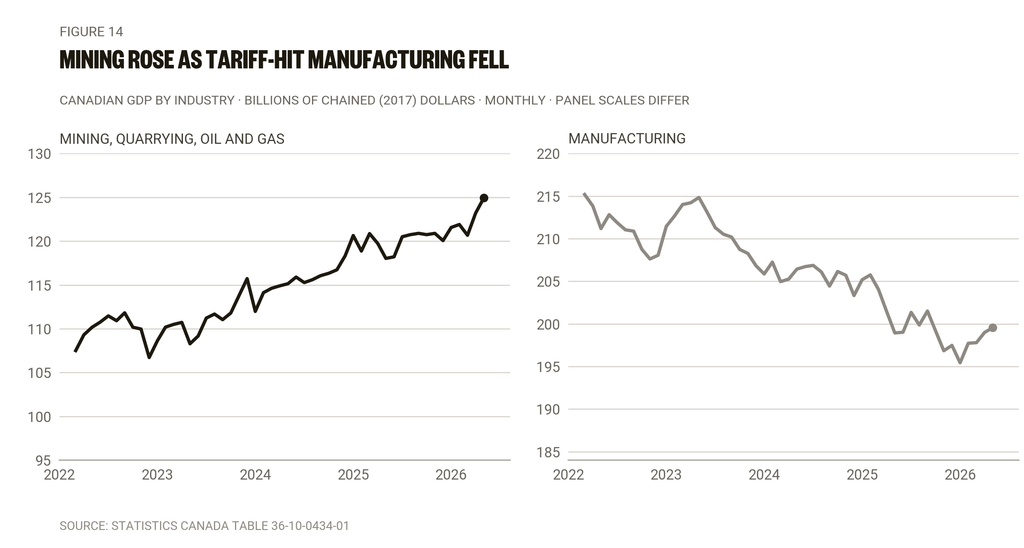
The mining expansion therefore offset much of the manufacturing decline.
Importantly, this capacity was not created in response to the trade war. The projects that made greater production and diversified exports possible had been planned, financed and constructed years earlier.
“Canada cannot predict the next economic shock, but this trade war showed the value of having more than one engine of growth,” said Stewart Muir, president and CEO of Resource Works.
“When one engine stalled, another kicked in: energy exports to Asia replaced lost U.S. sales, and the mining boom helped carry the country through the manufacturing downturn. None of that was improvised this year. It was built — in pipelines, plants and port capacity — years before it was needed.”
Diversification means building things
The lesson of the study is not that resources should replace manufacturing or other industries.
It is that a diversified economy is more resilient when it has multiple productive sectors and multiple customers.
Canada’s mining sector is one of only two major industries, along with agriculture, that sells a majority of its exports outside the United States. In 2025, that share reached 58.3 per cent, up from 44.3 per cent just two years earlier.
Further opportunities are already emerging.
Germany has signed for natural gas from the proposed Ksi Lisims LNG project in B.C., which is expected to attract $30 billion in investment. International Energy Agency executive director Fatih Birol recently described the current moment as a “once in a lifetime opportunity” for Canada to become a “real energy export superpower.”
Cross’s conclusion is that Canada should build on what the past decade has demonstrated.
The argument over whether major energy infrastructure might deliver economic benefits can increasingly be replaced by a simpler question: what does the record show?
In British Columbia, the record now includes nearly twice the real oil and gas production, a dramatically larger role in Canadian energy investment, access to new overseas customers and thousands of exceptionally well-paid jobs.
The infrastructure came first. The results followed.
Share This:






















On The Verge: Energy Sector Primed for New Wave of Growth – ATB Economics