


 CDN NEWS |
  US NEWS







EnergyNow Media
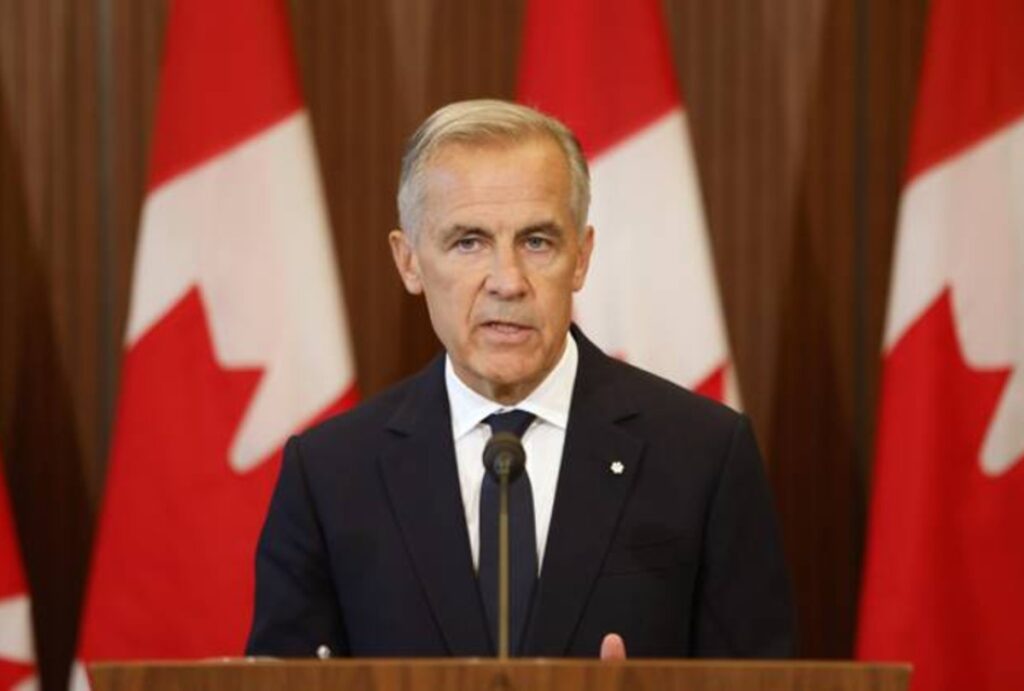
Prime Minister Mark Carney says Canada will match new U.S. tariffs dollar-for-dollar, while accelerating a broader strategy built around Canadian energy, infrastructure, domestic investment and reducing the country’s economic dependence on the United States.
OTTAWA — Prime Minister Mark Carney delivered one of his strongest statements yet on Canada’s rapidly changing relationship with the United States Saturday morning, declaring that Ottawa walked away from trade negotiations because Washington’s latest demands were simply too much for Canada to accept.
The message throughout Carney’s speech was that this is no longer merely a tariff dispute. In the government’s view, Canada must now prepare for a fundamentally different economic relationship with its largest trading partner.
“We’ve been under no illusions,” Carney said. “We recognized from the start that America has changed.”
He argued that the decades-long trend toward deeper economic integration between the two countries has ended, saying the U.S. has increasingly been prepared to use that integration as leverage.
“Our government understood before many that America would transform all of its commercial relationships, that it would put a series of tariffs on its closest allies, and use economic integration as a weapon.”
That realization, Carney said, shaped Canada’s approach to negotiations.
“Our goal has always been to get the best deal for Canadians, never a deal at any price or on any time frame.”
Canada Walks Away
The most important announcement came when Carney confirmed he had ordered Canada’s negotiators home after last-minute American demands changed the economics of the proposed agreement.
“We cannot accept what they’ve offered, and we will not give what they’ve asked.”
Carney said that despite important progress in recent weeks, the negotiations deteriorated rapidly.
“While we believed earlier this week that we were moving towards a mutually beneficial agreement, in recent days the United States proposed new terms that were uneconomic, unfair, and undermined the net benefits for Canada, and called into question the reliability of any deal.”
Then came perhaps the most memorable line of the speech:
“In short, they asked too much, and they offered too little.”
Carney said the cumulative demands also raised a much larger question about whether Washington still views Canada as an economic partner rather than simply a competitor.
“The cumulative effect of U.S. demands revealed the limits of their commitment to a true economic partnership.”
He therefore suspended negotiations Friday evening and ordered the Canadian negotiating team, led by Minister Dominic LeBlanc and chief negotiator Janice Charette, back to Ottawa.
The Prime Minister’s Office had confirmed Friday night that the United States intended to impose a 50% tariff on roughly $28 billion of Canadian goods, after a three-day postponement of the measures failed to produce a final agreement.
Carney: Canada Made Significant Offers
Carney emphasized that Canada had been prepared to make concessions.
Ottawa, he said, offered to drop remaining Canadian retaliatory tariffs on strategic sectors including steel, aluminum and autos if the United States substantially reduced its own tariffs to levels that would make Canadian exports economically viable.
Canada was also prepared to encourage provinces to return American alcohol to store shelves and make administrative adjustments related to supply management without dismantling the system itself.
But Carney drew a firm line around sovereignty.
“We were not prepared to compromise Canada’s sovereignty, or to undermine our key industries.”
He also singled out Canadian culture and the French language.
“We were not ready to compromise on our sovereignty, the protection of the French language, and our culture.”
Those issues, he said, “were never on the table.”
Canada Will Retaliate Dollar-for-Dollar
Canada’s response will now move from negotiation to retaliation.
“Canada will match Washington’s new tariffs dollar for dollar in order to protect Canadian workers, farmers, families, and businesses,” Carney announced.
The counter-tariffs will be concentrated in sectors including steel, dairy, appliances, agricultural equipment, pulp and paper and electronics, along with products already affected by other U.S. trade measures.
“This is a focused response,” Carney said, designed “to protect and defend our industries and allow them to compete with U.S. products in the Canadian market.”
The government is expected to provide the detailed tariff list in the coming days, with the new Canadian measures taking effect Tuesday, September 8, following Labour Day. Reuters also reported Saturday that Ottawa intends to introduce further measures to support Canadian industries affected by the dispute.
Carney acknowledged retaliation comes with a price.
“We take this step reluctantly,” he said, because tariffs will “raise costs and reduce choice for Canadians.”
He also acknowledged that American companies and states could become “innocent bystanders in a dispute that they did not want.”
But he argued accepting a bad agreement would ultimately be worse.
“By rejecting a bad deal, by standing up for Canada, by focusing on what we can control, we will build Canada strong for all.”
Energy at the Centre of the Canada-U.S. Relationship
For Canada’s energy sector, one of the most significant parts of Carney’s address was his direct challenge to the American argument that its merchandise trade deficit with Canada demonstrates an unfair trading relationship.
Carney said much of that deficit exists for one reason: the United States purchases enormous quantities of Canadian energy.
“The U.S. narrow merchandise trade deficit only exists because the U.S. buys so much of its energy from Canada,” he said.
“Canada fuels American growth, supplying 99% of their natural gas imports, 85% of their electricity imports, 60% of their crude oil imports.”
Then he added pointedly:
“I don’t think they want us to stop sending any of that energy.”
The latest Canada Energy Regulator data strongly support Carney’s broader point about the depth of energy integration. In 2025, Canada supplied 63.4% of U.S. crude oil imports, close to 100% of its imported natural gas and 81.3% of U.S. electricity imports. Canadian exports of crude oil, refined petroleum products, natural gas and natural gas liquids to the United States were worth approximately $157.5 billion in 2025.
That makes energy one of the most important — and difficult — parts of any attempt to fundamentally reshape the Canada-U.S. economic relationship.
“Plan A” Is Diversification
Perhaps the clearest indication of where Carney intends to take the country came when he rejected the idea that trade diversification is simply an emergency response to Washington.



“Building at home and diversifying trade abroad is not our plan B,” Carney said.
“It has been our plan A from the start.”
Carney pointed to major infrastructure projects, ports, mines and energy corridors being advanced across Canada, arguing that they will allow Canadian resources and products to reach more international customers.
He also placed energy directly within that strategy.
“We’ve also doubled the capacity of our electrical network from here to 2050, so that all Canadians can access affordable energy and sustainable energy for future generations.”
Then came another of the speech’s strongest lines:
“Because mastering our energy is mastering our destiny.”
Carney said Canada intends to realize its potential as an “energy superpower” across nuclear, LNG, renewables and low-carbon oil and gas.
For Western Canada in particular, those words could prove significant. The federal government and Alberta are already pursuing additional West Coast oil pipeline capacity designed specifically to increase access to Asian markets.
The Trans Mountain Expansion has demonstrated what additional tidewater access can accomplish. Since the expansion entered service, Canadian crude exports to countries other than the United States have more than tripled, according to the Canada Energy Regulator.
“The New U.S. Tariffs Are Designed to Hurt Us and Divide Us”
Carney portrayed the dispute as something Canada will have to endure rather than quickly resolve.
“The new U.S. tariffs are designed to hurt us and divide us,” he said.
“They’re a miscalculation.”
Why?
“Because Canadians will always take care of each other.”
Carney said Ottawa has committed approximately $25 billion to protect Canadian workers and companies affected by American tariffs, including financing for small and medium-sized businesses, productivity investments, supply-chain resilience and support for larger employers.
The government will also help affected sectors “retool and pivot” toward international markets.
“And we are being our own best customer,” Carney said.
What’s Next for Canada? A Canadian Perspective
The collapse of negotiations does not mean Canada and the United States are economically separating. The scale of the relationship — particularly in energy — makes that virtually impossible in the foreseeable future.
But it does suggest that Canada now needs to treat economic diversification as national infrastructure rather than simply trade policy.
Build More Routes to More Customers
For the energy industry, the lesson is particularly clear.
Canada remains heavily dependent on the United States as a customer. In 2025, the U.S. still accounted for 90.8% of Canadian hydrocarbon exports.
That means pipelines, LNG export terminals, ports, electricity interties and other trade infrastructure are increasingly about national economic security.
Trans Mountain has already shown that when Canadian producers have access to another market, trade patterns can change.
Additional access to the Pacific and potentially other international markets would give Canada something it has historically lacked: customer choice.
Energy Could Become Canada’s Most Important Strategic Asset
Canada should be cautious about treating oil, natural gas or electricity as retaliatory weapons. U.S. and Canadian energy systems are deeply integrated, Canadian producers depend heavily on the American market, and disrupting those flows would impose substantial costs on both countries.
But the current dispute demonstrates why Canada should increase the strategic value of its enormous resource base.
The stronger Canada becomes as an LNG exporter, oil supplier to Asia, uranium and nuclear supplier, critical-minerals producer and electricity exporter, the less vulnerable the country becomes to the decisions of any single trading partner.
Carney captured that argument succinctly: “Mastering our energy is mastering our destiny.”
The Next Test Is Execution
Announcements about pipelines, mines, LNG facilities, ports, data centres, power generation and transmission lines are one thing.
Building them is another.
If Canada genuinely intends to become less dependent on the United States, governments will have to demonstrate that major projects can move through regulatory review, financing, Indigenous consultation and construction much faster than they traditionally have.
Canada’s own energy regulator cautions that meaningful crude oil diversification remains constrained by infrastructure because most existing western Canadian pipeline capacity remains oriented toward the United States.
The trade dispute therefore puts additional pressure on Ottawa and the provinces to turn the phrase “energy superpower” into actual infrastructure.
Canada Will Still Eventually Need a U.S. Deal
Diversification does not eliminate geography.
The United States will almost certainly remain Canada’s largest trading partner and overwhelmingly its most important energy customer for years to come.
That means negotiations will eventually have to resume.
But after this week’s breakdown, the next Canadian negotiating position may be different. Ottawa appears increasingly prepared to absorb short-term economic pain rather than accept an agreement it considers unreliable or restrictive.
Carney’s message Saturday was that Canada should use the time between negotiations to strengthen its bargaining position — by building domestic infrastructure, expanding international markets and reducing the country’s vulnerability to future U.S. trade actions.
And his final remarks made clear that he views this transformation as much larger than the current tariff fight.
“Canada is becoming stronger and less dependent on America,” Carney said.
“We are already giving ourselves more than they can take away, and we are just getting started.”
He concluded with another unmistakable message about the direction he believes Canada must take:
“We set our own course.” “We make our own weather.”
Share This:






















On The Verge: Energy Sector Primed for New Wave of Growth – ATB Economics