


 CDN NEWS |
  US NEWS







By EnergyNow Editorial Staff
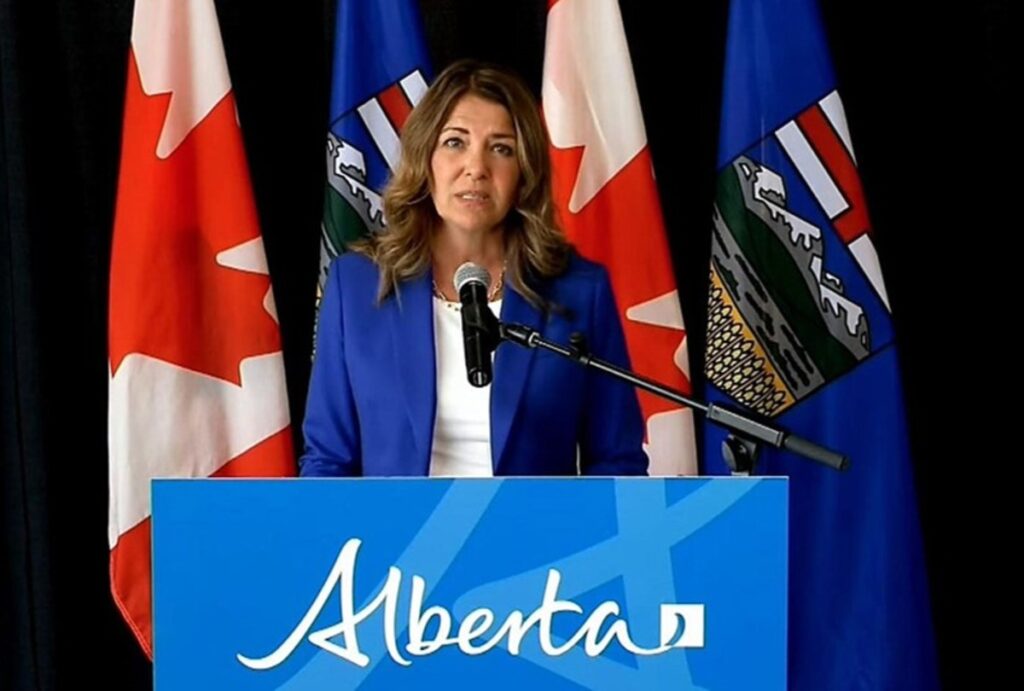
Alberta Premier Danielle Smith has delivered an important warning to Canadians calling for oil and natural gas to be used as weapons in the escalating trade dispute with the United States: energy retaliation may sound powerful, but it could inflict as much—or more—damage on Canada as it does on the Americans.
Speaking in Grande Prairie on August 26, Smith firmly rejected proposals to impose export taxes on Alberta energy or deliberately curtail shipments to the United States.
“Although I understand the need to respond strongly to these tariffs, I cannot think of a more disastrous policy decision than cutting off or taxing Alberta’s oil to the United States,” Smith said. “Doing so would absolutely devastate the Canadian economy.”
Her argument is based on a reality frequently overlooked in political discussions: the Canadian and American energy markets are not separate systems. They form a deeply integrated network of pipelines, refineries, storage terminals and distribution infrastructure built over decades.
Canada exports approximately four million barrels of crude oil per day to the United States, making it America’s largest foreign supplier. But portions of the same continental system also carry western Canadian oil through the United States and back into Ontario.
Alberta Oil Reaches Ontario Through the United States
The route taken by Alberta oil demonstrates why energy retaliation would be far more complicated than simply “turning off the taps” to American consumers.
The Enbridge Mainline originates in Edmonton and extends across the Prairies before crossing the Canada-U.S. border near Gretna, Manitoba. It then joins Enbridge’s Lakehead System in the United States.
Oil moves through Minnesota and Wisconsin before some of it returns to Canada through Line 5, which transports approximately 540,000 barrels per day of crude oil and natural gas liquids from Superior, Wisconsin, through Michigan and into Sarnia, Ontario.
From Sarnia, some crude is processed by Ontario refineries, while additional volumes can move east through Enbridge Line 9 to Montreal. According to the Canada Energy Regulator, the Mainline and Line 9 supply western Canadian crude to refineries in Ontario and Quebec and help provide much of the refined fuel needed in those markets. Canada Energy Regulator
In other words, some Alberta oil reaches eastern Canada only after travelling through American territory.
An escalating energy trade war could therefore expose Canada to American countermeasures affecting pipeline transit, U.S.-origin crude, natural gas, condensate and refined fuels. That is why Smith warned that Ottawa cannot assume an export tax would hurt only American refiners.
“If Canada were to put, let’s say, a 50 per cent export tariff on the four million barrels of oil that we export daily to the United States, the United States would immediately respond,” she said.
The exact nature and scale of any American retaliation cannot be known in advance. However, the exposure is real. In 2025, Canada imported approximately 506,000 barrels per day of crude oil, with 75.6 per cent coming from the United States. Ontario imported about 87,000 barrels per day, 99.7 per cent of which originated in the U.S. Quebec imported approximately 126,000 barrels per day, entirely from the United States. Canada Energy Regulator
Those figures make one point unmistakable: Canada may be a major oil-producing country, but not every Canadian refinery or region has direct access to Canadian crude.
Refined Fuels Could Face Reciprocal Tariffs
The vulnerability extends beyond crude oil.
Canada imports substantial volumes of gasoline, diesel, jet fuel, heating oil and other refined petroleum products from the United States. In 2023, U.S. suppliers provided approximately 333,000 barrels per day, representing 78 per cent of Canada’s imported refined petroleum products.
Quebec imported approximately 99,000 barrels per day of refined products that year, while Ontario imported about 33,000 barrels per day. Most of the products imported into those provinces were transportation fuels, including gasoline, diesel and jet fuel. Canada Energy Regulator
Canada produces more refined petroleum products overall than it consumes, but that national surplus can be misleading. Refining capacity and fuel demand are not located in the same places, and Canada lacks sufficient east-west transportation infrastructure to move every required product quickly between regions.
If Ottawa taxed Canadian crude exports, the United States could respond by placing reciprocal tariffs on American crude, gasoline, diesel, jet fuel, natural gas and condensate entering Canada. American restrictions on pipeline transit could create another layer of risk.
The result could be higher fuel prices, tighter regional supplies and greater costs for trucking, agriculture, aviation, manufacturing and home heating—particularly in Ontario and Quebec.
Smith put the danger in stark terms:
“Unlike Canada, the United States has strategic oil reserves that Canada does not,” she said. “Without strategic oil reserves, Canada has no way to supply Ontario and Quebec with the oil, natural gas and fuels that they would need in a timely fashion.”
Canada does maintain commercial inventories and emergency-management tools, but it does not have a U.S.-style national Strategic Petroleum Reserve capable of releasing large government-controlled volumes during a major disruption.
Jason Kenney: Keep the Leverage on the Table
Former Alberta premier Jason Kenney takes a somewhat different view.



As reported in an August 25 EnergyNow article, Kenney said Canada should not publicly surrender its energy leverage before negotiations are complete.
“You don’t deal with an aggressive attack on your economy by starting with listing all the things you will not do in reprisal, by limiting your options, by weakening your position,” Kenney said. “That makes no sense.”
Kenney acknowledged that cutting off exports is not feasible, partly because central Canada depends on oil transported through the United States. Nevertheless, he argued that carefully targeted export taxes could remain a potential response if Washington escalates the conflict.
He said such measures could affect “Republicans who drive F-150s and lay fertilizer on their farm fields,” adding: “They should be mindful that if they really want to escalate, it will not end well for the American economy two months before mid-term elections.”
Kenney’s core argument is about negotiating leverage rather than immediately stopping energy shipments.
“Let it be known we’re prepared to defend ourselves,” he said.
Smith’s position is that even threatening such action could undermine investment, frighten customers and encourage the United States to accelerate its search for alternative supplies.
Both arguments recognize that Canadian energy gives Ottawa influence. The disagreement concerns whether that influence is strengthened by threatening to use it—or preserved by remaining a dependable supplier while retaliating in less self-destructive ways.
The Risks of Taxing Canadian Oil
An export tariff on Canadian crude would create several major risks.
First, it could reduce the price received by Canadian producers. Depending on contracts, market conditions and the ability of refiners to substitute other crude, part of the tariff’s cost could fall back on producers through a wider discount on Canadian oil.
Second, reduced producer revenues would mean lower royalties and corporate tax receipts for Canadian governments. Alberta’s oil exports to the United States were valued at close to $111 billion in 2025, according to provincial statistics cited by The Canadian Press.
Third, a tariff could weaken production, investment and employment throughout the Canadian energy supply chain. The effects would reach beyond producing companies to drilling contractors, equipment manufacturers, engineering firms, construction companies, transportation providers and communities dependent on energy activity.
Fourth, it could encourage U.S. refiners to invest in alternatives. Many Midwest and Gulf Coast refineries are specially configured to process heavy Canadian crude, making immediate replacement difficult and expensive. Venezuela and other heavy-oil producers could not instantly replace Alberta’s volumes. Over time, however, a prolonged disruption could motivate American companies and governments to develop new supply arrangements and modify infrastructure.
Canada would then risk damaging its reputation as the United States’ most secure and reliable energy supplier.
Finally, retaliation could expose weaknesses in Canada’s own energy security. The country has spent decades debating pipelines capable of carrying more western Canadian oil directly to eastern refineries. The result is a system in which Canadian energy sometimes must leave the country before returning to Canadian consumers.
Build Canadian Strength Instead
Smith was unequivocal that the United States’ tariff actions represent a betrayal of the historic relationship between the two countries.
“There is no excuse for their behaviour right now,” she said. “But I know this as well: the relationship between the American and Canadian people is far stronger and more resilient than any one president or administration.”
Her preferred response is to support affected Canadian workers and businesses, avoid uncontrolled escalation and rapidly reduce Canada’s dependence on a single export market.
That means increasing shipments through the Trans Mountain system, pursuing new oil and natural gas export infrastructure, expanding LNG capacity and creating a direct, reliable energy corridor from Western Canada to Ontario and Quebec.
Smith confirmed that she intends to discuss that objective with Prime Minister Mark Carney.
“I’ll be talking with Prime Minister Mark Carney about other ways that we can export more Alberta oil and natural gas to Eastern Canada,” she said.
That may be the most important lesson in this dispute.
Canada should certainly use its energy strength to improve its negotiating position. But deliberately damaging its largest export industry—before adequate alternative markets and domestic infrastructure exist—would be an extraordinarily dangerous gamble.
The best response is not to make Canadian energy less reliable. It is to make Canada less vulnerable – more pipelines within Canada, more access to tidewater, more LNG terminals, more refining and storage options, and more customers around the world.
Until those alternatives are in place, tariffs on Canadian oil and gas would not be a surgical strike against Washington. They would be a broad economic weapon with a serious risk of exploding on both sides of the border.
Share This:





















REMAKING THE LANDSCAPE FOR INVESTORS – The First-Ever Canada Investment Summit – Maureen McCall