


 CDN NEWS |
  US NEWS







By Yogi Schulz
The incredible demand for AI-related computing capacity is driving rapid growth in AI data centres worldwide. The Alberta government is keen to ensure that some of that investment occurs in Alberta and has set a goal of attracting $100 billion in investment by 2030.
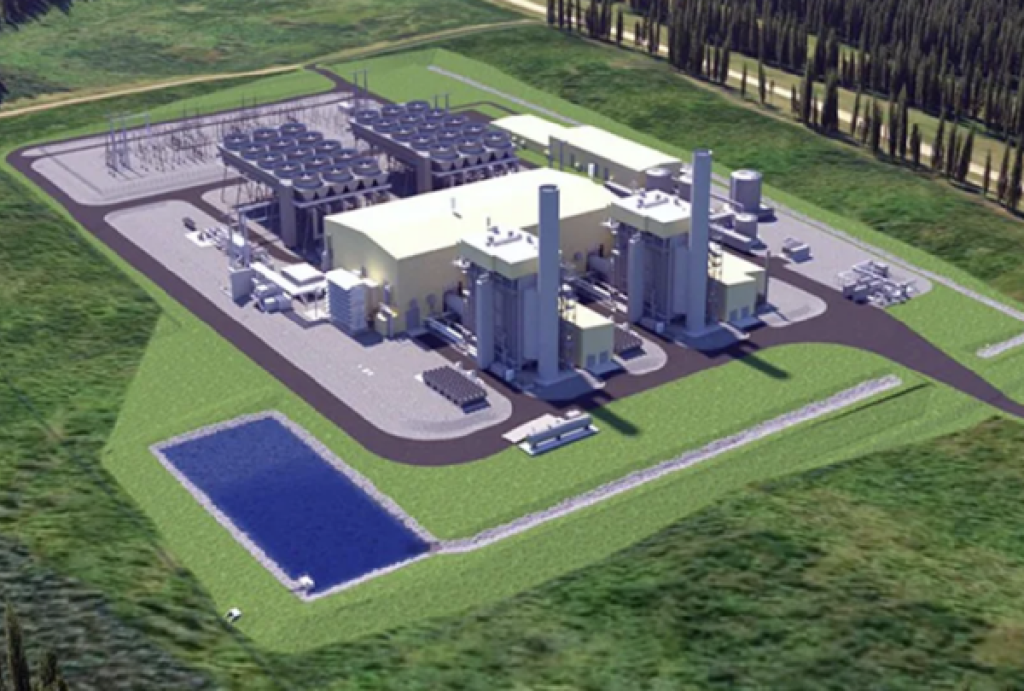
Recently, Pembina Pipeline Corp. and its partners announced plans to build the $4.6 billion Greenlight Electricity Centre, a 932-megawatt natural gas-fired plant in Sturgeon County, north of Edmonton. It’s designed to supply dedicated power to Meta’s massive AI data centre that will cost at least $40 billion.
Alberta offers many advantages for AI data centre developers. The advantages include:
- A pro-business culture.
- Abundant natural gas with a significant pipeline distribution system.
- Streamlined regulatory approvals, using a well-defined process.
- Competitive electricity costs.
- A government focused on attracting investment.
- A cooler climate that reduces cooling costs by 20 to 30% compared to Texas.
- An extensive fibre optic network.
- A skilled workforce for construction and operation.
- Excellent airline connections to many parts of the world.
- Lots of available office space at low occupancy rates.
- A time zone that works well for the US.
We can expect many more AI data centre announcements in Alberta based on recent load applications totaling more than 20 GW, as shown in the chart below. That compares with Alberta’s peak load of 12 GW. Assuming most applications come to fruition, data centre electricity consumption is expected to more than double Alberta’s electricity grid load.
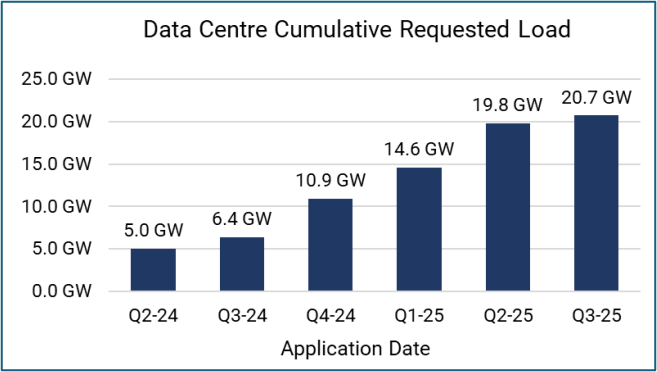
Source: AESO Update on Data Centres, AESO
Click here to view the Connection Project List Dashboard, which displays all applications on a geographic map.
How will the proposed AI data centres generate the electricity they expect to consume?
AI data centres are expected to generate their own electricity under Alberta’s Bring Your Own Generation (BYOG) permitting framework and rely on the provincial electricity distribution grid only in emergencies. AI data centres can generate electricity using a variety of technologies. Project proponents will weigh speed of construction against operating cost.
Here are the major electricity generation alternatives.
Natural gas turbines
Most AI data centres proposed for Alberta will prefer to use natural gas turbines to generate electricity to take advantage of:
- Cheap and abundant natural gas. By comparison, the availability of natural gas varies from province to province and state to state.
- Significant natural gas reserves to support future demand. This abundance will tend to limit future price increases.
- The significant natural gas pipeline distribution system. This infrastructure reduces the cost of new pipelines to connect data centres.
AI data centres require a highly available, continuous power supply. Natural gas turbines have a long history of reliability that can achieve this requirement.
The constraint on using natural gas turbines is that the major manufacturers, GE Vernova, Siemens Energy, and Mitsubishi Heavy Industries, are sold out until the end of 2029 and are booking slots for 2030.
The chart below forecasts Canadian natural gas production. It shows that sufficient reserves exist to at least double production for the foreseeable future.
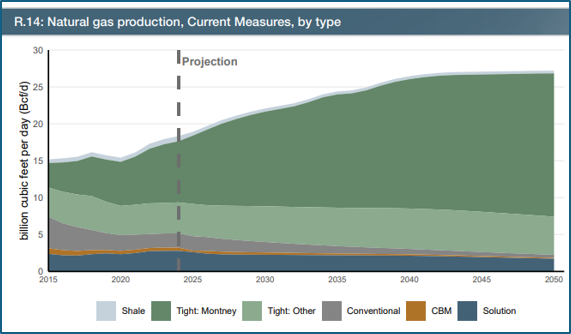
Source: Canada’s Energy Future 2026, P. 61
Solar panels
Some proposed AI data centres will rely heavily on solar panels if they can’t acquire natural gas turbines quickly enough.



The advantage of solar panels is that:
- The sun’s energy is free, unlike the fluctuating cost of natural gas.
- There are no material constraints on the availability of solar panels from manufacturers.
The constraint on using solar panels is that AI data centre projects will require:
- More land for the solar panels than for natural gas turbines.
- A significant investment in supplemental industrial batteries to compensate for intermittent solar panel electricity generation to achieve a highly available, continuous power supply.
The map below illustrates that the southeast corner of Alberta offers the most sunlight for solar electricity generation.
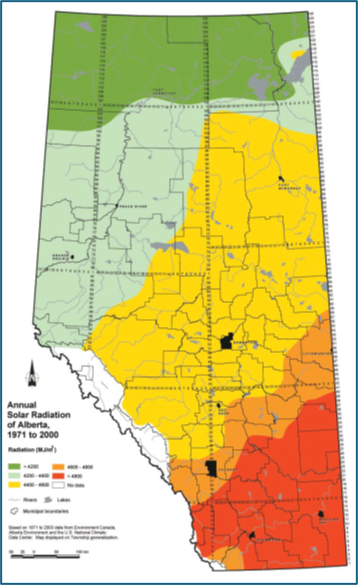
Source: Annual Solar Radiation of Alberta, 1971 to 2000, Agricultural Land Resource Atlas of Alberta
Wind turbines
Some proposed AI data centres will rely heavily on wind turbines if they can’t acquire natural gas turbines quickly enough.
The advantage of wind turbines is that:
- The wind’s energy is free, unlike the fluctuating cost of natural gas.
- There are no constraints on the availability of wind turbines from manufacturers.
- Wind turbines still allow for other concurrent uses of the land, unlike solar panels.
The constraint on using wind turbines is that AI data centre projects will require:
- More land for wind turbines than for natural gas turbines, but less than for solar panels.
- A significant investment in supplemental industrial batteries to compensate for intermittent wind turbine electricity generation to achieve a highly available, continuous power supply.
The map below illustrates that the southern part of Alberta offers the most wind for wind turbine electricity generation.
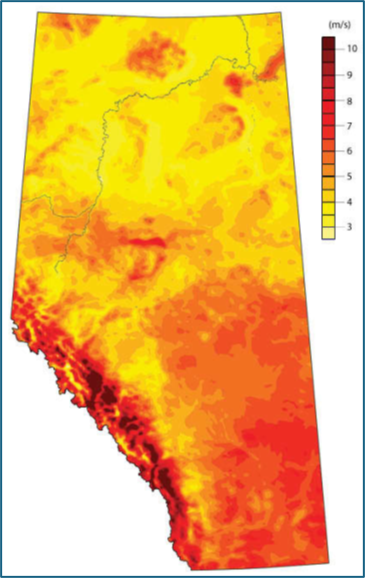
Source: Landowners’ Guide to Wind Energy in Alberta
Diesel-powered standby generation
Most AI data centres will install significant diesel-powered standby generation to ensure absolute power continuity.
Because Alberta operates multiple diesel-producing refineries, this cost is not material to AI data centres.
All of the above
Some AI data centres will likely rely on multiple electricity generation technologies, as each has advantages and disadvantages.
This strategy will appeal to some AI data centre proponents because it:
- Mitigates certain supply chain issues.
- Provides redundancy to ensure high reliability.
Speculative electricity sources
More speculatively, later AI data centres may also tap the following electricity sources:
- A major geothermal power project. The technology is advancing, and Alberta has regions where the temperature of the earth’s crust is high enough and sufficiently close to the surface to suggest a project could be economically viable. At present, geothermal energy is not as economically viable as solar or wind.
- A higher capacity interconnect with BC may provide more access to hydroelectricity.
- A nuclear power project. Small Modular Reactors (SMRs) are advanced, compact nuclear reactors that produce up to 300 MW of power. Alberta is part of an inter-provincial MOU with Ontario, Saskatchewan, and New Brunswick to collaborate on SMR development.
The appeal of all of these electricity sources is that they provide consistent 24/7 baseload power that complements intermittent renewable energy sources.
Conclusion
AI data centre developers will work hard to avoid delays in acquiring electricity-generation equipment that could affect their overall project completion date. They will employ the following strategies:
- Break up their data centre construction plan into multiple phases so that at least some computing capacity will be available as early as possible.
- Expect to employ multiple electricity generation technologies.
- Buy electricity from other generation stations until all of their electricity generation equipment is installed.
Share This:






















On The Verge: Energy Sector Primed for New Wave of Growth – ATB Economics