


 CDN NEWS |
  US NEWS







By EnergyNow Editorial Staff
Newfoundland and Labrador’s offshore petroleum industry is entering one of the most consequential periods in its history. After several years dominated by project delays, production interruptions, asset-life-extension work and weak exploration activity, the province is experiencing stronger oil output, the imminent startup of West White Rose and renewed momentum behind the proposed Bay du Nord development.
The industry nevertheless remains at a crossroads. Its established producing fields are maturing, operating in the North Atlantic remains expensive and technically demanding, and new developments must satisfy increasingly stringent economic, environmental and regulatory requirements. At the same time, Newfoundland and Labrador possesses decades of offshore experience, an established supply chain, valuable infrastructure and promising undeveloped resources.
The outcome of decisions now being made could determine whether the offshore industry gradually contracts or begins another multi-decade cycle of investment.
From Hibernia to a Major Offshore-Producing Region
The modern industry began taking shape after the discovery of Hibernia in 1979 and the signing of the Atlantic Accord by the federal and provincial governments in 1985. The Accord established the joint-management system for offshore resources and provided Newfoundland and Labrador with access to the economic benefits flowing from their development.
Hibernia produced its first oil in November 1997, transforming the province from a prospective petroleum region into an offshore producer. Terra Nova, White Rose and Hebron followed, creating an industry that has supported thousands of jobs, generated substantial provincial royalties and helped establish St. John’s as an internationally recognized centre for harsh-environment offshore expertise.
There are currently four producing offshore facilities:
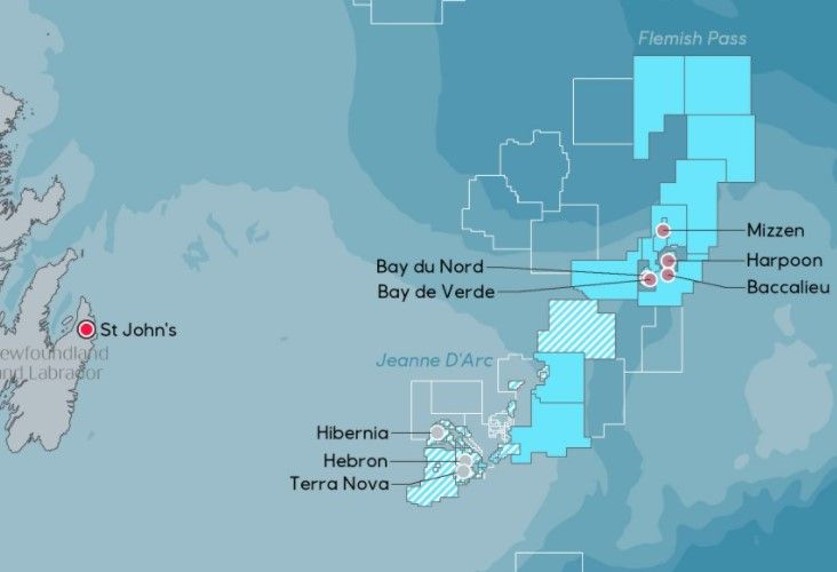
Hibernia, operated by Hibernia Management and Development Company, produces through a massive concrete gravity-based structure approximately 300 kilometres southeast of St. John’s.
Terra Nova, operated by Suncor Energy, uses a floating production, storage and offloading vessel, or FPSO, approximately 350 kilometres southeast of the provincial capital.
White Rose, operated by Cenovus Energy, produces through subsea wells connected to the SeaRose FPSO approximately 350 kilometres east of St. John’s.
Hebron, operated by ExxonMobil Canada, uses another gravity-based structure in the Jeanne d’Arc Basin approximately 350 kilometres east-southeast of St. John’s.
As of March 31, 2025, the Newfoundland and Labrador offshore had produced approximately 2.374 billion barrels of oil. At that time, 1,975 people held offshore-based positions supporting Hibernia, Hebron, Terra Nova, White Rose and the construction of West White Rose.
Although the sector is commonly called the oil and gas industry, commercial activity has been overwhelmingly centred on oil. Significant natural gas resources are known or considered possible in offshore basins, but exploration has historically focused on oil, and the province’s offshore remains comparatively underexplored for natural gas. Developing gas would require a commercially viable market and major infrastructure for transportation or processing.
An Industry of National and Provincial Importance
Offshore petroleum remains one of Newfoundland and Labrador’s most important economic sectors. Crude oil exports were valued at approximately $7.4 billion in 2025 and represented 52.8 per cent of the province’s total international exports. Offshore production increased by 14.6 per cent during the year, largely because of higher Hebron production and the return of the SeaRose FPSO following its refit.
The industry also generates economic activity well beyond the offshore installations themselves. Engineering companies, fabricators, marine transportation providers, aviation operators, environmental consultants, training organizations and equipment suppliers all participate in the offshore economy.
Producing projects recorded approximately $2.3 billion in expenditures during 2024, with about 53 per cent occurring in Newfoundland and Labrador. The West White Rose construction program added considerably more activity, with Cenovus reporting approximately $1.6 billion in White Rose-related expenditures during 2024, half of which represented Newfoundland and Labrador content.
Oil revenues are also important to provincial finances. Their value, however, can vary dramatically because royalties are affected by production volumes, project costs, exchange rates and global crude prices. This makes the industry both a major source of revenue and a significant source of fiscal volatility.
West White Rose Approaches First Production
The most immediate growth opportunity is West White Rose, an extension of the existing White Rose field.
The project uses a fixed concrete gravity structure containing drilling and wellhead facilities. Production will flow from the new platform to the SeaRose FPSO, allowing Cenovus and its partners to develop additional resources west of the original field while using much of the existing White Rose production system.
Construction was suspended during the pandemic but restarted in 2022. The platform has since been installed offshore, the project is considered complete, and drilling operations are underway. Cenovus reported in May 2026 that first oil was expected during the third quarter of 2026.
West White Rose is important for more than its initial production. It extends the economic life of the White Rose complex, supports continued use of the SeaRose FPSO and preserves operating, maintenance and supply-chain employment. Once infrastructure is in place, additional nearby resources may also become more economical to develop through future wells or subsea tiebacks.
The project illustrates one of the industry’s strongest near-term opportunities: extracting more value from discoveries located near existing facilities. Smaller pools that could not justify a standalone production system may become commercially viable when connected to Hibernia, Hebron, Terra Nova or White Rose infrastructure.
Bay du Nord Could Open a New Offshore Basin
The largest potential development is Bay du Nord, located in the Flemish Pass Basin approximately 500 kilometres offshore.
Unlike the producing projects in the shallower Jeanne d’Arc Basin, Bay du Nord would be Newfoundland and Labrador’s first deepwater oil development. The proposed initial phase would develop the Bay du Nord and Cambriol discoveries through subsea wells connected to an FPSO. Future discoveries such as Cappahayden, Harpoon and Baccalieu could potentially be tied into the production system later.
The initial phase is estimated to contain more than 400 million barrels of recoverable oil and require approximately $14 billion in investment. Equinor is targeting a final investment decision in early 2027 and first oil in 2031, subject to regulatory approval, market conditions and the company’s internal investment requirements.
The project advanced significantly in March 2026 when the provincial government announced agreements covering royalties, life-of-field benefits and an option for Newfoundland and Labrador to acquire an equity interest of up to 10 per cent.
The agreements include a minimum commitment to fabricate 95 per cent of qualifying subsea components in the province, more than 31 million person-hours of work over 25 years, $200 million in fabrication funding and $100 million for research and development. The province estimates that the first phase could generate up to $6.4 billion in direct government revenue.



Equinor submitted its formal development-plan application to the Canada–Newfoundland and Labrador Offshore Energy Regulator in May 2026. A 60-day public-review period began June 22 and is scheduled to continue until August 20, 2026. The regulator will use technical analysis and public feedback to recommend whether the development and benefits plans should be approved and under what conditions.
Another major change occurred in July 2026 when Equinor agreed to acquire BP’s 37.2 per cent interest, leaving Equinor as the project’s sole owner. Equinor said it may bring in new partners as development progresses. The transaction demonstrates Equinor’s continuing commitment, but BP’s departure also highlights the capital-allocation competition facing large offshore projects.
If sanctioned, Bay du Nord could establish infrastructure in an entirely new basin, encourage additional exploration and provide decades of work for the provincial supply and service sector. Without it—or another major development—the industry would become increasingly dependent on extending the lives of its existing fields.
Stronger Production Provides Near-Term Momentum
Current production has also been improving.
Newfoundland and Labrador produced 9.3 million barrels during May 2026, 17.1 per cent more than in May 2025. Hibernia recorded its strongest monthly production since June 2021, while Hebron produced close to record levels.
For the first five months of 2026, offshore production volumes were 26 per cent higher than during the comparable period in 2025. The estimated value of production increased by 59.5 per cent, producing the highest January-to-May value recorded by the province.
Higher production gives operators, governments and suppliers valuable breathing room as new projects move through development and regulatory processes. However, temporary production improvements do not eliminate the long-term reality that existing reservoirs will eventually decline.
Maintaining output will require continued drilling, reservoir optimization, satellite developments and timely investment in replacement projects.
The Major Opportunities
The most significant opportunity is the potential creation of a second offshore production region in the Flemish Pass. Bay du Nord could provide infrastructure that makes several surrounding discoveries commercially accessible, just as Hibernia helped establish the foundation for development in the Jeanne d’Arc Basin.
A second opportunity lies in maximizing existing infrastructure. Offshore platforms and FPSOs involve enormous upfront investment. Extending their operating lives and connecting nearby discoveries can produce additional barrels at substantially lower capital cost than building new standalone systems.
Newfoundland and Labrador can also strengthen its position as an offshore service centre. The province has experience in concrete gravity structures, subsea systems, marine operations, ice management, environmental monitoring, remote logistics and harsh-weather engineering. Those capabilities can be marketed internationally and adapted for offshore wind, marine construction and other ocean industries.
The expansion of the former petroleum regulator’s mandate provides another opening. Amendments to the Atlantic Accord Acts came into force on June 2, 2025, renaming the organization the Canada–Newfoundland and Labrador Offshore Energy Regulator and authorizing it to regulate offshore renewable energy as well as petroleum. This creates the possibility of shared expertise, infrastructure and supply-chain capacity between oil and gas and future offshore renewable projects.
The Challenges Facing the Industry
Despite the improving outlook, Newfoundland and Labrador remains a costly place to explore and develop petroleum.
Offshore installations must operate hundreds of kilometres from land in an environment characterized by cold water, high winds, fog, large waves, sea ice and icebergs. Deepwater development in the Flemish Pass adds further complexity. Bay du Nord would operate in water depths ranging from approximately 600 to 1,170 metres, far deeper than the province’s current producing fields.
A second challenge is attracting exploration investment. No bids were received for the two offshore land sales that closed in November 2025. The regulator subsequently began reviewing the land-tenure system and examining ways to improve competitiveness.
New calls for bids were issued in June 2026 covering 16 parcels in the Eastern and South-Eastern Newfoundland regions. The bidding packages include a new requirement for potential bidders to discuss the province’s Offshore Exploration Fund, while governments and the regulator have committed to reducing approval timelines and improving the path from discovery to production. Bids are scheduled to close on November 4, 2026.
Environmental performance and public confidence represent another continuing challenge. Offshore operations overlap with valuable fishing grounds and marine ecosystems, while spills or major accidents can have serious ecological, economic and reputational consequences.
During the 2024–25 reporting period, the regulator followed up on 19 pollution incidents, five of which involved petroleum spills. It also reviewed 194 safety-related incident reports and recorded 15 incidents resulting in a reportable injury or illness. These figures underline why safety, asset integrity and environmental oversight remain central to the industry’s future.
Climate policy creates an additional layer of uncertainty. Operators must demonstrate that new projects can remain commercially competitive as governments and customers seek lower-emission energy. Electrification, reduced flaring, more efficient production systems, carbon-management technology and digital optimization will become increasingly important.
The province must also avoid allowing project delays to weaken its workforce. Experienced offshore workers, engineers and tradespeople are mobile. Long gaps between major developments can cause skilled workers and suppliers to relocate, making future projects more expensive and difficult to execute locally.
A Critical Decade Ahead
Newfoundland and Labrador’s offshore oil industry has repeatedly demonstrated its ability to overcome severe technical, financial and geographic obstacles. It has built enormous concrete structures, operated FPSOs in iceberg waters and created a sophisticated marine and engineering supply chain on Canada’s eastern edge.
The next stage will require the same combination of ambition and discipline.
West White Rose should provide an important near-term production and employment boost. Continued drilling at Hibernia, Hebron, Terra Nova and White Rose can extend the life of existing infrastructure. Bay du Nord offers the possibility of opening a new basin and anchoring the industry well into the middle of the century.
But none of those opportunities is guaranteed. Projects must compete globally for capital, meet rigorous safety and environmental requirements, provide meaningful local benefits and withstand the volatility of international oil markets.
The central question is no longer whether Newfoundland and Labrador can produce offshore oil. It has already produced more than two billion barrels and developed globally respected expertise.
The question is whether governments, regulators and industry can convert the province’s remaining resources and accumulated knowledge into a new generation of commercially competitive, environmentally responsible developments.
The decisions made over the next several years will largely provide the answer.
Share This:






















On The Verge: Energy Sector Primed for New Wave of Growth – ATB Economics