


 CDN NEWS |
  US NEWS







The vote makes Smithers the second B.C. council to turn the study down outright. Of the councils that have voted, none backed CAPE’s companion call to freeze LNG approvals.
By Ian Biana
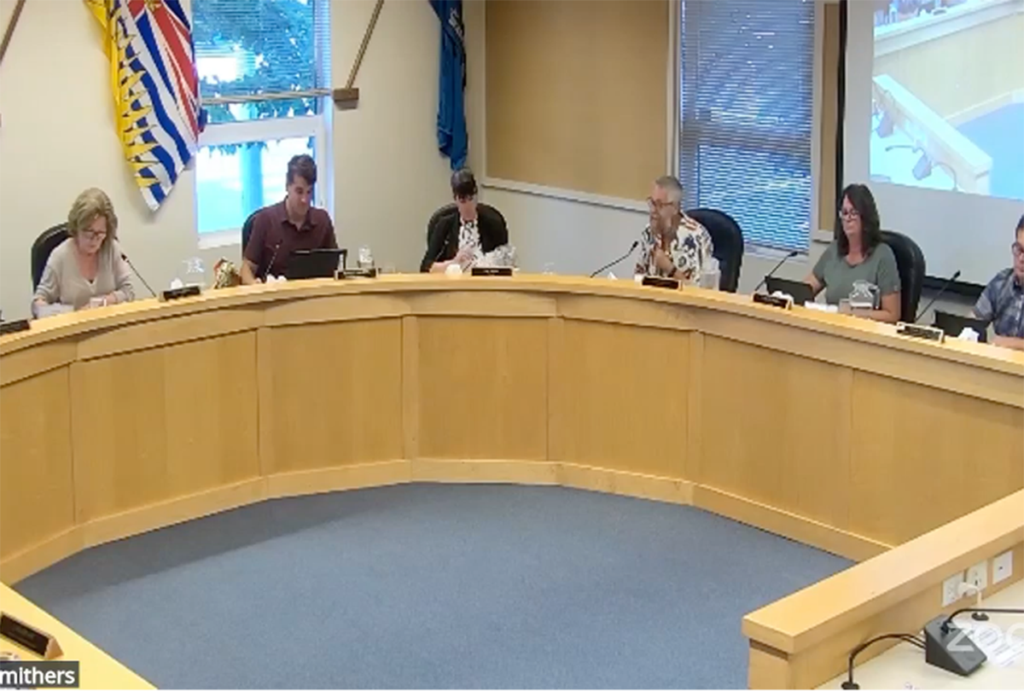
Screenshot from the Smithers council meeting on July 14, 2026, where councillors voted on a proposal to fund an LNG health study.
On July 14, Smithers council rejected its own staff’s recommendation. Staff had urged the town to write to the province in support of an independent, cumulative health impact assessment of B.C.’s natural gas and LNG industry.
The vote placed the town alongside Kitimat, host of LNG Canada, as the second B.C. council to turn the request down outright.
The backdrop of the flaring debate
The physicians’ campaign behind the request has a charged backdrop. Since LNG Canada’s Kitimat terminal began exporting last year, a cracked flare tip has forced the plant to burn off large volumes of gas through a backup flare. That’s well beyond permitted levels, by the company’s own disclosures to the B.C. Energy Regulator.
The regulator issued a public order in April over black-smoke emissions. LNG Canada has applied to raise its permitted flaring roughly tenfold. The company says local air-quality readings have stayed in the “good” to “low-risk” range throughout.
That flaring is the immediate reason physicians give for wanting a cumulative study now, before more plants come online. But it is a coastal problem, in a Kitimat airshed that inland Smithers does not share.
The request came from the Canadian Association of Physicians for the Environment (CAPE). The group presented to council on June 23 through Dr. Sally Harvie. It asked for two things: a provincial study of the gas supply chain from extraction to export, and a pause on public financing and approvals for LNG projects until the study was finished.
Staff recommended only the first. They declined to endorse the freeze, citing “potential economic harms” from pausing approvals. They also said the town lacks the expertise to advise senior governments on the matter.
The recommendation on the floor, in other words, had already separated the health science from the development politics. Council rejected it anyway, on a 4-3 vote.
The reason offered most often was redundancy.
The case for redundancy
Coun. Laura Leonard, a chartered accountant who runs a second-generation Smithers business and vice-chairs the town’s finance committee, was the most detailed voice in opposition. She argued British Columbia already runs “the most rigorous energy regulations in the world” and that the projects at issue had cleared their environmental assessments.
“We already passed the environmental assessments, and in my opinion, more assessments would be redundant. Human health risk assessments were conducted as part of the approval process.”
Leonard called current flaring concerns “temporary in a very long-term project.” She also rebutted the argument that LNG delivers little local benefit. Gas revenue returns to the province as royalties, routed through the Resource Benefit Alliance to northern communities.
Others landed in the same place. Coun. John Buikema said he was “struggling” but doubted the exercise would be more than “a repeat of something that’s already happened.”
Coun. Frank Wray, the deputy mayor, objected on different grounds: because CAPE’s full request paired the study with a development freeze, he worried endorsing half would be read as endorsing all of it.
Coun. Calvin Elliott, who had seconded the motion to bring it to the floor, said existing legislation covers the field and resisted what he called a “stop everything” approach.
Two of the opponents conceded a point that complicates the “rules are sufficient” position. Both Wray and Elliott suggested the problem may be enforcement, not a gap in the law. The province, as Wray put it, “isn’t holding” to commitments already made. Elliott allowed it “could be enforcing some of these regulations more stringently” and that health risks “are there for all of these projects.” That is an argument for tighter oversight, not against gathering data. It didn’t win their votes.
The votes in favour
The three votes in favour came from Mayor Gladys Atrill and councillors Sam Raven and Genevieve Paterson.
Atrill, who chaired and voted, pressed the supporters’ sharpest argument. A cumulative study, she said, isn’t the project-by-project review opponents kept citing. “This is about… the cumulative health impact of projects, and I think that’s different,” she said, noting a second major project is near approval.



Raven, who moved the motion and sits on the town’s health committee, reached for a tobacco analogy. Doctors once endorsed cigarettes; accumulated data told another story. “We might have the proof that there is a significant health impact,” she said. “They also might prove that it is no worse than having a gas station. But I think we need to have the data to support either way.”
What counts as health
B.C.’s environmental assessments already require a human health risk assessment for each project. So a province-wide cumulative review would add something only if it were genuinely comprehensive.
And a comprehensive account of community health is a wide one. Public-health researchers have long defined health by its social determinants: housing, income and employment, food security, clean water, access to care, mental health and, for many Indigenous communities, cultural continuity and economic self-determination.
By that fuller measure, the jobs, revenue and local services that resource development underwrites are themselves inputs to health. An assessment that tallied emissions while ignoring them would not be a cumulative picture at all.
Stewart Muir, CEO of Resource Works, the Vancouver-based group that has tracked CAPE’s municipal campaign, makes that case bluntly.
“A true study of cumulative health also looks at what it means to have food on the table grown with fertilizer produced from natural gas; at the single-use plastics used for medical treatment, made from natural gas; at the milk pasteurized with gas-fired heat; at the community pool heated with natural gas,” he said. “Those are all beneficial. If one pressure group says ignore everything that adds to our lives and focus only on the small number of things it wants you to look at—because it is mainly concerned with stopping projects for being hydrocarbon projects—then you’re indulging a form of propaganda.”
Muir added that the world still runs overwhelmingly on fossil fuels. The way to cut emissions is “to invest in continuously improving the processes and equipment that let us use the fuels that humanity, for better or worse, has in reality chosen.” He rejected handing “a halo of virtue” to anyone who simply calls themselves a renewables advocate.
Muir has challenged CAPE’s health messaging before. In an October 2025 Resource Works analysis, he examined the group’s assertion that fracking was driving higher cancer rates in the Peace-region town of Chetwynd. He found no support for it. The nearest wells predate modern hydraulic fracturing by decades. A pulp mill was the town’s dominant industrial emitter until 2015, and small-population cancer counts swing for reasons unrelated to industry.
Chetwynd, he wrote, deserved better than to be “used as a prop in someone else’s political campaign,” one CAPE had promoted at a press conference in Vancouver and Smithers.
A town without a terminal
Geography also makes Smithers an unusual venue for the fight. The town hosts no LNG terminal, no proposed LNG project and no natural gas production. It sits inland in the Bulkley Valley, not on the coast where the export plants are built.
Coastal GasLink, the pipeline that feeds the Kitimat terminal, runs well to the south through Wet’suwet’en territory rather than through the town. The gas line that does pass through Smithers, Pacific Northern Gas, is the utility that already heats local homes.
Unlike Terrace, 52 kilometres up the highway from Kitimat and sharing its airshed, Smithers sits behind the Coast Mountains in a separate valley. Whether cumulative or regional effects could reach a community this far from any facility is an open question. It’s precisely what the study was meant to test, and the majority concluded it didn’t justify the town’s endorsement.
It also helps explain why neighbours with direct exposure, such as Terrace, backed the study on flaring grounds that simply do not apply in the Bulkley Valley.
Study yes, freeze no
The vote also sharpens a pattern. Several B.C. municipalities—among them Squamish, Dawson Creek, Terrace and Hazelton—have backed the call for a provincial health study in recent weeks.
But every one of them declined CAPE’s companion demand to pause or freeze development. Smithers and Kitimat declined even the study. The councils, in other words, have consistently taken the health data and left the moratorium, the measure CAPE’s own materials treat as central, on the table.
Squamish is the most telling case. The town sits about seven kilometres from Woodfibre LNG, a project under construction on Howe Sound. A determined local campaign has fought it for the better part of a decade.
Its council went further than any other on the health file, writing to both the provincial and federal health ministers. Even so, it declined to call for a construction halt or a pause, confining itself to the request for independent data.
CAPE’s advocacy has itself drawn fire on accuracy. Industry groups accused the organization of using a manipulated image in a 2024 Vancouver transit-advertising campaign against B.C. LNG. They alleged the photo of flaring towers was digitally altered and depicted a foreign facility rather than a local one. CAPE, whose broader campaign seeks a ban on fossil-fuel advertising, has continued to press its health case at councils across the province.
“I commend Smithers council for taking a principled stand,” Muir said, “and for not accepting at face value propositions that do not stand up to scrutiny.”
For now, the message from two northern councils, including the one that hosts the province’s flagship LNG project, is that the health questions were asked and answered when the projects were permitted. Their confidence in that process, rather than a fresh round of study, is the appropriate default.
Ian Biana writes for the Resource Works Accelerate team and can be reached at [email protected].
Share This:






















COMMENTARY: Varcoe: ‘Do No Harm’: Should Alberta Step in to Fix Gas System Constraints, Given Past Energy Interventions?