


 CDN NEWS |
  US NEWS







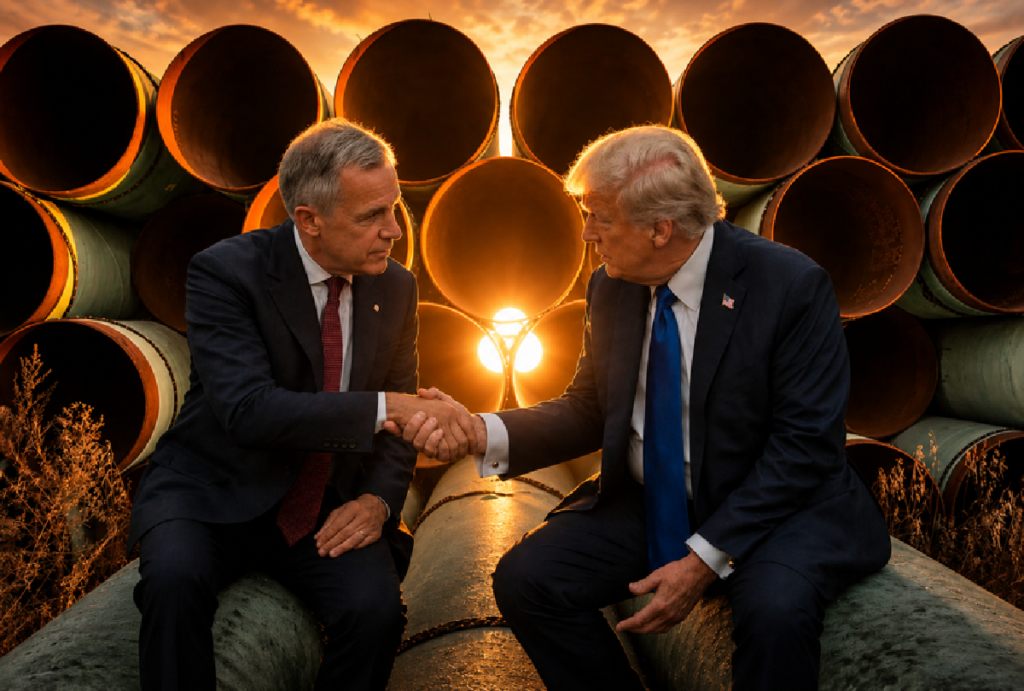
By Terry Winnitoy – EnergyNow
Trump may be divisive. He may be disliked by many Canadians. His tariffs may have harmed Canadian industries and strained one of the world’s most important trading relationships. But he also did Canada one enormous favour, he made complacency impossible.
Donald Trump may not have intended to do Canada any favours. But history may one day show that his tariffs, threats, trade disruptions and blunt America-first agenda did something Canadian politicians, business leaders and voters had avoided for decades: he forced Canada to look in the mirror.
For years, Canada lived comfortably beside the biggest energy customer in the world. The United States bought our crude oil, refined our heavy barrels, integrated our supply chains and provided a massive, convenient market just across the border. It was efficient. It was profitable. It was familiar.
It was also dangerous.
In 2024, Canada exported 4.2 million barrels per day of crude oil, and 95.7 per cent of that crude went to the United States. Those crude exports to the U.S. were worth $140.8 billion. That is not diversification. That is dependency with a flag on it.
Trump’s trade wars have made that impossible to ignore. When the U.S. can impose tariffs on Canadian steel, aluminum, copper, autos, trucks, buses, certain wood products and other sectors, even when many CUSMA-compliant goods remain exempt from broader tariffs, Canada gets a reminder that friendship is not the same thing as economic security. And when Washington’s trade policy can change with a speech, a post, an election or a negotiating tactic, Canada cannot build its future on the hope that one customer will always behave predictably.
That is why Trump, love him or hate him, may be the best thing that ever happened to Canada’s oil and gas industry. He shattered the illusion that geography alone was a strategy.
Canada’s energy industry has long understood the cost of limited market access. When almost all Canadian crude is forced into one export market, the buyer has leverage. Canadian heavy oil will always trade at some discount to West Texas Intermediate because of quality and transportation differences. But constrained pipeline access has historically made that discount worse. The Trans Mountain Expansion has already shown what optionality is worth: after TMX started up in May 2024, the WTI-WCS differential narrowed to about US$11.60 per barrel, and from June 2024 to July 2025 it averaged about US$12 per barrel.
That is not just a pricing statistic. It is a national revenue story.
The Trans Mountain Expansion, which began commercial operations in May 2024, increased capacity from about 300,000 barrels per day to 890,000 barrels per day, giving Canadian crude direct access to international markets from the Pacific Coast. Trans Mountain is also evaluating ways to increase system capacity to approximately 1.19 million barrels per day between 2027 and 2030.
The impact has been immediate. The Canada Energy Regulator reported that after TMX began operating, 75 per cent of the increase in Canadian crude exports in 2024 moved by marine vessel, and 70 per cent of that increase went to non-U.S. destinations. In other words, once Canada finally built a door to the Pacific, customers started walking through it.
That is the lesson Ottawa and the provinces must not forget: market access is sovereignty.
Prime Minister Mark Carney appears to understand the moment. His government has set an ambitious goal to double Canada’s non-U.S. exports over the next decade, generating more than $300 billion in additional trade. Budget 2025 also described Canada as an “energy superpower” in both clean and conventional energy and tied that ambition directly to the infrastructure needed to diversify trade relationships.
That matters because Canada cannot talk about becoming an energy superpower while refusing to build the infrastructure energy superpowers require. Superpowers do not strand their resources. Superpowers do not accept permanent discounts because they failed to reach tidewater. Superpowers do not allow one foreign buyer to determine the value of their national wealth.
The Canada-Alberta pipeline agreement is therefore more than a provincial political win. It is a test of whether Canada is serious. The federal-Alberta memorandum of understanding calls for one or more private-sector constructed and financed pipelines, with Indigenous co-ownership and economic benefits, capable of moving at least one million barrels per day of Alberta bitumen to Asian markets.



It also identifies potential expansion of Trans Mountain by an additional 300,000 to 400,000 barrels per day for Asian markets. Alberta’s west coast pipeline timeline aims to submit the project to the Major Projects Office by the beginning of July to pursue designation as a project of national interest by October 1, 2026, and potentially begin design and construction as early as September 1, 2027, subject to consultation and approvals.
Those dates matter. Canada has lost too many years to hesitation, regulatory uncertainty and political fear. Trump’s tariffs have made clear that delay is not neutral. Delay has a cost. Every year Canada fails to expand export capacity is another year Canadian producers are forced to sell too much of their product into one market under terms shaped by someone else.
The same logic applies to natural gas.
Canada is not just an oil country. It is a natural gas giant sitting on the Pacific doorstep of the fastest-growing energy markets in the world. LNG Canada loaded its first cargo in June 2025, with the Kitimat facility designed to initially export around 14 million tonnes of LNG per year under a 40-year export licence. The project made Canada a serious LNG exporter at precisely the time Asian economies are looking for reliable, lower-risk suppliers.
Canada’s west coast has a structural advantage. Natural Resources Canada notes that west coast LNG projects are about 10 shipping days from Asia. That is a strategic gift. Canadian LNG does not need to pass through the same chokepoints as U.S. Gulf Coast cargoes headed to Asia, and it comes from a country with abundant gas, rule of law, stable institutions and a reputation as a responsible producer.
Again, Trump did not create that advantage. But he helped Canada understand its value.
For decades, Canadian governments treated oil and gas as a regional issue. In reality, it is a national economic anchor. CAPP estimates that Canada’s oil and natural gas industry accounted for $88 billion, or 3.8 per cent, of national GDP in 2025, while supporting government revenues that help fund hospitals, education and social programs. At a time when U.S. tariffs are hitting Canadian manufacturing, metals, lumber and autos, the oil and gas sector is not a problem to be managed. It is one of the strongest cards Canada has left to play.
That does not mean Canada should abandon environmental responsibility. It means Canada should stop confusing obstruction with virtue. The world will continue to consume oil and natural gas for decades. The question is whether those barrels and molecules come from Canada, with high labour standards, Indigenous partnership opportunities, environmental regulation and transparent governance, or from countries with weaker standards and fewer democratic constraints.
Trump has exposed the hard truth. Canada’s problem has never been a lack of resources. It has been a lack of resolve.
We have the oil. We have the gas. We have the coastlines. We have Asian demand. We have allies looking for secure supply. We have Indigenous communities that can be equity partners, not afterthoughts. We have private capital willing to move when governments provide certainty. What we have lacked is the political courage to say yes to nation building infrastructure.
Trump’s America-first agenda has changed the conversation. It has reminded Canadians that sovereignty is not a slogan. It is pipelines, ports, LNG terminals, rail corridors, electricity transmission, carbon capture, Indigenous partnerships and timely approvals. It is the ability to sell what we produce to more than one customer. It is the ability to negotiate with the United States as a partner, not as a captive supplier.
Canada should still value the U.S. market. It will remain our largest and most important trading partner. But the lesson of the Trump era is that Canada must never again allow “largest customer” to become “only realistic customer.”
The Trans Mountain Expansion was the first proof that diversification works. LNG Canada is the next proof. A new west coast oil pipeline, expanded TMX capacity and more LNG projects would complete the shift from dependency to optionality.
So yes, Trump may be divisive. He may be disliked by many Canadians. His tariffs may have harmed Canadian industries and strained one of the world’s most important trading relationships. But he also did Canada one enormous favour, he made complacency impossible.
He forced Canada to realize that its oil and gas industry is not just an Alberta issue, not just a Western Canadian issue and not just an industry issue. It is a national security issue. It is a trade issue. It is a prosperity issue. It is a sovereignty issue.
And if Canada finally acts on that realization by building the pipelines, LNG terminals and export infrastructure needed to reach the world then Trump may unintentionally become the catalyst that helped Canada’s oil and gas industry become what it should have been all along: a global energy powerhouse.
Share This:






















On The Verge: Energy Sector Primed for New Wave of Growth – ATB Economics