


 CDN NEWS |
  US NEWS







Don Wright ran B.C.’s public service. His new reading of 30 years of federal fiscal data says Alberta’s oilsands quietly paid the rest of the country’s bills—and he is not finished with the argument.
By Stewart Muir

Don Wright at the IPSS 2022 | Resource Works Society
Don Wright served as deputy minister to the premier and head of the B.C. public service under John Horgan and, before that, as president of the British Columbia Institute of Technology. He is not a man with an obvious stake in Alberta’s success. That is exactly why the piece he published on July 3 is going to be difficult for anyone in this province to wave away.
Wright asks a narrow question and refuses to be pulled off it. When Alberta’s energy sector expands, who actually collects the benefit? His answer, built from three decades of federal fiscal data, is that the rest of Canada does—by an amount most Canadians have never had placed in front of them.
1996 rhymes with 2026
The setup is a history lesson with a purpose. Canada in 1995 was limping. Unemployment sat at 9.5 per cent, per-capita GDP had only clawed back to where it was in 1989, and Paul Martin’s February budget promised more pain. Jean Chrétien put natural resources minister Anne McLellan on the file. The 1996 budget delivered accelerated capital cost allowances, Alberta moved on royalties, and that June the two governments signed the Declaration of Opportunity in Fort McMurray.
Wright’s point is that the Canada—Alberta memorandum of understanding—and the companion Ottawa now appears to be negotiating with British Columbia—is the same instrument, 30 years later, reached for by a prime minister facing the same problem.
What the 1996 bet returned
The numbers are the article. From 1996 to 2015, oilsands capital investment exceeded $360 billion in 2025 dollars—28 per cent of the entire increase in Canadian non-residential investment across those years. Production climbed from 430,000 barrels a day in 1995 to 2.38 million in 2015 and 3.5 million in 2025. Unemployment fell to 6.2 per cent by 2007. And 1996 to 2014 stands as the only stretch since the 1970s in which Canada’s per-capita GDP growth beat the Americans’.
Martin balanced the books. Wright’s reading is that restraint alone did not do it. Revenue from a faster-growing economy did.
The number that ends the argument
Then he does the arithmetic nobody in B.C. has bothered to do.
Using the Finances of the Nation federal fiscal balance series, Alberta’s net contribution to Ottawa rose from $3.2 billion in 1995 to $24.6 billion in 2024. Of the other provinces, only British Columbia and Newfoundland and Labrador improved their position at all. Ontario went backwards.
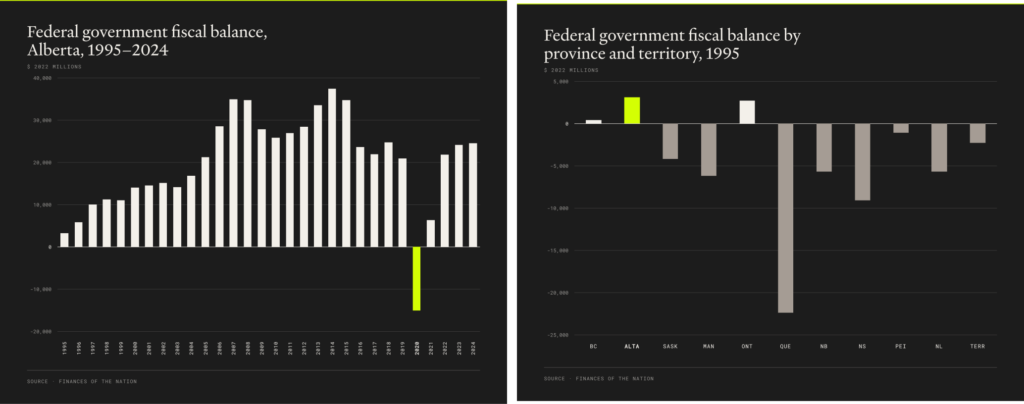
Hold Alberta’s contribution flat at the rate of inflation after 1995 and run the counterfactual forward, and federal debt in 2024 would have been $590 billion higher than the roughly $1.06 trillion Canada actually carried.
Wright concedes that no government would simply have watched that pile up. It would have cut, or it would have taxed. Which is the whole point. That is the bill the rest of the country did not have to pay, and it is the bill that never appears in any argument about concessions to Alberta.
The part Alberta will not enjoy either
This is not a grievance piece, and anyone planning to wave it around as one should read the last two pages first.



Wright is blunt that Alberta’s surplus position proves nothing about a federation rigged against it. It is an artifact of tax incidence—higher average incomes, lower unemployment, a younger population. Alberta drew equalization itself from 1957 to 1964. And Ottawa built the platform the province now stands on: the 1961 National Oil Policy that forced everything west of the Ottawa Valley onto Canadian crude, the 1975 equity stake that saved Syncrude when a private partner walked, the capital cost allowance change, the purchase and completion of Trans Mountain.
“Various voices outside of Alberta should dial down their demonization of Alberta and its energy sector and the arguments against ‘concessions’ to Alberta. All of Canada has benefited significantly from the expansion of Alberta’s oil sand production since 1995.”
— Don Wright, SAGE, July 3, 2026
Having paid that bill, he sends the invoice the other way. All of Canada has gained from what was built after 1995. If there is an economic case for further expansion and for the pipeline capacity it would require, all of Canada shares in that too.
The question he has not answered yet
Note the conditional. If there is an economic case.
Wright puts a footnote on it, saying the question of further oilsands expansion warrants its own discussion and that he wanted to clear away the dog-in-the-manger problem first. He is telegraphing a sequel.
He is also, whether by design or by editorial coincidence, in conversation with his own publication. Four days before Wright ran, SAGE published Peter Nicholson arguing that a new west coast pipeline is a field of dreams until someone demonstrates where the incremental barrels come from.
Both things can be true. Wright has settled the distributional question. Nicholson’s volume question is still open. Anyone who crops the hedge out of Wright to make a banner is going to be handed it back within a day.
Why this lands here
Because of who said it, and where he said it from.
The argument that Canada is better off when Alberta builds things is not new. What is new is a man who ran John Horgan’s public service saying it in public, with the receipts, and naming the reflex he wants stopped. That is not industry noise and it cannot be filed as such. It is a former deputy minister telling his own side that the accounting does not support the posture.
Canada would function considerably better, he concludes, if it spent more of its energy enlarging the pie than litigating the size of the slices. Chrétien understood that in 1996. Mark Carney appears to have arrived at the same place, three decades on.
The rest of us might catch up.
Stewart Muir is the president and CEO of Resource Works Society.
Resource Works News
Further reading
- Don Wright, “Who benefits when Alberta’s energy sector expands?”—SAGE
- Peter Nicholson, “A pipeline isn’t a field of dreams”—SAGE
- Finances of the Nation—the federal fiscal balance data (link)
- Statistics Canada—federal debt figures behind the counterfactual (link)
- “A pipeline through B.C.?”—The Walrus
Share This:






















On The Verge: Energy Sector Primed for New Wave of Growth – ATB Economics