


 CDN NEWS |
  US NEWS







The premiers’ new consensus on energy corridors and faster approvals is significant. But Canada still cannot say how long a major project actually takes.
By Stewart Muir
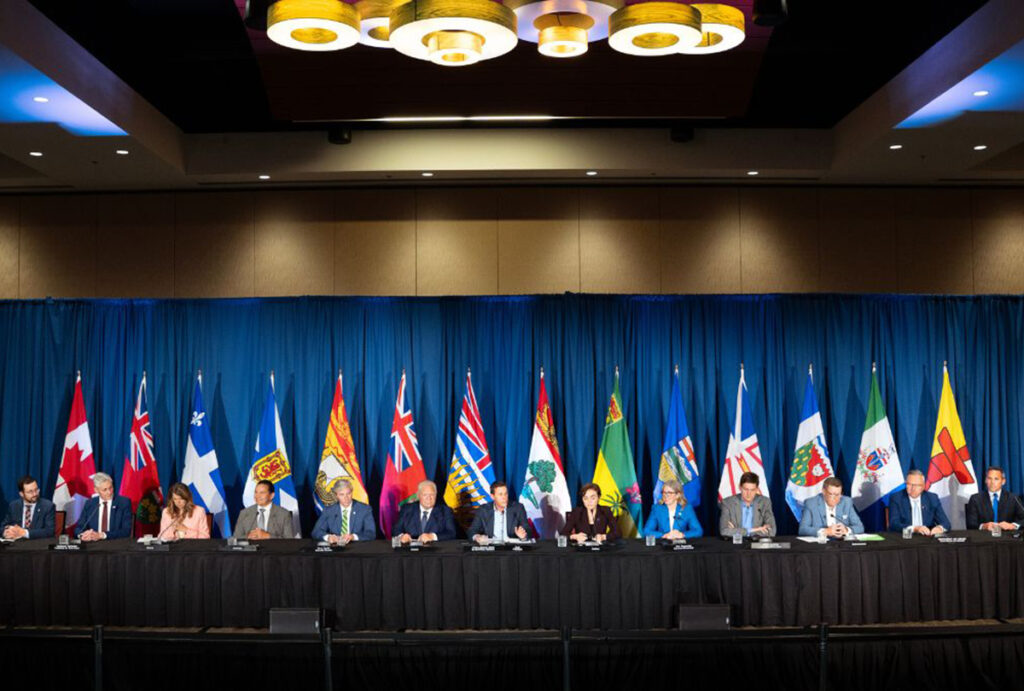
Canada’s premiers hold a press conference closing the Council of the Federation meetings in Charlottetown on Wednesday July 22, 2026. THE CANADIAN PRESS/Darren Calabrese
Something important happened in Canada this week.
On July 22, all 13 provincial and territorial premiers called on Ottawa to shorten federal permitting timelines, accelerate major-project approvals and provide more predictable investment for electricity transmission, pipelines, ports, railways and other trade and energy corridors.
They also called for better tax treatment for nationally significant projects, affordable and reliable electricity, and partnerships with Indigenous peoples.
This was not a funding announcement. It was not a legislative change. No project was approved.
Even so, the statement matters.
Every premier in Canada, across every region and political party, is now working from roughly the same premise: Canada needs to build the infrastructure required to produce, move and export energy.
That is a major change.
This is no longer only an Alberta argument about pipelines, a British Columbia argument about LNG or an Ontario argument about industrial power demand. Premiers from every part of the country are now saying that reliable energy, transportation corridors and faster approvals are national economic priorities.
The political argument has moved.
The next question is whether anything else will.
The gap between statutory deadlines and calendar reality
Canada has become very good at announcing urgency. Governments create offices, sign agreements, establish timelines and promise one-project-one-review systems. Each measure sounds useful, and some will be.
But none answers the question that matters most to an investor, an Indigenous partner, a utility or a project developer.
How long does the whole thing take?
Not the formal federal review. Not one statutory phase. Not the period a minister can point to in a news release.
The real clock.
That clock begins when someone develops a serious project concept, draws a route, starts engineering work and begins the commercial and community discussions needed to move forward. It ends when construction begins.
No government in Canada routinely publishes that number.
Instead, governments publish legislated timelines that begin only after years of work have already taken place.
A federal assessment phase may carry a 180-day clock. A new process may promise a decision within one year after an application is considered complete. Those deadlines may even be met.
The problem is that the calendar keeps running outside them.
The best public measurement we have of the first projects entering the federal Impact Assessment Act process found that a phase with a legislated 180-day timeline took 332 calendar days in practice.
The regulator may still have complied with the law. The project still consumed nearly twice the advertised time.
That gap tells us something important.
The permit is often the short part.
The permit is often the short part
Mining projects in Canada can take roughly 27 years to move from discovery to production. Accelerating two years of a 27-year process is worthwhile. But it does not solve the other 25.
Those years include route selection, engineering, environmental baseline work, commercial agreements, financing, application preparation, Indigenous engagement, community relations and repeated redesign.
Some of that work cannot and should not be avoided.
But much of the delay comes from beginning important conversations too late, changing requirements during the process, dividing authority among too many agencies and failing to make decisions when decisions are needed.



Roberts Bank Terminal 2 is a useful example.
The Vancouver Fraser Port Authority project was referred to a federal review panel in 2014. Federal approval came in 2023.
That is close to a decade from referral to approval. Referral was not the beginning of the project, and approval was not the beginning of construction.
Whatever view one takes of the project, the timeline shows why the formal decision window cannot be mistaken for the full project schedule.
Practitioner data reveals systemic uncertainty
A small practitioner survey I presented this week at the Pacific NorthWest Economic Region Summit (PNWER) made the same point from another direction.
The survey involved 22 people working directly with major projects, 21 of them in British Columbia. It was not a probability sample, and no margin of error was claimed.
But not one respondent could identify a dependable door-to-door timeline through the Canadian system.
That should concern every government now promising faster approvals.
Project developers do not need the shortest possible promise. They need an endpoint they can believe.
The same lesson applies to Indigenous consultation.
Consultation is often blamed for delay when the deeper problem is timing.
If governments and proponents begin serious engagement only after a route has been selected, financing assumptions have been made and public positions have hardened, conflict becomes more likely and more expensive.
The stronger projects start earlier.
The Haisla Nation’s 50 per cent ownership of Cedar LNG is an important example. A nation that owns half of a project is not standing outside the process waiting to be consulted. It is involved in the decisions that determine the project’s direction and timing.
That does not remove legal obligations, disagreement or environmental review. It improves the chance that problems will be addressed before they become crises.
Establishing a practical test for progress
The premiers are right to connect faster approvals, energy infrastructure and Indigenous partnership.
But their statement now creates a practical test.
- Will governments identify actual projects?
- Will they commit actual money?
- Will they change tax rules?
- Will they publish approval dates and report whether those dates are met?
- Or will this become another declaration of intent that produces no bankable schedule?
One useful reform would cost almost nothing.
For every major project, governments should publish the full elapsed time from the first formal project description to a complete application, from the complete application to a decision, and from the decision to the start of construction.
Put those figures beside the statutory timelines.
That would show where time is actually being spent. It would separate regulatory delay from commercial delay, political delay, proponent delay and consultation that began too late.
It would also stop governments from declaring success because one legislated clock was met while the project itself remained stalled.
Give me a five-year schedule Canada can consistently meet over a two-year schedule it repeatedly misses.
The first can support investment, procurement and partnership.
The second is a press release.
Canada’s premiers have now agreed that faster approvals and energy corridors are national priorities.
Good.
The next step is not another statement of ambition. It is named projects, committed funding and a real clock that tells Canadians whether anything is actually getting built.
This article is drawn in part from a presentation delivered by the author on July 21, 2026, at the annual Pacific NorthWest Economic Region Summit in Edmonton.
Stewart Muir is the President and CEO of Resource Works Society.
Resource Works News
Share This:






















On The Verge: Energy Sector Primed for New Wave of Growth – ATB Economics