CDN NEWS |
  US NEWS







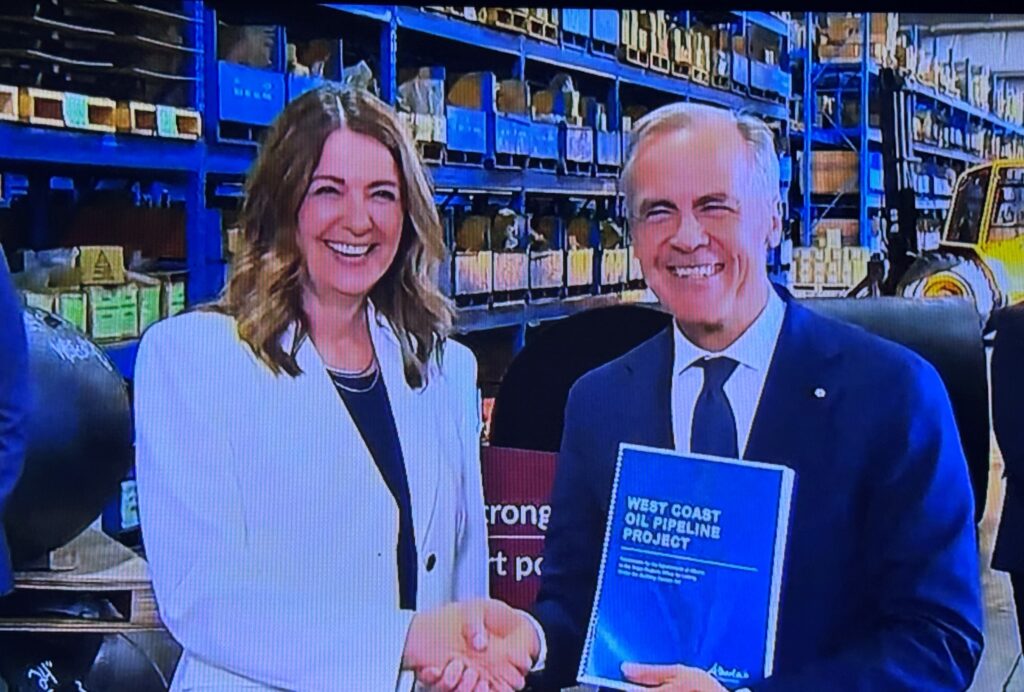
“Let’s work together and build this pipeline.” – Alberta Premier Danielle Smith
By EnergyNow Editorial Staff
The Calgary Stampede bills itself as the Greatest Outdoor Show on Earth, but for a brief period on Thursday night in Calgary, Alberta Premier and Prime Minister Mark Carney put on the greatest (and most expensive) indoor show in Canada.
Alberta’s long-sought West Coast oil pipeline took a major step forward Thursday as Premier Danielle Smith and Prime Minister Mark Carney announced that Alberta has formally submitted the project to the federal Major Projects Office for consideration as a project of national interest.
The announcement followed an earlier news conference in Vancouver, where Carney and British Columbia Premier David Eby signed a broad Canada-B.C. prosperity agreement that preserved the federal North Coast tanker ban while opening the door to a new southern oil pipeline route through British Columbia.
Together, the two announcements mark the clearest path yet for a new Alberta-to-Pacific Coast oil export pipeline, one designed to move more than one million barrels per day to tidewater and give Canadian oil producers greater access to Asian markets.
Smith said Alberta has now filed its West Coast Oil Pipeline submission under the Building Canada Act and selected a southern route from Bruderheim, Alberta, to a deep-water, VLCC (Very Large Crude Carrier)-capable port terminal on British Columbia’s southwest coast. The route would largely follow the existing Trans Mountain corridor, a decision Smith said was made after studying both northern and southern options.
“This project builds on existing infrastructure,” Smith said. “It reflects feedback from Indigenous groups and the government of British Columbia, reduces regulatory barriers, given it would not be subject to the Oil Tanker Moratorium Act, and gets Canada’s most valuable natural resource to global markets faster.”
The partnership announced in Calgary includes the Government of Alberta, the federal government through Trans Mountain Corporation, Pembina Pipeline Corporation, and future Indigenous equity partners. Carney said Trans Mountain Corporation will plan and construct the pipeline, while Pembina will bring private-sector expertise, capital discipline and operating experience to the project.
“Canada and Alberta will be equal partners in this project,” Carney said, adding that meaningful ownership stakes will be made available for Indigenous communities, alongside contracting and employment opportunities.
The exact investment structure has not yet been finalized. When asked how much would come from Alberta or Canadian taxpayers, Smith said the ownership stakes and financial contributions remain to be negotiated among Alberta, Ottawa, Pembina and Indigenous partners. Carney pushed back against the idea that federal participation should be viewed simply as spending.
“It’s really not a matter of federal expenses,” Carney said. “It’s really a federal investment, and through TMC.”
Smith made a similar argument, saying pipelines become highly profitable once built and in service. She pointed to federal returns from the existing Trans Mountain system and said the new pipeline could generate billions of dollars in revenues over several decades for Alberta, Ottawa and participating Indigenous communities.
“The profits from this pipeline will generate billions in revenues over the coming decades for the provincial and federal governments and will enrich Indigenous communities that choose to partner with us,” Smith said.
The project is also tied directly to the proposed Pathways carbon capture project, now being advanced through a tripartite agreement between Alberta, Ottawa and the Oil Sands Alliance. The alliance represents five major oilsands producers: Canadian Natural, Cenovus Energy, ConocoPhillips Canada, Imperial and Suncor. Carney said the pipeline, oilsands growth and Pathways are intended to move together as part of a broader energy and emissions agreement.
The Pathways project is being described by both governments as the world’s largest carbon capture and storage project. Carney said the agreement would help achieve 16 million tonnes of emissions reductions per year, which he compared to removing most of Alberta’s passenger vehicles from the road.
Smith framed the combined pipeline and Pathways announcement as a turning point for Alberta’s economy and for Canada’s role as an energy supplier.
“This is not just another energy project,” Smith said. “It’s a nation-building project that will unlock wealth and opportunity for millions of people across the country, and provide desperately needed energy to millions more across the globe.”
The broader economic numbers outlined by Carney were significant. He said the day’s announcements — including the Alberta pipeline, B.C. infrastructure, LNG, trade corridors, critical minerals and clean power investments — would catalyze more than $200 billion in direct investment and create more than 175,000 jobs across Canada.
“These measures will build the strength of our entire country,” Carney said. “They will take control of our future. They will bolster our sovereignty.”



The Calgary announcement was made possible in part by the earlier Vancouver agreement between Carney and Eby. That agreement commits Ottawa to maintaining the federal North Coast tanker ban, which effectively rules out a northern pipeline route to ports such as Prince Rupert or Kitimat for crude oil exports. It also recognizes that any new pipeline through southern B.C. would carry environmental risk for the province and coastal communities.
Under the Canada-B.C. deal, British Columbia would receive a negotiated economic and revenue framework if the pipeline proceeds. That could include an annual royalty payment from the pipeline operator and an environmental liability and emergency response fund held in trust and accessible by B.C. and First Nations.
Eby has been a vocal critic of new Alberta pipeline proposals, especially any project that would weaken or remove the northern tanker ban. But after signing the agreement with Carney, he acknowledged that interprovincial pipelines fall under federal jurisdiction and said B.C. would not fight the project in court.
“This is an area of federal responsibility under the law. We learned this the hard way on the last pipeline,” Eby said. “That’s why this agreement matters. It ensures that the northern tanker ban stays in place, and it ensures that if the pipeline goes ahead, British Columbians are fairly compensated for the environmental risks we would take.”
The B.C. agreement also includes support for LNG Canada Phase 2, Ksi Lisims LNG, Cedar LNG and Woodfibre LNG, as well as major investments in ports, transmission infrastructure and trade corridors. That gives Carney a political bridge between Alberta’s push for oil export capacity and B.C.’s demand for environmental protection, economic compensation and clean-energy development.
For Alberta, the key decision was the route. Smith had previously discussed northern pipeline options, but in Calgary she said the southern route offered major practical advantages: use of an existing corridor, established relationships with Indigenous communities, fewer regulatory barriers and a faster path to market.
“We looked at both projects,” Smith said. “The southern route had key advantages of using an existing pipeline route, existing established relationships with Indigenous partners and potential partners along that line, as well as the ability to reduce the amount of time to get it to market.”
Carney echoed that argument, saying speed matters because Canada’s allies are looking for secure, democratic and reliable energy supplies now. He said the project is part of a larger strategy to move Canadian energy to new customers and reduce dependence on a single market.
The project is still far from construction. Alberta has submitted the proposal, but federal and Indigenous consultations are now expected to begin through the Major Projects Office. Ottawa and Alberta are aiming for a national-interest listing by October 1, with construction potentially beginning in 2027 if consultation, approvals and permits are completed.
The biggest unanswered questions remain the final cost, ownership shares, shipper commitments, Indigenous participation agreements and the precise structure of federal, provincial and private investment. Smith said oilsands producers have not yet made formal shipping commitments, but discussions with the Oil Sands Alliance are continuing as part of the broader package involving production growth, the new pipeline and Pathways.
The political significance, however, is immediate. After years of failed or cancelled pipeline proposals, including Northern Gateway, Energy East and Keystone XL, Smith said government participation is necessary to de-risk the project and give the private sector confidence that this pipeline will not disappear in the regulatory process.
Carney described the announcement as “cooperative federalism at work,” while Smith said the moment represents a chance for Canada to stop leaving its resource wealth stranded.
“We’ve certainly come a long way from talk of phasing out Alberta’s oil and gas, haven’t we?” Smith said.
For Alberta, the announcement is a major step toward the long-standing goal of reaching new markets beyond the United States. For Ottawa, it is a test of whether a federal government can support major oil infrastructure while advancing carbon capture, Indigenous ownership and coastal protection. For B.C., it is an uneasy compromise: no endorsement of the pipeline, but no court fight either, as long as the tanker ban remains and the province is compensated for the risks.
The West Coast Oil Pipeline is not yet approved, financed or shovel-ready. But Thursday’s twin announcements in Vancouver and Calgary moved it from political aspiration into a defined federal-provincial process, backed by named partners and a proposed route.
As Smith put it: “Let’s work together and build this pipeline.”
Share This: