CDN NEWS |
  US NEWS









“The time to act on them is now.” says Oil Sands Alliance
By This Article and More by Chris Varcoe Here
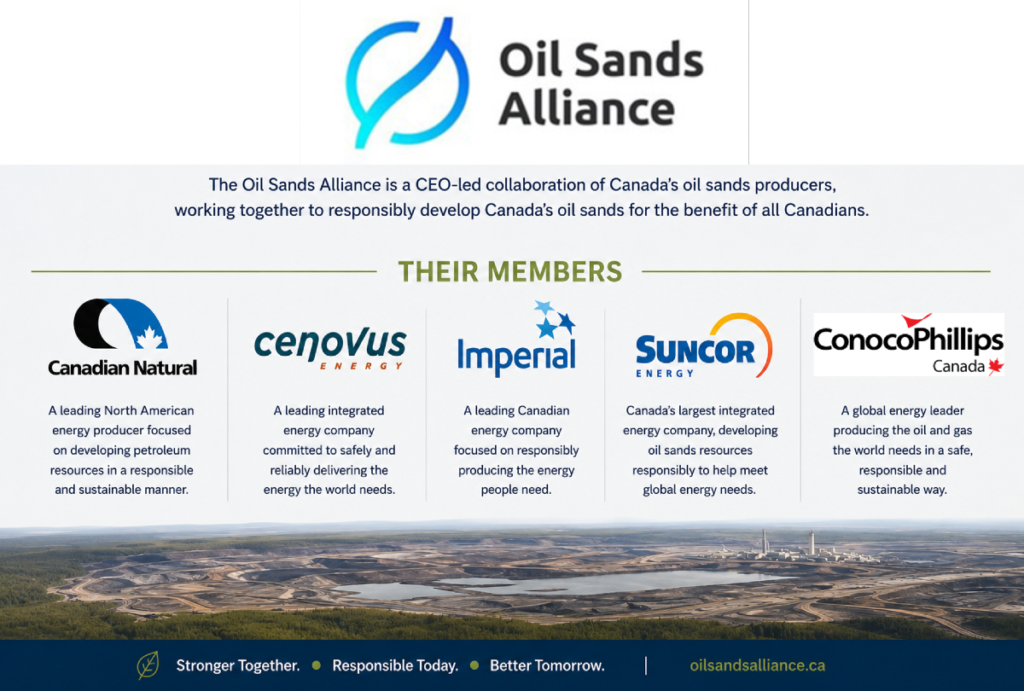
As talks over a new industrial carbon pricing deal grind on between the Carney and Smith governments, Canada’s largest oilsands producers have issued a cautionary note.
And it arrives as negotiations over the memorandum of understanding (MOU) on the federal-provincial energy pact are at a pivotal point, and have extended well past its initial April 1 deadline.
“Unfortunately, while both governments have taken steps toward this critical national interest objective since signing the MOU, the pace of change has been slow,” the Oil Sands Alliance said in a statement.
“We are at risk of letting this opportunity pass Canada by.”
The MOU reached last November — one Alberta hopes will lead to approval and development of a new oil export pipeline to the West Coast — called for a series of specific agreements on energy and environment issues to be reached by April 1.
These included deals to reduce methane emissions from the oil and gas sector, and coming up with a joint approach to impact assessments for major developments that would avoid duplication by agreeing to a “one-project, one-review” approach by governments.
Both agreements were reached before the deadline passed.
Yet, two other issues remain, including an understanding by both governments that Alberta’s industrial carbon price would climb to an effective rate of $130 per tonne under Alberta’s Technology, Innovation and Emissions Reduction (TIER) system.
Alberta’s industrial carbon price was frozen last year at $95 a tonne of emissions, while carbon credit prices have been trading substantially below that point.
The MOU also called for reaching an agreement between the Oil Sands Alliance and both governments on the proposed $16.5-billion Pathways carbon capture project in northern Alberta.
Speaking to a Canadian Association of Energy Contractors luncheon in Calgary on May 1st, federal Natural Resources Minister Tim Hodgson indicated talks were ongoing and sounded hopeful.
“We still share a vision of how we (become) a clean and conventional energy superpower . . . and I believe we’re still looking at each other saying, ‘Let’s keep working,’ ” he told the crowd.
Any final agreement “must keep Alberta’s energy and industrial sectors competitive and thriving on the global stage,” said a statement by Sam Blackett, press secretary to Premier Danielle Smith.
The Oil Sands Alliance, which represents five of the country’s largest oilsands producers — including Suncor Energy, Canadian Natural Resources and Cenovus Energy — pointed out no other major exporters of heavy oil face such an industrial carbon tax, stressing it will limit the sector’s ability to expand and attract investment.
“We have provided both governments with concrete recommendations on what needs to be done to achieve it,” Oil Sands Alliance president Kendall Dilling said in a statement.

“The time to act on them is now.”
It didn’t provide specifics, but said a new carbon policy must support industry competitiveness and production growth. This comes at a key moment, when talks are still advancing on carbon pricing.
Last week, one source said they expected an agreement “in the next 10 days to two weeks.”
In an open letter last September to the prime minister, more than 90 industry CEOs and leaders said the federal carbon levy on large emitters is not globally cost competitive and should be repealed, allowing provinces to set regulations.
In recent months, it appears some of the industry no longer supports industrial carbon pricing, contending it impairs the flow of capital into the sector.
With the latest comments from the Oil Sands Alliance, it appears a deal on carbon pricing in Alberta is getting closer to being reached, said Michael Bernstein, CEO of Clean Prosperity, a Canadian climate policy group.
“It’s telling us that a deal is imminent, and the sector is doing everything it can, as any sector would, to try to minimize its cost and maximize its profits,” Bernstein said Monday.
“The public interest is very clearly in a different place, which is (that) we should absolutely be supporting the oil sector to expand and grow and ensure they’re competitive, and we should be looking to decarbonize in ways that we know are practical and cost-effective.”
A study released by the group last month indicated that the financial payoff from new pipeline capacity would far outweigh additional carbon costs to industry that are outlined in the MOU.
“It’s time for these extraordinarily profitable companies to stop pressing for ever-larger subsidies and accept the deal that has been presented through the MOU,” Janetta McKenzie of the Pembina Institute said Monday in a statement.
“No new pipeline can move forward unless the companies finally put their money on the table for the Pathways project.”
Martha Hall Findlay, director of the University of Calgary’s School of Public Policy — and Suncor Energy’s former chief sustainability officer — believes Alberta’s industrial carbon price has helped contribute to a reduction in the emissions intensity of oilsands production in recent years.
However, she also thinks the Pathways carbon capture project should be postponed, and the country and industry should focus on developing much-needed infrastructure that can also generate more revenue and address other concerns, such as national security.
The message from the alliance reflects that geopolitics and energy security considerations have shifted.
“I think it’s saying we know we have to get this done, we want to get this done,” said Hall Findlay, a former Liberal MP.
“The message I’m receiving is the world has changed. We want to contribute to making Canada the energy superpower that it can be. And we need to be realistic about what we can do.”
Chris Varcoe is a Calgary Herald columnist.
[email protected]
Share This: