CDN NEWS |
  US NEWS









By Jim Warren
The May 15 signing event for the updated pipeline MOU included the announcement of changes to the original November 27, 2025 agreement. Mainstream media personalities such as CBC Rosemary Barton have celebrated those changes, claiming they have advanced the noble cause of cooperative federalism. Everything is kittens and rainbows now thanks to our nation building prime minister.
At the same time, the value of the tweaks made to the MOU has been discounted by independence-minded Albertans like Cory Morgan. In a video posted to his YouTube channel, Morgan claimed the updated agreement will not facilitate construction of a new oil pipeline from Alberta to the West coast. He appears to view the revised MOU it as a collection of empty Liberal promises, designed, in part, to boost support for the federalist camp in Alberta’s upcoming independence referendum.
Two days prior to the Friday signing, Nancy Southern, CEO of ATCO addressed what other energy industry leaders have identified as the biggest barrier to getting a revived Northern Gateway pipeline built. Many of Southern’s peers claim the costs of federal industrial carbon taxes combined with the billions required to build the Pathways Alliance carbon capture storage and utilization project mean that any coastal pipeline built under the terms of the original November MOU would be a commercial failure.
According to a Canadian Press report, Southern concedes “nobody wants to have extra costs imposed upon them, but the Canadian oil industry is ‘extraordinarily innovative’ and can find ways to compete. She says the ‘energy superpower’ that Canada is striving to become needs to be able to endure decades from now.”
Southern foresees the possibility that by 2040, Canada will be a “world leader in carbon capture technology and clean fuels are in high global demand.”
Nancy Southern’s optimism aligns reasonable well with Danielle Smith’s confidence that a new oil pipeline to the Pacific coast will be built to service the high demand for oil and gas in the Asia Pacific region.
Unfortunately, May 15 was not the first occasion when Smith’s pre-MOU announcement optimism failed to produce the conclusive results those anxious to see the pipeline built were hoping for.
What’s new in the MOU
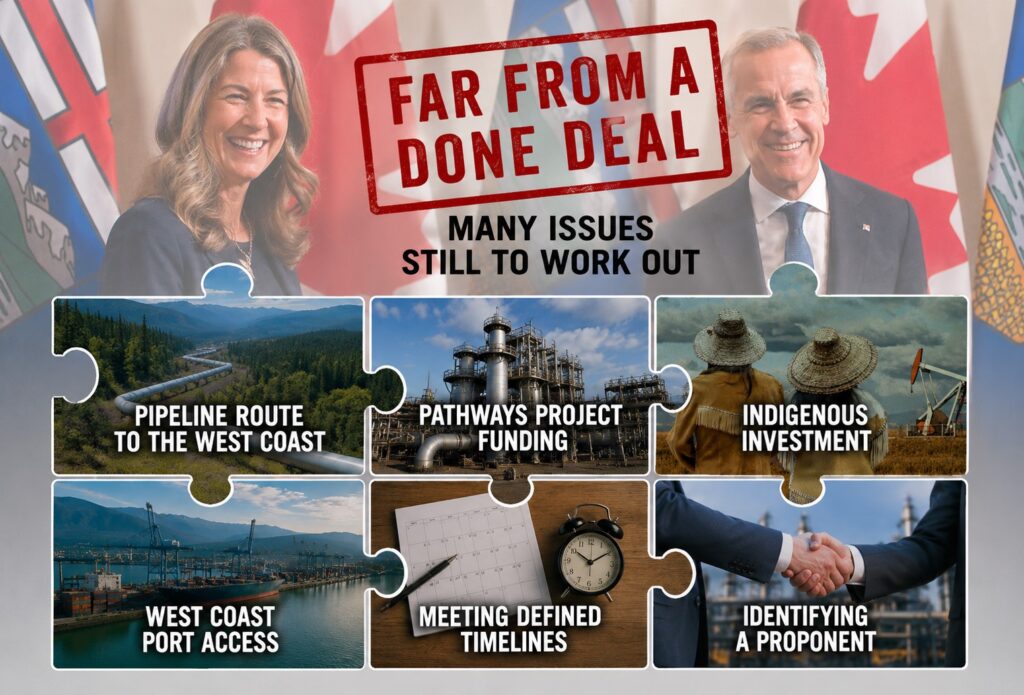
The May 15, 2026 version of the pipeline MOU introduces a schedule with target dates for important milestones on the way to a completed pipeline. For example, by July 1, 2026, Alberta will submit a “comprehensive pipeline proposal” to the federal government’s Major Projects Office (MPO) in Calgary.
Oddly, the “comprehensive proposal” is not required to identify a project proponent(s). The Government of Alberta will stand in as a sort of placeholder proponent if one has not been found by July 1.
What does have to happen by July 1 is the identification of the route for the new pipeline and the site for its Pacific Coast terminal. The route selection process will allow for consultations with First Nations communities and municipalities located on or near the chosen route.
Between July 1 and the next milestone, which is October 1, 2026, the federal government is committed to doing the things required “to pursue a national interest designation for the pipeline under the Building Canada Act.” As of May 15 we have no idea what those tasks might be. Perhaps once the actual text of the May 15 document has been posted (this story was written on 16th) we will have a better idea.
The next target date is not until September 1, 2027 the date after which construction should begin. Presumably a proponent(s) will have been announced in the months prior to this date.
One of the concessions the federal government made in the updated version of the MOU is a reduction in the taxation level and pace of implementation for the industrial carbon tax on oil production in Alberta. The current industrial carbon tax levied on oil production in Alberta is $95.00 per tonne of CO2 emissions. Under the original MOU signed in 2025 the federal government insisted that tax be increased to $170.00 per tonne by 2030.
According to the May 15 update, the industrial carbon price will remain at $95 per tonne for the remainder of 2026. After that it will increase incrementally annually to a price of $130 per tonne by 2040. What happens to the carbon price after 2040 was not clearly explained at Friday’s announcement.
In her press statement for the announcement Danielle Smith indicated that the changes to the industrial carbon tax plan would result in $250 billion in savings for Alberta’s oil industry over the rate the industry would have paid under the November 27 deal.
It sounds like a lot. The question is whether it is enough of a sweetener to get reluctant investors onside. Some prospective investors view any level of carbon emissions taxation as harmful to the competitive position of Canadian oil producers in a global energy market place where no other producing country of consequence saddles its oil and gas producers with emissions taxes.
The industrial carbon tax will still increase between the end of 2026 and 2040, just not as much or as fast as it would have under the original MOU. In addition, the industry is still burdened with the estimated $25.0 billion it will cost to build the Pathways Alliance Carbon Capture Sequestration and Utilization system. Construction of that system must occur in parallel with progress on construction of the pipeline.
Estimates for the cost to building the pipeline range from $30 to $35 billion. Reputable industry analysis claim Alberta’s energy producers, pipeline proponents and possibly the federal and provincial governments will have to come up with $85 to $90 billion to get everything built before a single barrel of oil has been sold. And once the pipeline is in operation every barrel of diluted bitumen transported and exported will have a carbon price of $18.60 per barrel charged against it (an estimate based on a carbon price of $130 per barrel).
The unavoidable question is—given that over course of the past 11 years federal Liberal climate policies and mismanagement have helped drive $500 billion in investment out of Canada, can we expect anyone to step up to the plate now and make a $90 billion bet on a pipeline that might not be commercially viable?

Dueling analysts
According to Ron Wallace, one of Canada’s most well-respected commentators on energy policy (and also an EnergyNow.ca contributor, I might add), the answer is “probably not.”
Wallace contends a commercially viable pipeline project is simply incompatible with the Liberals’ overly zealous green transition plan and the goal to reduce Canada’s CO2 emissions to Net Zero by 2050. Something has to give if Mark Carney and Danielle Smith really want to get the pipeline built. And that something is investment killing Liberal environmental legislation and the mindless race to an unachievable Net Zero.
Since Wallace is the first of two prominent oil industry analysts whose views we will be comparing, let’s think of him as “Analyst 1.”
Wallace claims that if the goal is to increase Canadian oil exports by one million barrels per day developments are already underway that will get us there before a pipeline to the Pacific could possibly built. Trans Mountain intends to increase the volume of oil its line can transport, Enbridge is already engaged in upgrading lines transporting Canadian oil to the US, and the recently announced US presidential approval for a partially resurrected Keystone XL running from Alberta to Guernsey, Wyoming, will reach and potentially exceed one billion barrels per day the Pacific Coast pipeline would provide.
Furthermore, the infamous differential charged against Canadian dilbit has been far less onerous in recent years than it was in the past. It has been from 12% to 15% in recent months. Probably not a deal breaker when Western Canada Select Crude is going for $88 pb.
Why would anyone plough money in a risky pipeline proposition in Canada when there is a far less burdensome US option available?
Wallace does not address the possibility that maybe additional export capacity to the US will provide the time cushion required for Alberta and the federal government to come up with a much improved MOU.
Analyst 2
Perhaps given the geopolitical turmoil and uncertainty of our times, we should expect there are other rational yet contradictory predictions about the future of conventional energy in Canada and the world. Indeed, not all the wise gray eminences and oil market gurus are in agreement. At least one well-respected industry analyst from Alberta, who must remain anonymous, is convinced the MOU update is an encouraging step on the way to getting an Alberta to the Pacific coast pipeline built. Let’s refer to this expert as “Analyst 2.”
His optimism is based on the fact that in the wake of the current war in the Persian Gulf the world of oil production, supply chains, and markets are upside down and uncertain. And those conditions are likely going to remain thrown off kilter for some time to come. This “new world disorder” has derailed Mark Carney’s campaign to build his Utopian, low-emissions New World Order—at least temporarily and potentially permanently.
Dozens of countries in the Asia Pacific region and some in Europe may soon be desperately short of oil and natural gas. Some of them will talk about adopting more renewable energy systems as a way to achieve energy security and independence.
That may be so, but what is also likely is that once oil and LNG, currently stranded in the Persian Gulf, again become available they will put their renewable energy ambitions on the back burner and resume purchasing fossil fuels if they can find reliable sources of supply.
In view of their recent experiences, security of supply may become of greater importance than it was in the past. And if the demand for energy supplied by reliable sources increases it should show up as a price premium for exports from stable regions of the world.
Notwithstanding our penchant for holding separation referenda, Canada is widely viewed as a peaceful, stable country—with lots of oil and natural gas.
Analyst 2 claims that Mark Carney really does want to see the pipeline built. He has figured out that oil and gas exports provide the best opportunity, maybe the only opportunity, to revive Canada’s flagging economy. Seriously, what else is there? Ontario’s dying auto industry won’t save us. The cod fishery won’t do it. And don’t expect B.C.’s leading industries—money laundering and house price inflation, to pull us out of the hole.
Our prime minister may or may not care all that much about the cost of living challenges facing the average Canadian household. What probably does motivate him is fear of the damage to his reputation as an economic wizard if Canada’s economy falls off the cliff.
Sure, there is potential to increase oil exports to the US. But how embarrassing is that for the prime minister? He can’t get a pipeline built in his own country so Donald Trump has to approve one for him.
If our second reputable analyst is right, there could yet be significant wiggle room in Carney’s positions on carbon taxes and the Pathways project. What’s more, the prime minister now has a multi-billion dollar sovereign wealth fund, aka line of credit, to dip into if required.
And perhaps our prospective investor horizons will be broadened due to the tumult generated by the US-Israel war with Iran. What are the chances some of the Asia Pacific nations lacking secure energy supplies will be interested in taking equity stakes in an Alberta to Prince Rupert oil pipeline? Japan, South Korea, Australia, New Zealand, Taiwan, and China are relatively rich and looking for oil and gas. So too are less wealthy countries like Vietnam, the Philippines and Indonesia.
It’s almost as if the forces favouring prompt construction of the pipeline are unstoppable.
Far be it for me to decide between the two predictions. Actually, both of them offer room for optimism. Ron Wallace assumes oil producers on the Prairies can probably look forward to another million barrels per day in exports in the near future. Most of the oil will be exported to the US but a couple of hundred thousand more barrels per day could be headed to Asia via the Trans Mountain.
The second analyst’s predictions assume a revived version of Northern Gateway will be built. And if the new pipelines to the US also go ahead as planned, it will mean oil sands producers will be scrambling to mine enough oil to fill the new pipeline capacity. The universe isn’t unfolding quite like supporters of conventional energy might have hoped, but the outlook as of May 15 is better than it was in November.
Share This: