CDN NEWS |
  US NEWS









By Annika Segelhorst and Elmira Aliakbari

In 1971 and 1972, NASA sent some of its top astronauts to Sudbury, Ontario as part of its training for the Apollo missions. Why? Decades of air pollution had killed the area’s trees and grasses, exposing a unique crater geology and leaving Sudbury looking like a suitable substitute for the moon.
Almost two billion years ago, a massive meteor struck the area now called Sudbury, creating one of Earth’s most mineral-rich geologies. Prospectors found these mineral deposits in the late-1800s, paving the way for Sudbury to become one of the world’s top sources of nickel and copper ore. Yet as demand for nickel grew, industrial emissions grew, too. When raw metal ores are transformed into usable products, processes such as smelting can release large amounts of sulphur dioxide into the air—a harmful pollutant that can affect human health and contribute to acid rain. Across Canada, smelting facilities, power-generating stations and other industrial operations became large sources of sulphur dioxide pollution by the middle of the 20th century.
Sudbury’s metal smelting facilities were, by the 1970s, the largest source of sulphur dioxide pollution in the world, with 85 per cent of that pollution coming from one enormous smokestack. In the intervening decades, new technologies have dramatically reduced air pollution levels.
Sudbury’s landscape has since experienced a significant re-greening. While Sudbury’s environmental transformation is particularly extreme, this story parallels the experience of Canada as a whole—between 1977 and 2023, average annual sulphur dioxide levels in Canada fell by 94 per cent.

Government data on sulphur dioxide levels show significant improvements in air quality across Canada since monitoring began in the mid-1970s. Average annual levels across Canada fell by 94 per cent between 1976 and 2023, according to a recent report. Since 2001, these levels have consistently remained below Canada’s health-based guidelines, indicating that air quality has generally been within safe limits.
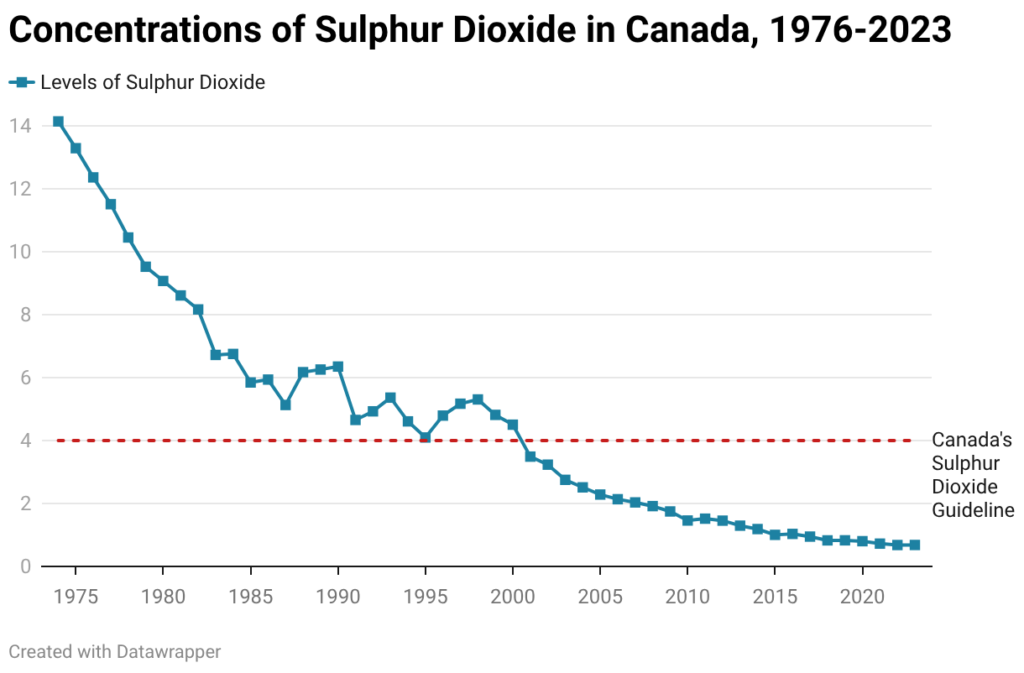
Even the highest yearly pollution levels, which capture the worst conditions, have declined substantially—falling by 88 per cent between 1977 and 2023.
Major emissions reductions in smelting and metal processing, electric power generation, and oil and gas production are responsible for this improvement in Canada’s air quality. While regulations certainly played a role in driving pollution control, advances in industrial technologies, including sulphur recovery systems at refineries, improved air scrubbers at smelters, and rules around fuel formulation, were indispensable in reaching clean-up goals.
Sudbury’s moonscape, thankfully, has long since disappeared. The once barren areas of Greater Sudbury that were visited by astronauts during their training are now covered with vegetation, indicative of the environmental restoration that has occurred since sulphur dioxide levels have fallen.
Sudbury’s transformation mirrors a broader Canadian trend. Across Canada, sulphur dioxide pollution has fallen dramatically over the past half century. As industries adopted cleaner technologies and governments upheld environmental standards, air pollution markedly improved. Today, the air Canadians breathe is, by many measures, far cleaner than it’s been in generations.
Share This: