


 CDN NEWS |
  US NEWS







A new era for Canadian energy exports that some had feared would never come
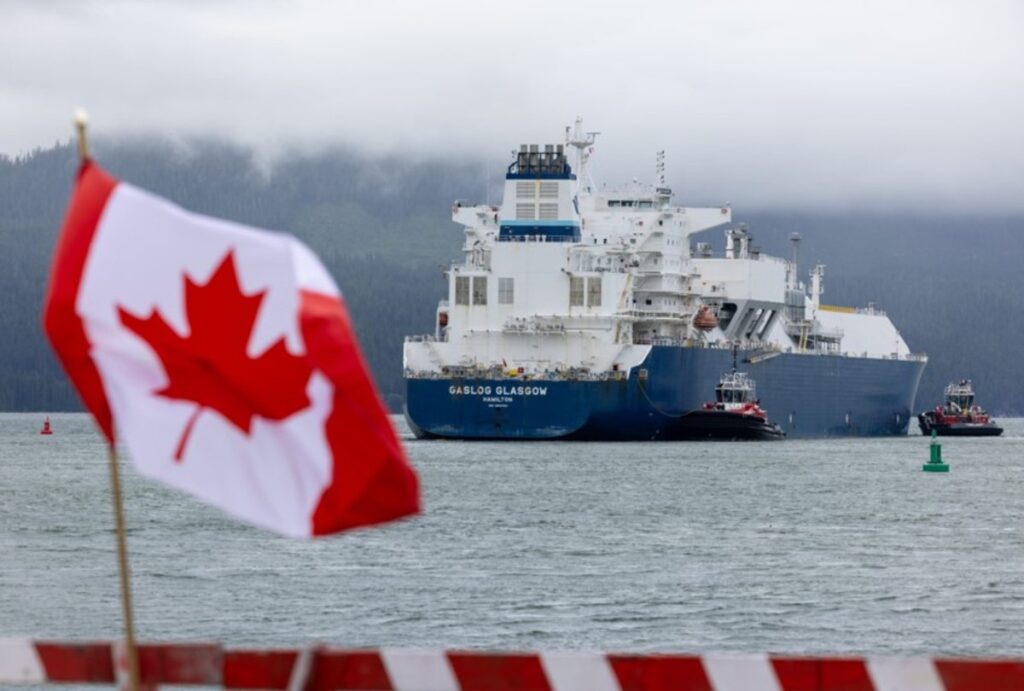
The LNG tanker GasLog Glasgow prepares to depart LNG Canada’s shipping terminal in Kitimat, B.C., on June 30. Photo by Handout/LNG Canada
A tanker carrying Canada’s first major shipment of liquefied natural gas has arrived at a South Korean port, ushering in a new era for Canadian energy exports that some had feared would never come, as the country’s natural gas reaches new buyers in premium Asian-Pacific markets.
A vessel called the GasLog Glasgow delivered the historic shipment from LNG Canada‘s terminal in Kitimat, B.C. The analytics firm MarineTraffic shows the Shell PLC-chartered tanker arrived at a major import terminal and storage base in Tongyeong, South Korea shortly after 10 a.m. local time on July 17.
Two other tankers have left LNG Canada’s terminal and remain in transit, heading to ports in Japan and South Korea. In total, the B.C. terminal has shipped 11 billion cubic feet of natural gas since the facility was commissioned, RBC Capital Markets reported in a research note published Wednesday. The bank based its estimate on the total capacities of the three vessels that have departed from Kitimat so far.
A fourth vessel — Petro-China-chartered tanker called WuDang — is in the port of Kitimat awaiting loading, RBC said. And three more are expected to arrive to load shipments in the coming weeks.
Though Canada is the world’s fifth-largest producer of natural gas — with a significantly shorter sailing time to Asian markets compared to competitors on the United States Gulf coast — the country is a late entry to global LNG markets, nearly a decade after the U.S. and around three decades after Australia and Qatar.
Proponents of the sector had worried that Canada was far too late and had missed the boat on LNG — at a heavy cost to the industry.
Until this week, all of Canada’s natural gas exports, averaging around 8.6 billion cubic feet per day (Bcf/d) in 2024, were delivered via pipeline to the U.S.
But Canada’s long-delayed entry into gas-hungry Asian markets is raising hopes that more LNG export projects could move forward — supporting production growth and lifting natural gas prices in Western Canada — despite some near-term challenges on the horizon.



The export terminal at Kitimat has been increasing production slowly due a technical problem with a line on one of the facility’s massive LNG processing units, Reuters reported last week. Repairs are expected to allow the unit to reach full output in a matter of weeks, though commissioning and ramp-up of production at a second unit is expected to continue into next year.
Canada’s LNG sector is launching amid weaker-than-expected demand for natural gas across North America and a fresh round of tariff threats from U.S. President Donald Trump.
Canadian natural gas producers had been hoping LNG Canada’s startup would boost chronically low prices, but they have so far been disappointed as the benchmark price in Western Canada continues to trade below US$1.00 per thousand cubic feet (mcf).
The region’s natural gas trades at a sharp discount to U.S. equivalents because of local oversupply and infrastructure constraints. Producers and investors had hoped that the direct outlet to global markets would ease pipeline congestion and the resulting discount on Canadian gas, but a material change to prices might not come until the B.C. terminal is closer to running at full capacity, Rystad Energy analyst Mathieu Utting said.
However, the same market conditions that have been so tough for Canadian producers are likely to be a boon for LNG Canada’s owners. Partners in the project, including Shell, Malaysian energy giant Petronas, PetroChina, Mitsubishi Corp. and Korea Gas Corp., are poised to capture higher margins from buying Canadian natural gas at low prices, before liquefying it and exporting the resulting LNG onto premium markets in Asia.
The JKM benchmark, which reflects spot LNG prices in Japan, South Korea, China and Taiwan, is currently trading at approximately three to four times the level of U.S. Henry Hub gas prices.
Shell declined to confirm a purchase price or details about the sale of LNG Canada’s first shipment for competitive reasons, though Utting said it was likely a contracted sale to one of Shell’s Asian customers.
Opinion has been divided over how long prices will remain weak in Western Canada, with most analysts suggesting that the answer will depend on how quickly LNG Canada can ramp-up to full capacity — and how producers respond.
Utting said LNG Canada’s impact on the market is likely to continue to grow as more volumes begin moving to the B.C. coast, with the full build-out of phase one expected to pull around 2 billion cubic feet per day (bcf/d) of natural gas from Western Canada.
“LNG Canada will impact the market in two ways,” he said. “One, for all equity holders in the project, this means premium East Asia LNG prices, and two, this will help relieve some of the bottlenecks out of the WCSB and that will in turn help the AECO benchmark.”
- Email: [email protected]
Share This:






















On The Verge: Energy Sector Primed for New Wave of Growth – ATB Economics