CDN NEWS |
  US NEWS







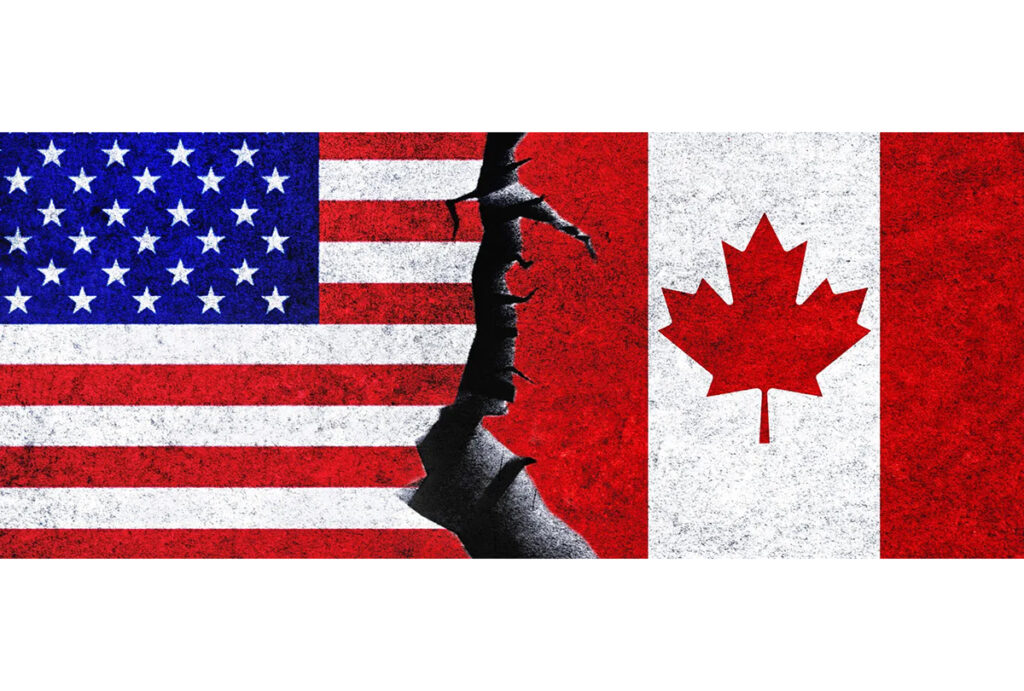
Despite the cordial nature of Prime Minister Mark Carney’s recent meeting with President Donald Trump, U.S. tariffs remain on Canadian exports of steel, aluminum, cars and other products.
In fact, Trump not only made clear that he has no intention to rescind the tariffs, he also suggested that renegotiating the Canada-United States-Mexico Agreement (CUSMA) is a low priority for him, adding that it may no longer even be necessary, presumably because he sees no advantage to free trade between Canada and the U.S. This is a bewildering insight even for Trump, as Canada is his country’s largest export market.
Prior to the meeting, Trump reiterated his claim that America “subsidizes” Canada to the tune of US$200 billion per year. In typical fashion, Trump did not explain how he arrived at this number, which makes addressing the claim impossible. But according to trade data, in 2024 Canada had a trade surplus in goods with the U.S. of $C85 billion (or $US62 billion)—that’s less than half of Trump’s claim. And Canada actually ran a trade deficit in services with the U.S.—a fact Trump consistently ignores in his public statements.
So, you can’t equate Trump’s number to Canada’s trade surplus with the U.S. Perhaps his “$200 billion” claim includes the value of the U.S. military’s defence umbrella. Or perhaps Trump simply uses a conveniently large number to justify his treaty-breaking actions against Canada.



Nevertheless, it seems clear that Canada-U.S. trade negotiations are a non-starter for Trump, who has repeatedly said the U.S. needs nothing that Canada produces. It’s impossible for the Carney government to make an effective case for closer economic integration when the other party to the negotiation sees no value in the trade relationship.
The prime minister and his team went to Washington to get a clear understanding of what Trump wants to negotiate. The only realistic takeaway from the meeting is that Trump is serious in wanting to make trade liberalization conditional on Canada becoming the 51st state. The latter is, of course, off the table for most Canadians. So, what’s the path forward for Canada?
Under different circumstances, the Canadian government might consider an EU-type arrangement with the U.S. Some formal sharing of responsibility for economic governance would arguably give Canada increased leverage in shaping North America’s business environment. However, whatever the theoretical benefits of an economic union with the U.S., it’s unrealistic to expect the Trump administration to agree to any shared economic governance with Canada, and also unwise to expect it would honour any agreement, even if an agreement that was palatable to Canadians could be reached.
In light of these realities, the Carney government should temporarily suspend trade negotiations with the U.S. There will likely come a time in the foreseeable future, perhaps after the 2026 midterm elections in the U.S., when the U.S. Congress is prepared to rescind the president’s executive power to abuse emergency provisions in U.S. trade legislation to wage political vendettas against trading partners.
Meanwhile, in preparation for a future where mutually beneficial trade deals with the U.S. are again possible, federal and provincial government officials in Canada should have their own candid negotiations about what Canadian tariff and non-tariff barriers are truly non-negotiable, and what U.S. concessions would be required to put previously non-negotiable items on the table for bargaining. A bold new trade agenda from Canada could energize U.S. legislators who want to restore a rules-based international economic regime and reassert their Constitutional responsibility, which has been effectively usurped by Trump, to approve and uphold U.S. trade agreements with other countries.
This way forward is not what Canada hoped for, but it appears to be the only realistic course of action.
Share This: