


 CDN NEWS |
  US NEWS










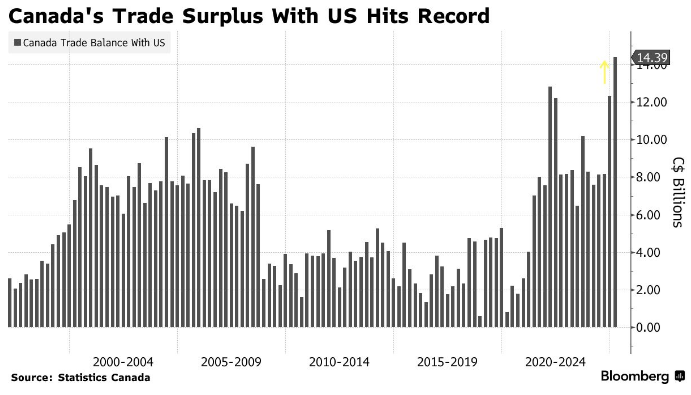
Canada’s exports to the US surged in January on shipments of cars, auto parts and energy, pushing the northern nation to post a record trade surplus with the US.
The country’s merchandise trade surplus with the US widened to C$14.4 billion ($10 billion) in January, from C$12.3 billion in December, Statistics Canada said Thursday. Exports to the US surged 7.5% in January and set a record for a second consecutive month.
Canadian auto exports — of which 93% are destined for the US — jumped 12.5%, with shipments of passenger cars and light trucks reaching their highest level since May 2019. Energy exports grew 4.8%, driven by crude oil and natural gas bound for the US. Consumer goods exports rose 7.8% on pharmaceuticals headed south, while industrial machinery exports also spiked.
The data capture how US President Donald Trump’s tariff threats have influenced trading flows and business decisions, with exporters and importers scrambling to avoid higher costs due to steep levies. Sweeping tariffs on Canada and Mexico were initially expected to start as soon as inauguration day on Jan. 20, before Trump announced a Feb. 1 start date.
After a further one-month delay, the Trump administration on Tuesday imposed 10% tariffs on Canadian energy products and 25% duties on everything else the US buys from Canada and Mexico, with automakers getting a reprieve until April. Additional levies targeting what Trump views as trade imbalances are also expected next month.
The Canadian government this week immediately hit back with retaliating levies on C$30 billion worth of American products, including appliances, cosmetics, fruit and tires. The list will be broadened in three weeks and cover American-made vehicles and other products, totaling C$155 billion in import value.
The overall US trade deficit widened to a record $131.4 billion in January, according to Commerce Department data that was released at the same time as the Canadian figures.
In January, the Canadian auto sector shipped over C$1 billion more than in December, according to Andrew DiCapua, economist at the Canadian Chamber of Commerce.
“Trump’s tariff talk is already shaking up trade,” he said in an email. “US buyers are scrambling to stock up on Canadian goods, pushing exports higher as they rush to beat the tariffs. This inventory stockpiling could backfire if the tariffs don’t last, but given the chaos, that seems unlikely.
“One thing’s for sure, this uncertainty is creating major swings in the data, and we’re just getting started. Businesses have got to pile up supplies and that is exactly what they’re doing.“

Read More: Trump Likely to Defer Tariffs on Goods, Services Under USMCA
Overall in January, Canadian exports exceeded imports by C$4 billion and as a result, its trade surplus with the world widened from an upwardly revised C$1.7 billion in December. Economists in a Bloomberg survey were expecting a much smaller C$1.3 billion surplus.
Exports jumped 5.5% in the first month of the year and imports rose 2.3%, both reaching record highs with a fourth straight monthly increase. A weak loonie contributed to the gains, but on a volume basis, exports were still up 4.5% and imports up 1.5%.

The Stellantis Windsor Assembly Plant in Windsor.Photographer: Emily Elconin/Bloomberg
The extent to which surging exports will have boosted GDP growth in the first quarter as a whole will depend on how sharply January’s increased is reversed in February and March, once Trump had taken office, said Bradley Saunders, economist at Capital Economics.
“The decision to ultimately postpone the 25% tariff on goods imports from Canada for 30 days last month may mean the hard data paint a more positive picture. Similarly, the imposition of the 25% tariff this week was swiftly followed up with a temporary 30-day carveout for autos, which will also soften the blow to export volumes,” he said in a report to investors.
Canada’s economy depends heavily on its ability to trade with the US. In 2024, the combined value of Canada’s imports and exports of goods traded with the US surpassed the C$1 trillion mark for a third straight year. The US was the destination of 75.9% of Canada’s total exports and was the source of 62.2% of Canada’s total imports.
Shipments to countries other than the US fell 1% in January.
Canada’s export outlook has soured amid the tariff war and the recent 30-day pause on auto sector tariffs does little to remove uncertainty for this industry, Rishi Sondhi, economist at Toronto Dominon Bank, said in a report to investors.
“Indeed, the negative impact on US-bound shipments will be one of the primary channels through which Canada’s economy is harmed. A weak Canadian dollar could provide some offset, although would add to tariff-related inflation pressures for Canadians.”
— With assistance from Erik Hertzberg
Share This:























THE GEOTHERMAL OPTION: B.C.’s Overlooked Firm Power Option: What the Geothermal Evidence Shows – Resource Works