


 CDN NEWS |
  US NEWS







By Yogi Schulz
Energy transition forecasting has become more complex due to uncertainties in the plans of nations, businesses and households. While the pace of the energy transition will not determine global energy consumption, it will determine the mix of various energy sources throughout the forecast period. Forecasting how the mix of various energy sources will evolve adds more complexity to forecasting.
Many organizations and individuals have created energy transition forecasts that vary widely and are contradictory. These forecasts are heavily influenced by the author’s:
- Ideological commitment to or skepticism about addressing climate change.
- View on how to conduct the energy transition technically.
- Opinion on how to finance the energy transition.
- Recognition of the role of people change management in the energy transition.
In this article, Yogi Schulz will attempt to be as factual as possible and discuss:
- How and when the energy transition will unfold.
- Recommendations to achieve the energy transition.
Most of the data and discussion is focused on the goal of the Conference of the Parties (COP) to hold the global average temperature increase below 1.5° C by 2050. COP is the UN organization chartered with the mandate to address climate change.
To read the related article “Global GHG Emissions Forecasting in the Age of Climate Change,” click here.
Energy transition forecast
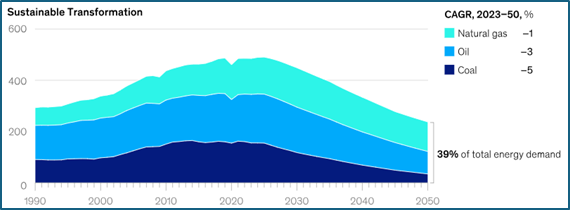
This chart shows McKinsey’s most optimistic forecast for global fossil fuel consumption in 2050, which is still 39% of total energy demand. In 2050, many environmentalists and the COP want the energy transition to be complete. Complete means no or negligible fossil fuel combustion.
Source: Global Energy Perspective 2024, McKinsey
Some environmentalists promote a rapid energy transition to address climate change before it causes more ecological and property damage. Others suggest a more cautious approach given the following constraints:
- Universal resistance to change.
- Concerns about transition costs to businesses and households.
- Risk of adopting new energy consumption or production technologies not ready for routine use.
The uncertainties around every forecast for the pace of the energy transition include the following factors:
Uncertain progress by countries
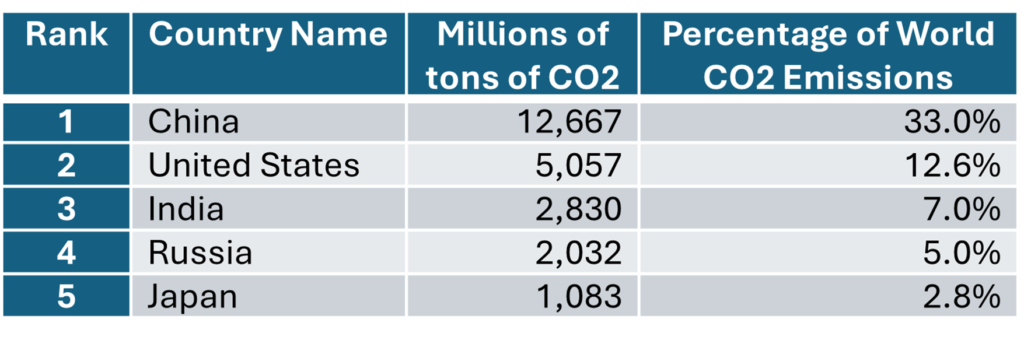
This table shows the five countries that produce over half of annual GHG emissions. The success or failure of the energy transition will be proportional to their efforts to reduce their GHG emissions.
Source: Countries With The Highest Carbon Footprint 2024, GreenMatch
The impact of the remaining countries is negligible individually. However, other countries should not use that fact as an excuse to avoid lowering our GHG emissions where reasonably feasible.
The pace at which countries are willing or able to reduce their GHG emissions varies widely. The slow current pace suggests that the energy transition will take decades beyond 2050.
Uncertain progress on reversing skepticism
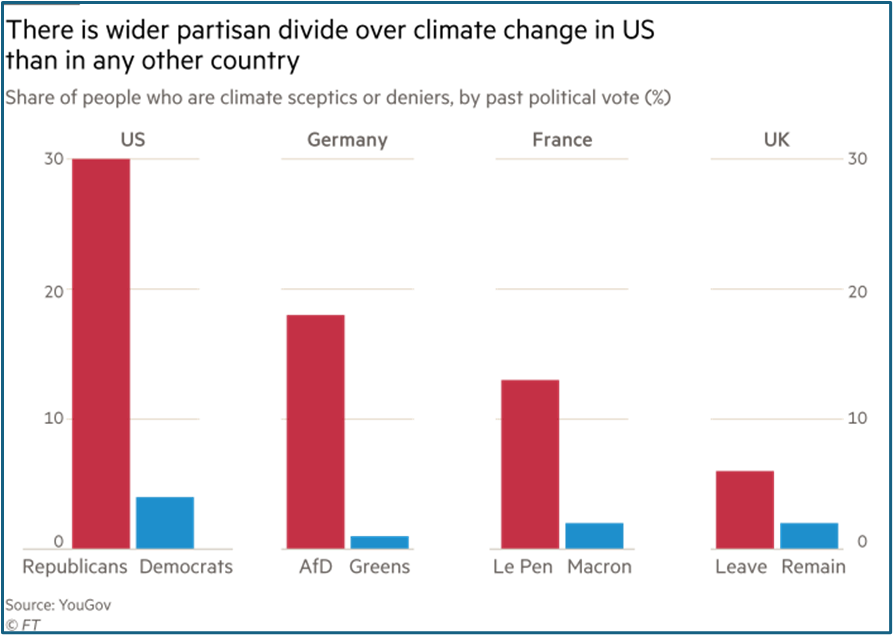
This chart illustrates that many people are skeptical that climate change is a problem that needs attention. Social media is awash with comments from self-appointed experts claiming that they know better and that respected scientists are wrong about climate change. It’s difficult for political leaders to challenge skepticism when election outcomes are close, and backlashes to comments occur frequently.



Source: Survey underscores high levels of US scepticism on climate change, Financial Times
The impact of GHG emissions on the planet’s climate is not easy to understand. That difficulty has created an opportunity for some to:
- Claim that climate change is natural and normal. Signification fluctuations have occurred during geological time.
- Question the science and claim there’s no consensus among scientists.
- Claim the climate is not changing, and what we’re observing is simply weather anomalies.
- Suggest we don’t need to worry. Civilization, plants and animals can adapt to the changes.
- Suggest that climate change’s global average temperature increase is positive because it increases plant growth and agricultural yields.
- Claim that the need to address climate is a conspiracy theory.
The impact of these inaccurate arguments is to create skepticism about climate change. The public expression of this skepticism delays political action and will extend the energy transition.
Recommendations to achieve the energy transition
The pace at which governments, businesses and households act on the recommendations below will determine how long the energy transition will take beyond 2050.
Accelerate progress in reducing GHG emissions
Our challenge is to collectively reduce GHG emissions enough to have a material impact on climate change. The elements of a reasonable-cost approach that will overcome the usual resistance to change include:
- Reduce consumption of fossil fuels by replacing them with low or no-GHG-emitting energy sources gradually. Climate change denial is ridiculous.
- Implement a carbon tax that’s revenue-neutral to the government. More taxes undermine commitment.
- Quit spending money on subsidies and grants. They’re unlikely to materially accelerate the energy transition while adding enormous amounts of public debt, contributing to inflation.
- Accept that the energy transition can’t be achieved without nuclear fission power generation and include it in the mix of future energy sources.
- Increase attention to reducing methane emissions. Methane has a higher GHG impact on the atmosphere and a dramatically smaller number of sources than CO2.
- Focus more attention on energy conservation and efficiency. These measures are often overlooked but can contribute materially.
- Implement more electricity interconnect capacity to share renewable electricity better and increase distribution grid resilience.
- Implement a smarter electricity distribution grid to cope with more intermittent generation.
- Replace energy production and consumption devices at the end of their useful life, not sooner. Stranded assets add to cost and undermine commitment.
If governments, businesses, and households can adopt these measures more quickly, it will reduce the elapsed time needed for the energy transition beyond 2050.
Accelerate progress in development permitting
The energy transition depends on a massive increase in electricity generation, distribution, and mining of critical minerals.
Most nations have added considerable complexity and uncertainties to their permitting process for major industrial and mining development projects. The motivation is often well-intentioned consultation and transparency.
Accelerating slow permitting and reducing expensive delays will shorten the energy transition.
Accelerate progress in exploiting local characteristics
The mix of energy sources countries will employ to achieve the energy transition will vary enormously. For example, some nations have:
- More land and sunshine to favour solar electricity generation.
- More land and wind to favour wind electricity generation.
- Little land and will develop nuclear electricity generation.
- Little land and will pursue highly decentralized solar or wind generation.
- Geothermal resources.
- Topology suitable for hydroelectric electricity generation.
- Significant natural gas or coal resources and may choose to implement CCUS to remove the associated GHG emissions when these are burned for electricity generation.
- Access to surplus electricity from neighbours and will simply buy that.
Many countries struggle to formulate a political consensus on actioning the required additions to the energy infrastructure. Minimizing delays will shorten the energy transition.
Accelerate progress in required technology
The significant technologies required to complete the energy transition include:
- Nuclear fission electricity generation.
- Carbon Capture and Underground Storage (CCUS).
- Enhanced control technology for distribution of variable electricity generation.
- High-voltage AC or DC electricity grid interconnectors.
- Heat pumps.
- Technology to reduce energy wasted or not consumed.
- Alternative technology for cement and steel production.
- Critical minerals processing.
- Processing CO2 into commercial materials.
Sometimes, policymakers and citizens become enthralled by silver bullets that will make the energy transition faster, cheaper and easier. Examples include:
- Unfortunately, it’s an expensive and complex substitute for natural gas.
- Electric trucks. Unfortunately, the weight of the required batteries precludes them from displacing diesel.
- Nuclear fusion. Unfortunately, its development is nowhere close to commercialization.
For all required technologies, likely adopters are concerned about risk and cost. Those concerns will extend the energy transition. Government research support can reduce the time spent on development.
These forecasts and related analyses suggest that the energy transition will continue well beyond 2050. If McKinsey’s optimistic forecast above becomes reality as the world approaches 2050, the energy transition could be achieved before 2100.
Yogi Schulz has over 40 years of experience in information technology in various industries. He writes for Engineering.com, EnergyNow.ca, EnergyNow.com and other trade publications. Yogi works extensively in the petroleum industry to select and implement financial, production revenue accounting, land & contracts, and geotechnical systems. He manages projects that arise from changes in business requirements, the need to leverage technology opportunities, and mergers. His specialties include IT strategy, web strategy, and systems project management.
Share This:



















