


 CDN NEWS |
  US NEWS








By Yogi Schulz
Forecasting greenhouse gas (GHG) emissions can tell us what we will pay for the energy transition to address climate change. If GHG emissions are not decreasing as governments and environmentally-conscious citizens expect, carbon taxes will likely increase, and regulations will tighten. These measures will increase the cost of living, contribute to affordability issues and may increase inflationary pressure.
Forecasting GHG emissions has become more complex due to economic and population growth uncertainties. Also, the pace of the energy transition will determine the global GHG emissions trend.
Many organizations and individuals have created GHG emissions forecasts that vary widely and are contradictory. These forecasts are heavily influenced by the author’s:
- Assumptions about economic and population growth.
- Assessment of how measures to address climate change will play out.
- Views about the likelihood of energy conservation and efficiency.
- Recognition of the role of people change management in the energy transition.
In this article, I will attempt to be as factual as possible in discussing atmospheric GHG forecasts. This is the second of three articles. To read the previous article, “Global energy consumption forecasting in the age of climate change”, click here.
Most of the data and discussion is focused on the goal of the Conference of the Parties (COP) to hold the global average temperature increase below 1.5° C by 2050. COP is the UN organization chartered with the mandate to address climate change.
Global GHG Emissions Forecast
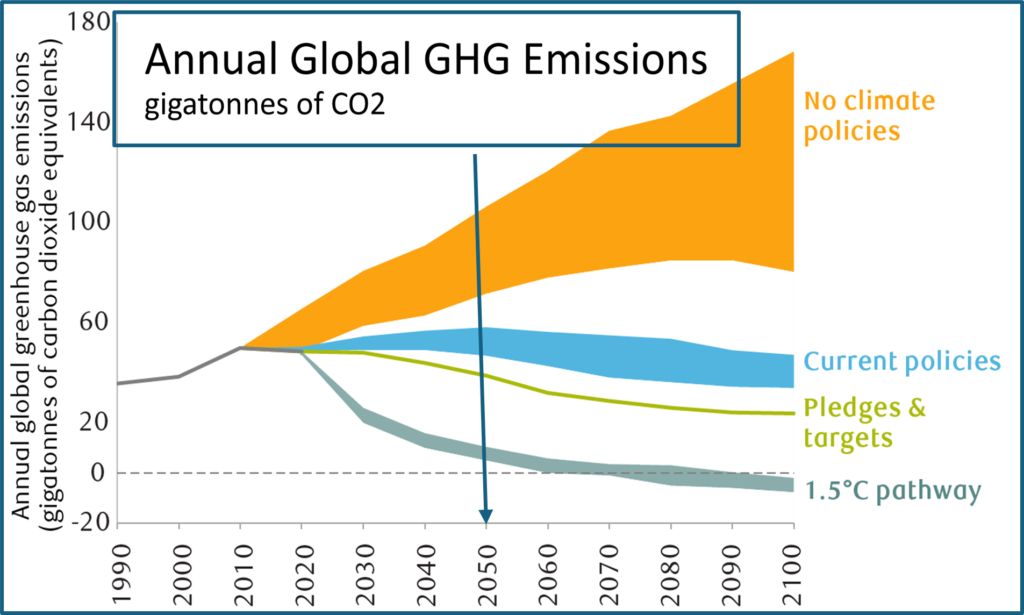
The chart below shows multiple scenarios about how the global effort to reduce GHG emissions to address climate change might play out.
The goal of COP is to hold the global average temperature increase below 1.5° C by 2050. None of the scenarios shown on the chart achieve the COP goal.
We’ve added about two ppm of GHG to the atmosphere yearly in recent decades. That increase will continue until we achieve net zero. The 2023 GHG value was 420 ppm. The eventual peak GHG value may turn out to be as high as 475 ppm.
Some published charts claim to achieve the COP goal. However, these are aspirational at best for the reasons discussed below.
No climate policies
If nations, businesses and households make no effort to address climate change, the global average temperature will increase by 4.1–4.8° C by 2100. The temperature increase will:
- Be the same if climate change policies are not implemented.
- Produce a catastrophic impact on weather, flora and fauna.
This scenario creates a forecast with a wide uncertainty range because the mix of energy fuels individual countries will employ to meet their energy consumption forecasts is challenging to predict.
Current policies
If current policies are implemented, the global average temperature will increase by 2.7–3.1° C by 2100. The forecast shows a small uncertainty range because some current policies are ambiguous. Also, some countries have not developed any policies.
Pledges & targets
The global average temperature will increase by 2.4° C by 2100 based on countries delivering on pledges to reduce further emissions. The pledges are contained in the press releases issued at the annual COP meetings. Some countries have not made any pledges.



1.5° C pathway
GHG emissions must decrease to zero to hold the global average temperature increase below 1.5° C. Notice how this line goes below the zero line.
To reach the target of an increase in global average temperature that does not exceed 1.5 degrees Celsius, nations must go beyond net zero and remove an additional 5 – 8 gigatons of CO2 from the atmosphere.
Source: Net zero: What will life be like in 2050?, RBC Wealth Management
If we accept the Energy Consumption Forecast by Fuel Type chart in the previous article as reasonably accurate, then holding the global average temperature increase below 1.5° C will not occur by 2050 and may not happen by 2100.
Attempting to hold the global average temperature increase below 1.5° C by 2050 with sufficiently drastic measures will cause significant public debt, consumer price increases and inflation. Some commentators suggest such an approach will lead to economic and social collapse.
Reducing GHG levels
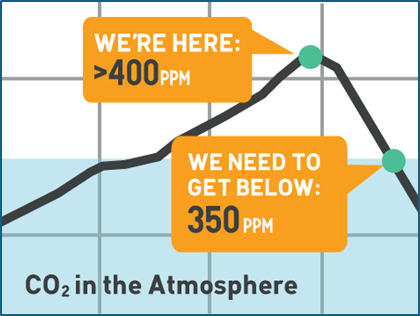
The world has focused so much on achieving net-zero emissions that we forget it’s only the first step. Net-zero stabilizes the atmospheric GHG level but does not reduce it.
The chart below illustrates the need to reduce GHG emissions to less than 350 ppm to stop the adverse impacts of climate change that we are already experiencing.
Source: Why 350?, MN-350
To return the atmospheric GHG level closer to its pre-industrial level of 280 ppm, the world would need to move towards net-negative GHG emissions by actively removing more emissions from the atmosphere than are being emitted. Reducing the atmospheric GHG level would require:
- Carbon Capture and Underground Storage (CCUS).
- Direct Air Capture (DAC).
To some extent, the following natural processes that remove CO2 from the atmosphere will help reduce the CO2 level:
- Some CO2 will be absorbed quickly by the ocean surface.
- Some CO2 will remain in the atmosphere for thousands of years due to the slow process by which carbon is transferred to ocean sediments.
In the lower atmosphere, methane, another significant GHG, reacts with hydroxyl radicals to create water vapour and CO2.
If the eventual peak GHG value turns out to be 475 ppm, and the rate at which GHG can be reduced is an aggressive two ppm per year, 350 ppm can be achieved in about 60 years.
These forecasts suggest that GHG emissions from all sources will grow in response to population growth and rising prosperity, which increase per capita energy consumption. With growing energy consumption and a modest transition to low GHG energy sources, atmospheric GHG levels will continue to grow. With a more determined transition to low GHG energy sources, atmospheric GHG levels will level off. It is challenging to forecast when the world will reach net-zero.
Yogi Schulz has over 40 years of experience in information technology in various industries. He writes for Engineering.com, EnergyNow.ca, EnergyNow.com and other trade publications. Yogi works extensively in the petroleum industry to select and implement financial, production revenue accounting, land & contracts, and geotechnical systems. He manages projects that arise from changes in business requirements, the need to leverage technology opportunities, and mergers. His specialties include IT strategy, web strategy, and systems project management.
Share This:



















