


 CDN NEWS |
  US NEWS







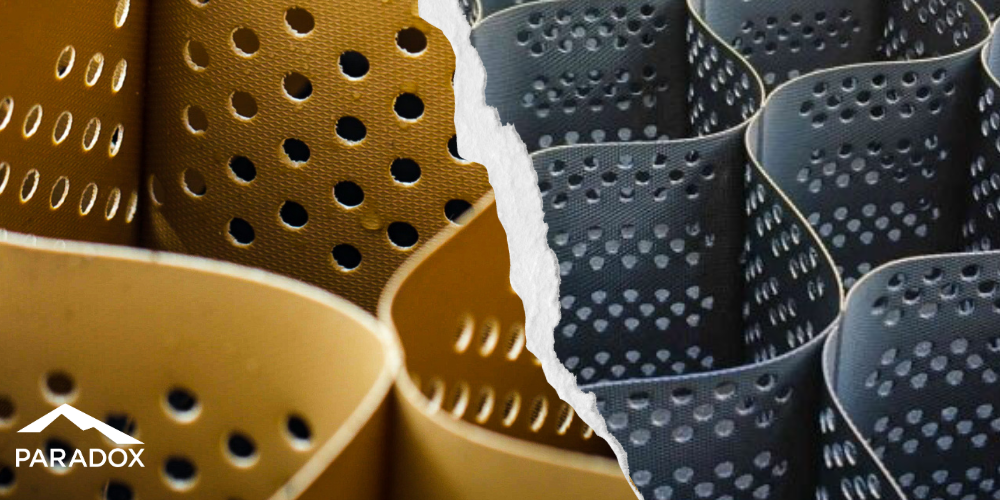
What are geocells?
Geocells are unique, high-performance cellular confinement systems used for soil stabilization. They have the structure of a honeycomb laid out over subgrade and hold granular infill, creating a reinforced composite surface. The 3D interaction of the soil, cell walls, and geometry maintains soil compaction, thus increasing the structural strength of the infill and pavement layer. Versatile in use, geocells are a great option for building paved and unpaved roads, access roads, heavy haul and mining roads, pads, and slope stabilization applications.
Differences between Tough Cell® NPA geocells vs HDPE geocells
Tough Cell® NPA (Novel Polymeric Alloy) geocells and HDPE (High-Density Polyethylene) geocells are both cellular confinement systems. Designed to perform as options for soil stabilization, erosion control and load support applications, they are similar, but Tough Cell® NPA is superior in terms of material, strength, durability and longevity.
Geocells made with HDPE (High-Density Polyethylene), also known as soft cells, offer flexibility and are suitable for landscapes, light duty roads, and short-term applications. However, Tough Cell® geocells provide long-term solutions and are made with NPA which provides high elastic and tensile stiffness suitable for civil engineering applications with low permanent deformation levels.
Here are the differences elaborated:
1. MATERIAL COMPOSITION: Tough Cell®’s NPA material is a combination of different polymers designed to enhance the tensile strength of the geocells. HDPE is made of plastic material that is unable to withstand extreme pressure due to its lower stiffness which leads to deformation more easily than Tough Cell®’s NPA.
2. MECHANICAL PROPERTIES: NPA geocells provide a higher level of strength and stiffness than their counterpart HDPE, which provides moderate strength and stiffness. NPA geocells also provide better resistance to deformation and creep, allowing the cell to retain its shape under heavy dynamic loading while providing high dimensional stability. With NPA’s high resistance to creep, it provides long-term protection for structures. Learn more
Additionally, NPA geocells have a large window of temperature resistance, with proven, tested, effective temperature ranges from -60oC to +60oC without failure. In other words, it performs well in extreme temperatures without significant loss of strength or flexibility. Extreme temperatures affect the plastic properties of HDPE, leading to a decrease in the performance of these cells.
3. DURABILITY: NPA geocells provide long-term durability through their high resistance to UV radiation, oxidation, and chemical degradation, whereas HDPE geocells provide a shorter lifespan in various environments.
4. APPLICATIONS: NPA geocells are ideal for projects that require high load-bearing capacity, such as railways, heavy haul roads, and pads in the oil industry. They are suitable for soft soils and challenging soil conditions, slope stabilization, erosion control, and retaining walls. Their HDPE counterpart is commonly used for simpler projects that may not require the level of support, durability, and longevity that Tough Cell® NPA geocells offer.
Benefits of Tough Cell® NPA geocells vs HDPE geocells
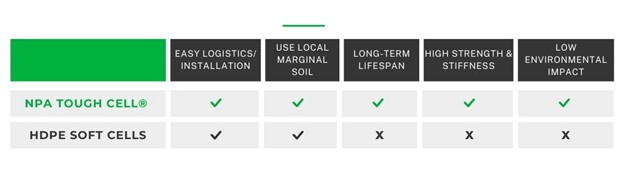
- Higher tensile strength- up to 25 kN/m
- 3-10x more resistant to deformation
- 2 to 5x more dimensionally stable over a much wider temperature range (-60oC to +60oC)
- Significantly more resistant to stress-cracking
- 10x more resistant to oxidation and UV degradation over time
Do you need to build a road, slope, or pad? Contact Paradox to get a quote for the most trusted and reliable geocells on the market! 1.877.MUD.UGLY or [email protected].

Share This:























COMMENTARY: Norway Breaks Ranks – The First Crack in Europe’s Net-Zero Facade