


 CDN NEWS |
  US NEWS







How natural gas exports carbon capture and digital infrastructure position Canada as a global clean energy leader
By Jim Rushton
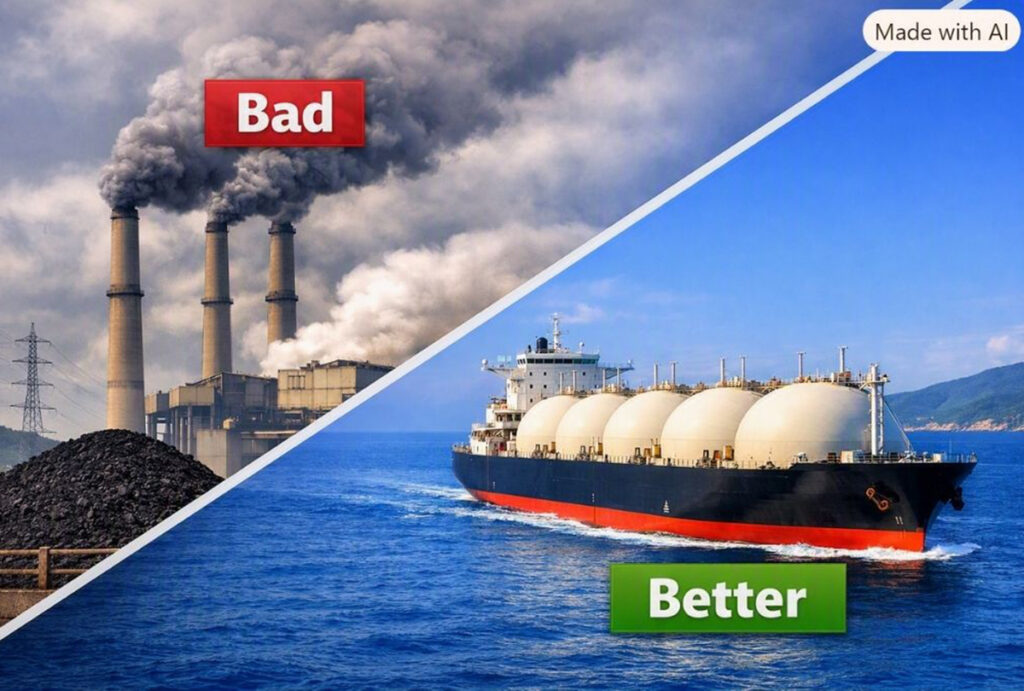
AI-generated illustration contrasting “bad” and “better” approaches to Canada’s energy and climate future.
The recently released Yale and Columbia University Environmental Performance Index (EPI) suggests that Canada is an environmental laggard.
We can expect those who object to the recent pragmatic policy changes Ottawa has made regarding oil production and transport, and British Columbia regarding LNG exports and the continued use of domestic natural gas, to take advantage of the EPI project.
In a comparison of the Global West, Canada ranks 21st out of 22 countries. However, the ranking system overlooks some key characteristics: 19 of the 22 countries are tiny compared to Canada; only Australia mirrors Canada’s sparse population distribution and high power demand due to extreme hot and cold climates.
Reading the IEA’s Global Methane Tracker, we find that in 2026 Canada has the lowest methane intensity in upstream and downstream oil and gas production in North America and ranks in the top tier among global rivals.
Digging deeper into Canada’s carbon emission record, we find more to be positive about.
Canada’s real-life record ignored in favour of policy goals
In 2003, Ontario relied on coal for 25 per cent of its electricity and brought that share to zero in 2014. Alberta cut coal electricity generation from 54 per cent in 2015 to zero by 2024.
Per capita emissions remain comparatively high, largely due to land area, latitude, and the country’s status as a significant global supplier of oil and gas, other resources, and agricultural products.

Source: Environment and Climate Change Canada, 2026 National Inventory Report.
CCUS in Canada
Canada is home to roughly one-seventh of the world’s active large-scale carbon management projects, and has been an early mover in carbon capture, utilization and storage (CCUS) since some of the technology’s first large-scale deployments.
Following COP26 in 2021, Canada and other oil and gas producers, including the United States and Norway, placed greater emphasis on carbon management, particularly for hard-to-abate sectors and oil and gas production itself.
The IPCC has concluded that CCUS deployment currently lags what’s needed to limit warming to 1.5°C or 2°C, making the pursuit of Canada’s Carbon Management Strategy even more important.
The climate activists’ campaign ramps up
Despite Canada not being a climate laggard, the climate movement has turned its attacks on the pragmatic economic changes Ottawa and the provinces have made to rebuild the economy in the face of existential threats.
Tech bros bad—Big Oil bad
Forever, the climate movement’s villain was Big Oil. Now it has Big Tech to add to its populist campaign.
Underlying the attacks against data centres, new pipelines, and LNG is the notion that actions taken in Canada would affect temperatures and wildfires in the foreseeable future.
Worse, they ignore the domestic and global benefits of continuing on the pragmatic path Canadians are supporting today.
Street protests against data centres in Vancouver have begun, even though the province has already imposed tight restrictions on data and AI centres. Anti-pipeline and LNG campaigns are about to start ramping up.
Emily Lowan’s Green Party is organizing a petition against the Prince Rupert Gas Transmission Pipeline (PRGT), which they label a MAGA pipeline. The Green Party is doing so despite the Nisga’a Nation holding an ownership stake in the pipeline that will supply the Ksi Lisims floating LNG terminal—which is itself an historic Nisga’a project. The Gitxaala now supports the Nisga’a projects.
The Union of British Columbia Indian Chiefs have written to Prime Minister Carney and Premier Smith, with a copy going to Premier Eby, calling for a halt to efforts to advance the West Coast Pipeline.



Three reasons to keep going
Data centres
Microsoft’s research finds 17.8 per cent of the world’s working-age population uses AI in some form. The growth is so persistent that they track it quarterly.
Protests against data centres will not stop the demand for them from growing. It would result in a missed opportunity for massive domestic and foreign direct investment in data storage on Canadian soil, under Canadian law.
An essay published by the HUB suggests that Canada should become the world’s data-centre capital rather than trying to replicate Silicon Valley. Software is a global phenomenon and data storage is domestic.
We have the comparative advantage of large, very sparsely populated areas with a cold climate. The pairing of renewables with nuclear, natural gas and potentially thermal and new hydro generation presents a tremendous opportunity.
Construction employment is huge, and when operating, data centres provide jobs similar to those at a midsized factory. Communities in Northern Canada, 400 jobs really means something. Maybe this is why more Indigenous communities are looking into Small Modular Reactors (SMRs)
Pipelines
Potential oil customers are knocking on Canada’s door weekly.
Energy security will be a top issue long past the current geopolitical turmoil, giving Canadian oil and natural gas a strong competitive advantage.
“I wish there were a few more Canadas in the world, so that we can have a much more reliable and sustainable global energy system.”—Fatih Birol, Executive Director of the International Energy Agency
This should give us confidence in the market and give assurance that we are doing the right thing by exporting more.
Natural gas
As noted, Canada’s low methane intensity makes our natural gas a strong replacement for coal
It is hard to visualize just how much coal and organic material needs to be replaced over time. We can get an idea with this chart.
Replacing coal and traditional biomass (wood, waste, animal dung, etc.) combined comes very close to replacing oil. And, much of it will need to be replaced with firm power.
The situation provides a lot of space for BC’s LNG, Canada’s growing expertise in CCUS and conventional and small modular nuclear reactors
According to modelling in the Public Policy Forum’s Dec. 8, 2025 publication, Refuel, the completion of all in-progress LNG terminals in British Columbia would result in global reductions of GHG emissions equivalent to—and at the high end of the model, larger than—a full year of all B.C.’s economically caused emissions.
Embracing global climate pragmatism
Consider the benefits of proceeding with today’s plans as quickly as reasonably possible, year over year. Globally, the benefits would be celebrated and boost national pride.
Domestically, living standards would rise, deficits would disappear, the social safety net would widen, and, for those most concerned about environmental issues, our own green transition would be accelerated.
The move toward pragmatism has changed the elite premise that emission reductions only count domestically. Climate Change is a global problem; emissions counts should be global, and greener products should be recognized.
In British Columbia, we should respect the work of Prime Minister Carney and Premiers Smith and Eby, for each, in their own way, is bringing economic and climate pragmatism to pipelines, LNG and data centres; we surely need it.
Pragmatic action is hard, not fancy, but necessary.
Jim Rushton is a 46-year veteran of BC’s resource and transportation sectors, with experience in union representation, economic development, and terminal management. Reach him at [email protected].
Resource Works News
Share This:




















SETTING OFF ALARM BELLS: Carney’s EU Deal Threatens Alberta, Energy, & Sovereignty – 170,000 Reasons to Reject Canada’s EU “Associate Membership” – The Nemeth Report