CDN NEWS |
  US NEWS









Introduction
Proper sampling in the energy industry is essential for accurate analysis of natural gas components such as BTU determination, moisture, and H2S. This article discusses fundamental methods for designing and sampling for these analyses, explores alternative systems for specific applications, and considers various sampling configurations for different contaminants. The application, including the purpose of the analysis, gas composition, and operating conditions, drives the selection of proper components such as coatings, membrane locations, regulator placements, and elastomer selections.
Industry Standards and Probe Placement
The American Petroleum Institute (API), Gas Processors Association (GPA), and International Standards Organization (ISO) have established guidelines for natural gas sampling:
- API Manual of Petroleum Measurement Standards, Chapter 14.1 – Collecting & Handling of Natural Gas Samples for Custody Transfer
- GPA 2166-05 – Obtaining Natural Gas Samples for Analysis by Gas Chromatography
- ISO 10715 – Natural Gas Sampling Guidelines
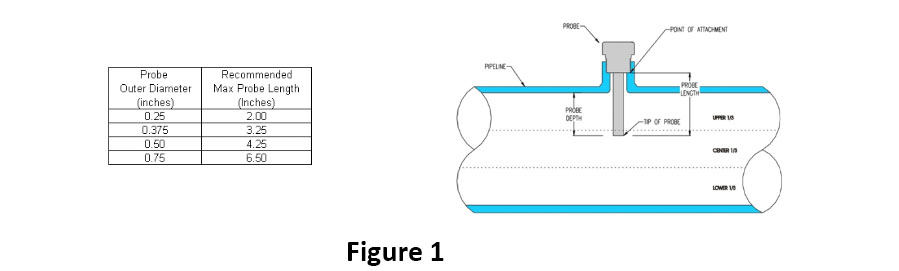
These standards emphasize the importance of placing the sample probe in the center one-third of the pipe cross-section to avoid probe breakage due to resonant vibration triggered by high gas velocities. Additionally, probe length recommendations and mounting positions help ensure a representative sample, particularly for transmission quality gas. Both standards recommend using probes less than ten inches in length. The length referenced is not the distance between the inner pipe wall and probe tip but rather the length between the point of attachment and the probe tip. (See Figure 1 for recommended probe length dimensions taken from API 14.1 and GPA 2166 Standards).
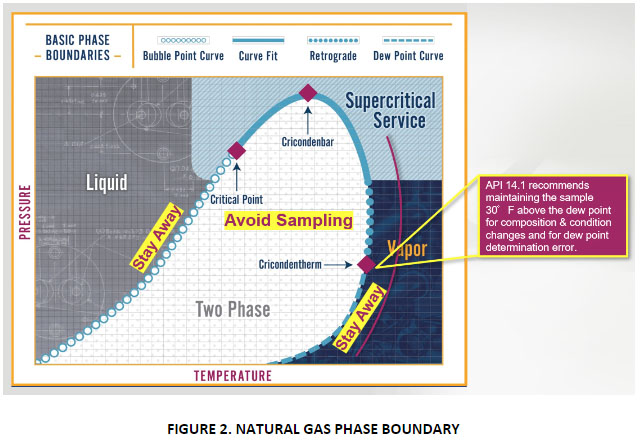
Sampling above the hydrocarbon dew point is crucial, as obtaining a representative sample from a gas source near this point is challenging.
Wet Gas Sampling
Wet gas, defined as having a gas volume fraction (GVF) greater than 80%, includes both natural gas liquids and other contaminants like water, oil, and treatment chemicals. Proper sampling of wet gas requires identifying specific segments of the gas flow and selecting appropriate sampling methods. The analytical community must refine the definitions and methods for handling wet gas to improve accuracy.
Phase Curve and JT Effect
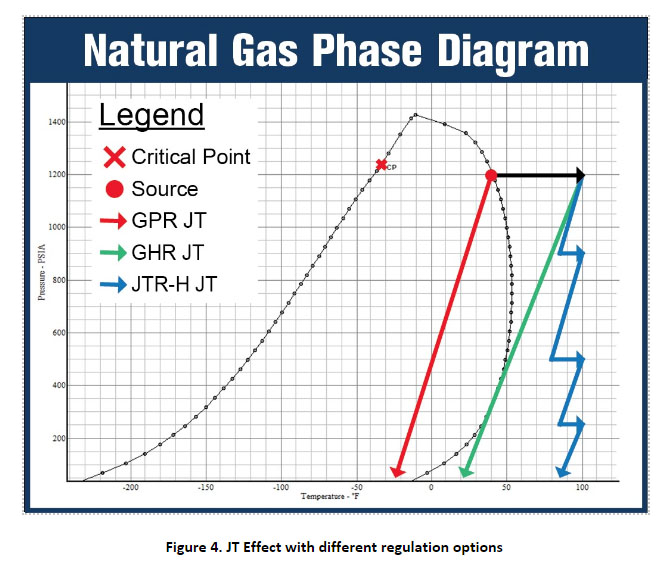
Understanding the gas’s phase at the extraction point is essential for selecting the right sampling equipment. Phase diagrams illustrate the gas’s phase boundary and the Joule-Thomson (JT) effect, where compressed gas cools as it expands. (See Figure 2 for the natural gas phase boundary).
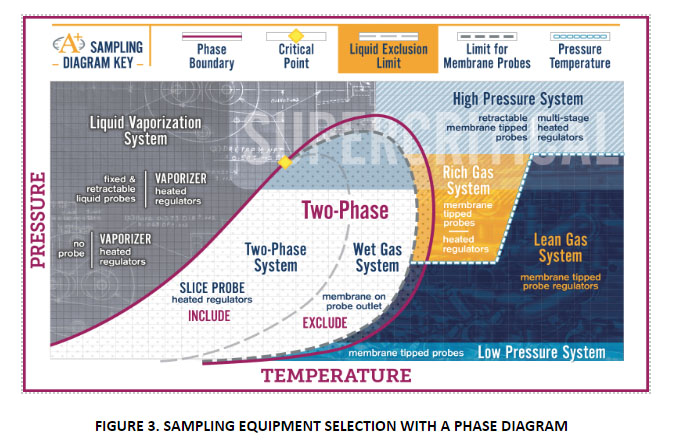
Proper sample system design must account for this cooling effect to avoid condensation and ensure accurate analysis. Selection of the most appropriate sampling equipment based upon the relation of source conditions to the phase boundary is illustrated by the phase diagram in Figure 3.
External, multistage, or multiple heated regulators in unison will help mitigate JT cooling effects. Figure 4 illustrates the JT effect with different regulation options.
Sampling for BTU Determination
Accurate BTU determination requires separating liquids from the gas sample in the pipeline under operating pressure and temperature, typically using a membrane-tipped probe. This method maintains vapor-liquid equilibrium, preventing unrepresentative samples. Attempting to sample both liquid and gas phases can distort the sample and damage the analyzer, making separation at the source the best practice.
Sampling for Moisture and H2S Measurement
Moisture and H2S measurements benefit from using membrane-tipped probes to exclude contaminants. High levels of H2S can clog membranes, necessitating alternative designs like membrane separators at the top of the probe for easier maintenance and safety.
Trace Measurement and Adsorption
Trace measurements for moisture and H2S require minimizing adsorption, where molecules adhere to the sample components’ surfaces. Using small, low-volume components and special coatings can reduce adsorption and improve accuracy, particularly under varying temperature conditions.
Sampling Supercritical Fluid and Elastomer Selection
Supercritical fluids, which diffuse through solids like a gas and dissolve materials like a liquid, require seals designed for supercritical gas service. Proper elastomer selection, considering contaminants like CO2, is crucial for maintaining sample integrity and preventing equipment damage.
Conclusion
Adhering to industry standards is vital for proper sampling of pipeline quality gas. Exploring best practices for probe depth and wet gas categorization, using phase diagrams for equipment selection, and understanding the JT effect are essential for designing accurate sample systems. For BTU determination, separating hydrocarbon liquids under prevailing conditions ensures representative samples. Moisture and H2S measurements benefit from membrane-tipped probes, while trace measurements require low-volume components and coatings to reduce adsorption. Sampling supercritical fluids demands appropriate regulation and elastomer selection.
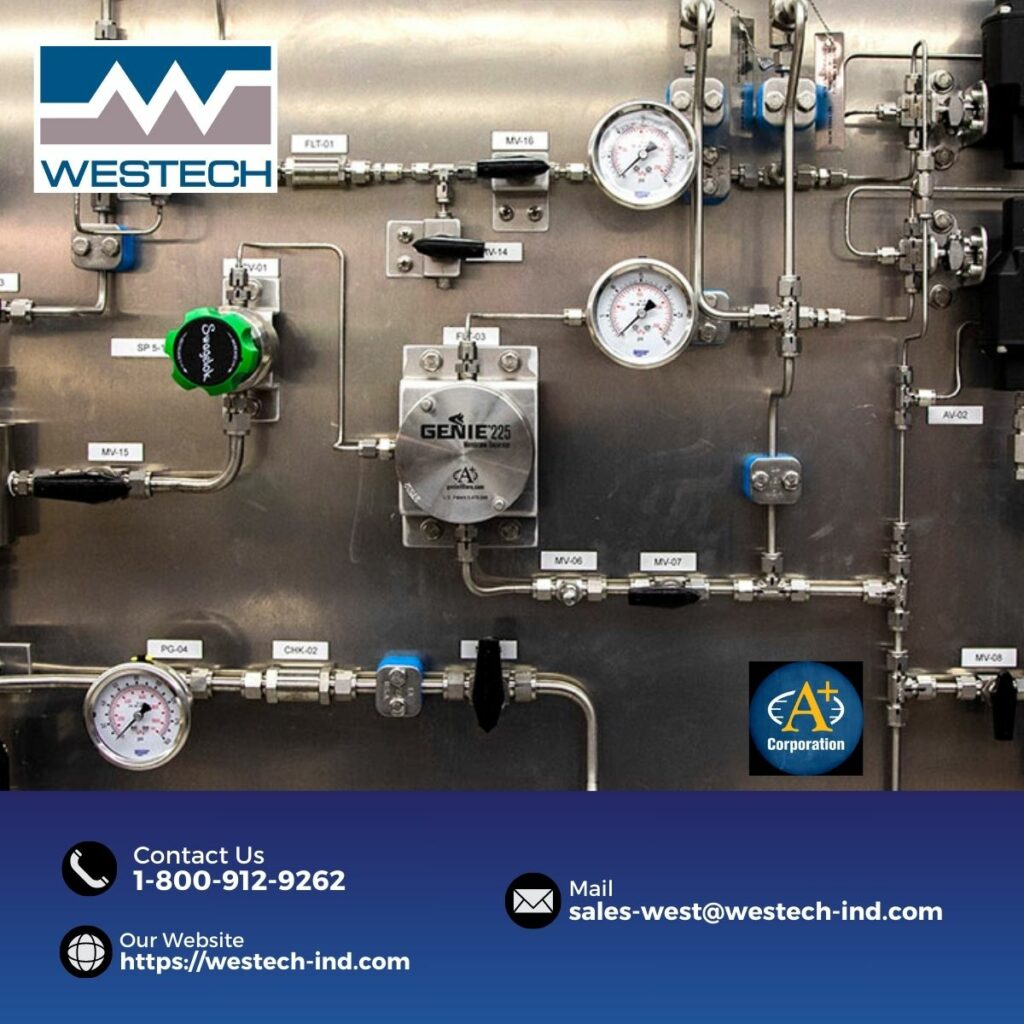
At Westech Industrial, we are proud to partner with A+ Corporation, offering advanced sampling solutions to the Canadian energy industry. As a distributor for A+ Corporation in Canada, we provide top-notch sampling systems designed to meet the industry’s highest standards. Visit our website to learn more about our A+ Corporation sampling solutions or call us at 1-800-912-9262 for further information.
Reference:
Vincent Argrave, Regional Sales Manager, A+ Corporation
Share This: