


 CDN NEWS |
  US NEWS







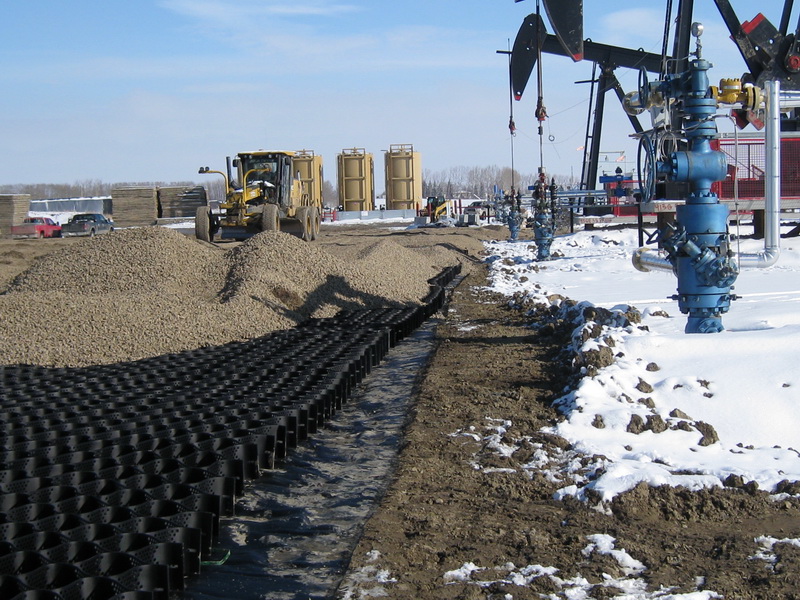
WET WEATHER CONDITIONS & SOFT SOILS CAUSE SITE ACCESS CHALLENGES DURING CONSTRUCTION SEASON
In 2013, oil producers, drilling companies, and oilfield service providers faced unprecedented weather with late-season snowfalls and an extremely wet spring.
The natural soils of the Bakken region, in Saskatchewan and Manitoba, consist of a variety of black shale, siltstone, and sandstone materials. These soils lose their strength when wet or saturated, making it difficult for construction companies to access oil sites during a typical spring season.
What made the spring of 2013 unique was the extended period during which the soils remained saturated, weakening them enough to delay earthwork or access operations. Even as late as the middle of June, many producers and services companies delayed accessing otherwise ready well sites because the site soils could not support construction equipment or drilling operations without significant subgrade preparation.
CONVENTIONAL SOIL-STRENGTHENING METHODS FOR DRILL PADS AND ROADS
If a drill pad or an access road is not constructed over winter or during dry weather, oil producers will usually wait until the soils dry and strengthen before trying to correct the situation. Corrections could include over-excavation/replacement of the soils, amending the soil strength by adding cement, or, most commonly, building a road or well pad in the traditional way and then repairing the distressed portions as often as necessary to keep these areas serviceable for heavy trucks and machinery.
Over-excavation and replacement require road aggregate or fill to complete, which is often difficult to find, expensive to purchase, and not very durable. Alternatively, soil-cement mixtures require suitable temperatures to properly cure, and in sub-freezing conditions, they will not achieve the necessary strength to support heavy loads. And while a company may be lucky and not have to heavily maintain the access road or oil pad, often the company will incur considerable expense by dedicating manpower and machinery resources to maintaining a passable road. In some cases, drilling or completions will shut down completely to allow the soil conditions to be corrected.
SOIL REINFORCEMENT THROUGH A 3D SOIL CONFINEMENT SYSTEM (GEOWEB® Geocells)
The GEOWEB Soil Stabilization Systems offers an alternative to these methods of increasing the load-carrying capacity and durability of access roads and drill pads.

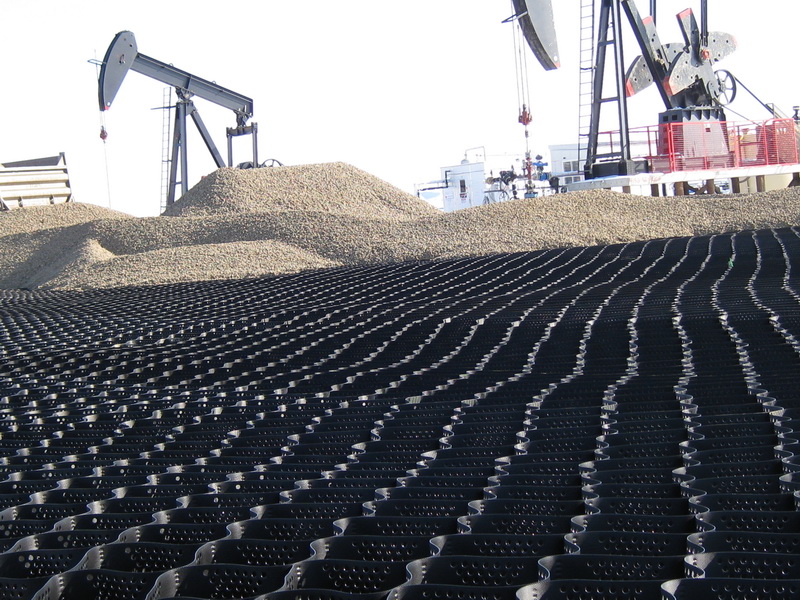
A cost-saving, alternative technology is the GEOWEB Cellular Confinement System (CCS) developed by Presto Products in the late 1970s. Originally developed in cooperation with the U.S. Army Corp of Engineers as a fast, easy-to-deploy beach access system that strengthens the sand found abundantly on beaches, the GEOWEB System expands to form a honeycomb-like structure. This structure, when infilled with granular materials such as sand, gravel, on-site fill, or crushed aggregate, uses the principle of confinement to impart added strength to the roadway fill materials. By adding strength to otherwise marginal or unsuitable materials, the GEOWEB system effectively bridges soft soils and creates a strong and durable driving surface for even the heaviest of loads.
CONFINED FILL REDUCES CROSS SECTION AND MAINTENANCE
A GEOWEB-reinforced roadway or drill pad will support heavy truck traffic and drilling operations over a variety of soil conditions. For example, some Canadian oil sands producers place the GEOWEB access road and drill pad system, complete with a woven geotextile fabric, over the “muskeg” soils (bogland) so prevalent in the boreal regions where they extract oil.

The producers expect these roads and drill pads to support eight-ton wheel loads on a long-term basis, and the engineered GEOWEB system delivers roads that can do this. Consider that an unreinforced road or drill pad will typically require one meter or more of unreinforced road aggregate to support such loads; then consider that the GEOWEB confinement system infilled with a reject sand was able to offer a significantly reduced cross-section and provide equivalent support.
As an additional benefit, the maintenance grading required for these roads is substantially reduced compared to typical roads because the GEOWEB material, placed near the road surface, confines near-surface fill, and reinforces the road base; this prevents the shearing that creates ruts and potholes. One oilsands producer reported that they have not graded their road for nearly three years of operation.
PERFORMANCE NOT IMPACTED BY WET WEATHER OR SOFT SOILS
The GEOWEB Geocells are shipped in compact bundles making them easy to transport and deploy. On site, the sections are expanded into position and connected without special handling equipment and filled with the chosen infill. The roadway is ready for traffic immediately after infilling and compaction.
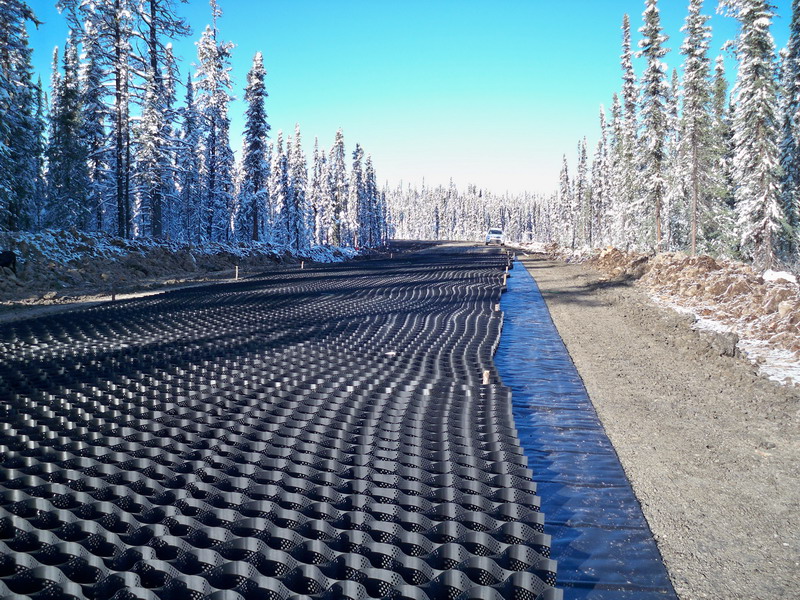
Perhaps most significantly, the GEOWEB geocells can be installed in the middle of winter, when roads are typically constructed in the northern reaches of Canada. When the soils thaw, the roads continue to function even as the thaw weakens the subgrade soils. The strength and flexibility of the GEOWEB system allows operations to continue unimpeded by these weak soils.
A BETTER WAY TO BUILD DRILL PADS
Oftentimes oil and gas producers in North America will install timber mats to support operations temporarily over soft ground. These mats are then removed when they are no longer needed.
Timber mats present logistical and restoration challenges that must be overcome. For instance, the mats are heavy, become waterlogged, and can often be difficult to extract from the ground. The fill beneath timber mats also require restoration when complete and before the drilling company turns the site over to completions.
Oil producers are turning to the GEOWEB system as a way to support their heavy loads, minimize pad restoration, and to build their drill pads one time.
By utilizing local fill materials and reducing the resources needed for road maintenance and construction, the GEOWEB system effectively utilizes local resources to overcome the difficult winter and spring-access challenges in the Bakken region. And they do so within a faster timeline and at less cost than conventional methods.
For project assistance in the US, contact Presto Geosystems at 800-548-3424 or 920-738-1328.
For project assistance in Canada, contact Presto’s Canadian distributor Layfield Group at (888) 748-7905.
- Request a free project evaluation >>
- Download engineering package >>
- Download construction package >>
- Watch how the GEOWEB system performs >>
Share This:























COMMENTARY: Norway Breaks Ranks – The First Crack in Europe’s Net-Zero Facade