


 CDN NEWS |
  US NEWS







By Jim Warren
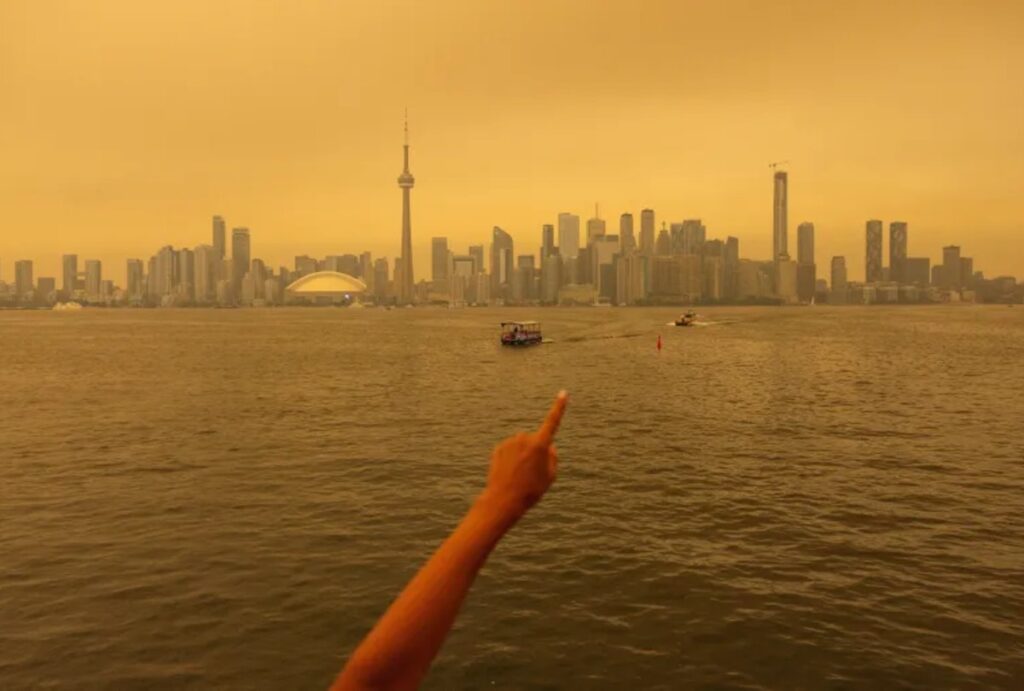
Here we go again. After a spell of hot weather and an unusually large number of forest fires in Ontario, Central Canada’s hand wringers have once again hit the panic button.
As per usual, the troubles of Toronto dominate mainstream media newscasts. Reports about smoke and uncomfortable weather conclude by blaming it all on climate change.
Out here in the western part of Canada we watched with pleasure over the past couple of years as climate change declined in importance as an issue of political concern.
It was too good to last. The Angus Reid Institute recently published poll results showing that 21% percent of Canadians now rate climate change as one of their top three issues of concern. That’s up from 14% from this past spring when cooler minds prevailed.
The extension of winter into March and April of 2026 across vast sections of the country is now a memory lost to mass amnesia.
We are at a point where there is a growing body of statistical evidence supporting the contention that human-generated global warming is having some influence on temperatures and extreme weather events. But, that evidence does not suggest that the pace and intensity of climate change is so urgent we need to drive ourselves into penury by adopting the sorts of overly zealous emissions reduction policies demanded by climate-alarmed fanatics.
You know the type. It includes European leaders content to let old people suffer heatstroke because allowing the installation of more air conditioners would send the wrong message and increase greenhouse gas emissions. The planet must be saved so the old must die.
One of the wonderful essays Bjørn Lomborg wrote for the Fraser Institute put recent forest fire seasons into perspective. Lomborg presents historical and satellite data showing that over the period from 1900 to 2020 the area of the world burned by wildfires has declined in a major way (See the chart he developed below).
According to Lomborg,”The record shows a dramatic fall in the world’s average annual burned area. Last year it was the second lowest, and in 2022 the lowest ever. And studies find that with adaptation the area burned will keep falling, even without climate action.”
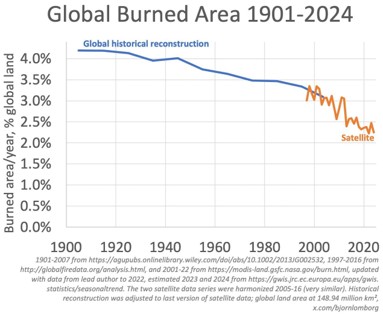
Lomborg adds that cutting emissions is an inefficient way to deal with wildfire hazards. “Studies by the U.S. Environmental Protection Agency show that even drastic cuts in emissions would reduce the burned area only slightly this century. Simpler, cheaper, faster policies like better forest management, prescribed fires, [etc.]…”
Here in Canada forest fire management hasn’t caught up with the decline in the forestry sector. There are a lot fewer pulp mills and saw mills operating today than a few decades ago. We’ve been removing a lot fewer trees and creating fewer fire breaks.
Common sense explanations won’t do much good for Toronto and Ottawa given that smoky conditions ruined picnicking on a few weekends and the CBC has already told them why.
We know what comes next.
The Green 14 in the Liberal caucus and the international environmental movement will demand Carney take a tougher stand against increasing oil production. And they will do all they can to block a new oil pipeline to the Pacific.
The Angus Reid poll is a reminder that there are politically powerful, well-financed environmental organizations poised to reinvigorate their assault on Western Canadian oil and gas. Challenging the propaganda and distorted science employed by the environmental movement will be critical in the months ahead as Canadian oil and gas producers attempt to launch the pipeline projects required to increase production and exports.
To that end this short column is accompanied by a movie review that takes a deep dive into one of the most successful and deceptive efforts to create a moral panic around the alleged need to save the planet from fossil fuels.—Al Gore’s movie, An Inconvenient Truth.
It’s the 20th anniversary of the release Al Gore’s climate change movie. It won him an Oscar and the Nobel Peace Prize. Green journalists will be celebrating, so it won’t hurt to be armed with a reminder of the errors and misrepresentations contained in, An Inconvenient Truth.
Inconvenient Errors and Misrepresentations: Looking Back at Al Gore’s Award Winning Movie – A Review
This year marks the 20th anniversary of Al Gore’s slide show, upgraded to documentary film, An Inconvenient Truth. There is little doubt Gore’s efforts in the field of climate porn have contributed significantly to the challenges faced by conventional energy produces here in Canada and around the world.
The film was shown thousands of times in hundreds of theatres around the world. That made it eligible for an Academy Award. Gore and the producers won for best documentary in February 2007. Perhaps Hollywood’s democrats felt sorry for Gore after controversially conceding the 2000 presidential election to George. W. Bush. The Oscar was sort of like a consolation prize.
The film’s release and reception was one of several seminal events in the mid to late 2000s inimical to the fossil fuel industries. For instance, the film’s appearance roughly coincided with the launching of the international environmental movement’s assault on Alberta’s oil sands. Gore’s movie would convince millions of people around the world we are headed for a climate apocalypse almost entirely due to fossil fuel consumption.
The movie was part of the propaganda war that helped pave the way for the Justin Trudeau government’s 10 year assault on oil and gas production and the construction of new export pipelines.
The film’s critics have denounced its hyperbolic claims regarding the pace of global warming and the intensity of its effects. Inaccurate interpretations of climate science along with the movie’s misleading, incorrect and manipulative presentation led to claims it had more in common with political propaganda than science. The film did, however, prove successful when it came to scaring the crap out of millions of school kids.
Despite the film’s warts, Gore was able to share the 2007 Nobel Peace Prize with the Intergovernmental Panel on Climate Change (IPCC). The IPCC is the United Nations agency responsible for collating and assessing climate science research conducted by thousands of scientists from around the world. Gore’s film made numerous errors in reporting IPCC findings.
But, as noted above, there were critics at the time who cried foul.
For example, in the UK, international ground zero for hand wringing over climate change, a school board member from Kent challenged the national government’s plans to distribute Gore’s film to schools. Stewart Dimmock, the complainant, took the government to court claiming the film was rife with inaccuracies and political bias. It was political propaganda masquerading as science education.



In his October 2007 judgement, UK High Court Justice Michael Burton agreed the film had included oversimplified climate science “to make a political statement and support a political program.”
Burton ruled there were nine specific instances in which the film departed from mainstream science in support of alarmism and exaggeration to make its political argument. The ruling stated that to be in compliance with British educational law, the film could not be shown to students without teachers identifying those errors and explaining why they were scientifically incorrect.
I was surprised by the Gore film’s simplistic, incomplete and inaccurate presentation of the allegedly “catastrophic” consequences of climate change. I first encountered it while taking a graduate course in climate change science. I was absolutely amazed by Gore’s gross misrepresentation of the rate of melting on the Greenland ice cap and its supposed effects.
The following link is to a short video clip of the relevant section of the movie. https://www.youtube.com/watch?v=I-SV13UQXdk
In this short portion of the film, Gore shows us maps which illustrate in red the amount of cumulative melting of the Greenland ice cap between 1992 and 2005. The slide we see when Gore says “here’s the melting from 2005,” indicates that by that year the melting (red coloured area) now accounted for over 1/3 of the island. In 1992, less than 10% of the island was shown in red.
Gore introduces the next series of slides with the statement “…because of what’s happening in Greenland right now the maps of the world will have to be redrawn, if Greenland broke up and melted… or if half of Greenland and half of West Antarctica broke up and melted.”
Next we’re shown a series of animated maps depicting what is going to happen due to the melting in Greenland and part of the Antarctic. Southern and coastal Florida submerged under the rising sea, sixty million people will be flooded-out in Bangaldesh, 40 million in Shanghai. Half of the Netherlands disappears under the floodwaters.
In writing about the hit film’s 20th anniversary, UnHerd columnist, Juan David Rojas recalled how it “made a marked impression on me and my classmates. Gore’s warnings of super-hurricanes and a submerged Floridian peninsula filled the classroom with alarm, especially in the wake of Hurricanes Wilma and Katrina.”
Last week Rojas declared the fear engendered by the movie was based on distortions of the actual science.
“Twenty years on, the peaks of Kilimanjaro remain snowcapped, Glacier National Park features glaciers year round, and Florida’s coastline is largely unchanged. Even in the worst of cases, Gore’s prediction of a sunken Sunshine State would take more than a millennium to become reality.”
Here is what Gore got wrong
For starters the portions of the maps of Greenland coloured red do not mean those areas of the giant island became ice free. Gore’s maps misinterpret data produced by the US National Snow and Ice Data Center which provide a daily indication of where some melting has occurred somewhere on the surface of the massive glacial ice cap.
It is possible that much of the area shown in red experienced temperatures above 0.0o Celsius for part of a single day in an entire year.
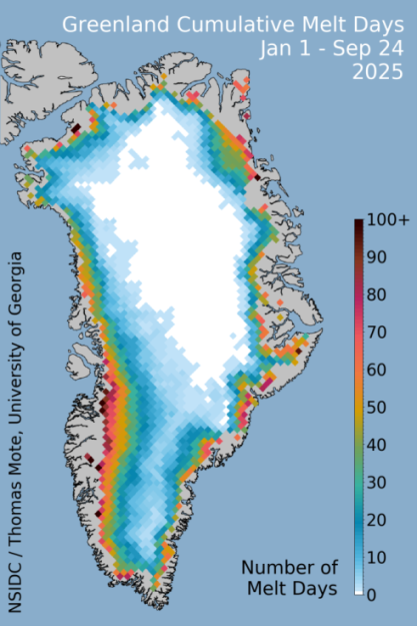
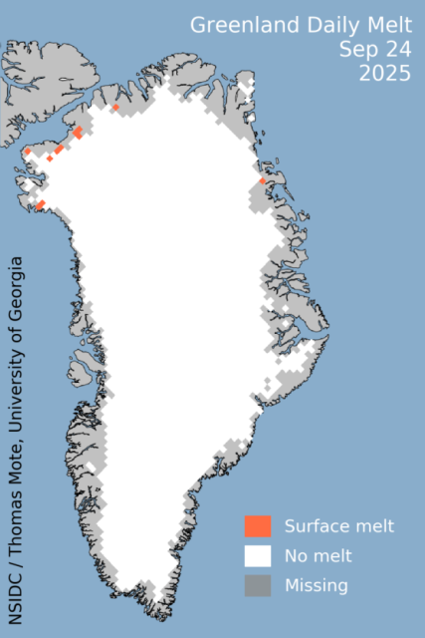
The two maps of Greenland presented below, were created by the Snow and Ice Data Center, they are based on daily satellite images of Greenland. The first map depicts the cumulative number of days when parts of Greenland’s surface experienced melting temperatures between January 1 and September 24. Greenland’s melt season typically runs from early May to late September each year. The second map show the places on Greenland’s surface on September 24 where the temperature reached or exceeded the melting point. As the map shows, 75% of Greenland’s ice cap has not disappeared.
National Snow and Ice Data Center
https://nsidc.org/ice-sheets-today
National Snow and Ice Data Center
https://nsidc.org/ice-sheets-today
Secondly glacial ice caps melt and coast glaciers calve icebergs but they don’t break up. Floating ice packs, including Antarctica’s ice shelves, can break up due to melting and wind. But when floating ice melts it does not increase sea levels. When Gore produced his slide show the IPCC wasn’t even including a factor for glacial ice cap melting in Greenland and Antarctica in its calculations for sea level rise. Perhaps because the melt rate was virtually too slow to matter much. And as Rojas claims, melting the ice caps would require considerably more global warming than we have experienced and would likely take centuries to occur.
The IPCC’s predictions for sea level rise are based on thermal expansion of the oceans due to increased global warming. The levels of sea level predicted range between a couple feet to around one metre by 2100.
However, the badly worded, simplistic explanation provided by Al Gore left people thinking flooding due to sea level rise was imminent and would be deadly. Gore’s errors were not simply due to misspeaking and the challenges of presenting science to non-scientific audiences.
In 2009, two years after receiving his Oscar, Gore attended the Copenhagen climate conference where he said computer models used by climate scientists indicate “there is a 75% chance that the entire North polar ice cap during some of the summer months could be completely ice-free within the next five to seven years.”
Gore claimed the prediction was based on the work of oceanography Professor Wieslaw Maslowki from the Naval Postgraduate School in California. Maslowski subsequently denied ever “writing that the likelihood of anything as exact as this.”
Furthermore, there isn’t a glacial ice cap at the North Pole, it is covered year round by floating sea ice—the North Polar ice pack. When floating pack ice melts the oceans do not rise in response. The physics of buoyancy don’t allow it. Watch an ice cube melt in your cocktail glass – it does not change the level of the water in the glass.
Climate-alarmed environmentalists drew strength from the success of the Gore film—the virtue of their cause had after all been endorsed by Hollywood celebrities and the Nobel Committee.
That helped facilitate the exposure of the film to millions of movie goers and impressionable students in thousands of classrooms. Unfortunately, one of its more lasting influences is the residue of mass paranoia about planetary meltdown, the destruction of human civilization and the threat to all life on Earth.
In the wake of a hot summer and an unusually large number of wildfires in parts of the world, we should expect a renewed round of propaganda from the environmental movement.
-30-
Share This:






















INSIGHT: Canada’s Economy Falling Behind Despite Misleading Headlines – Fraser Insitute