


 CDN NEWS |
  US NEWS







There are more opportunities than threats in the energy transition
Parkland Corporation supplies over 21 billion liters of petroleum products across North American and the Caribbean. It has a refinery in Burnaby, BC and operates nearly two thousand convenience stores across Canada alone under well-known brands like Pioneer, Ultramar, Fas Gas Plus, Chevron, and On the Run / Marché Express.
But as the energy transition gathers pace, is the company’s business model under threat?
Definitely not, according to Jeremy van Loon, Director of Sustainability at Parkland Corporation. If anything, he says, the energy transition creates an opportunity for a new relationship with customers.
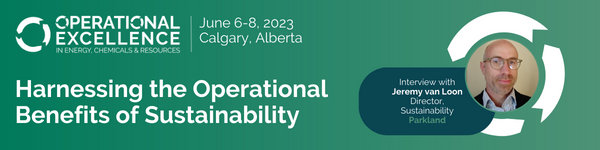
In this interview, van Loon, who will be speaking at our upcoming Operational Excellence in Energy, Chemicals and Resources talks about how the company is responding to a changing world, the role of sustainability in building operational resilience, and his focus in the year ahead.
Diana Davis, IX Network: Parkland’s CEO recently said that there is more opportunity than threat in the energy transition. How is Parkland preparing to take advantage of the energy transition?
Jeremy van Loon, Parkland: I think Bob Espey, our CEO, was reflecting what a lot of other people are saying. There are lots of opportunities around the energy transition. For example, electrification of passenger cars is gaining momentum. There will be behavior changes associated with that as drivers spend more time charging their vehicles as opposed to filling them up with liquid fuels.
That changes the experience for drivers from a 3–5-minute experience to fill up to a 20-25 minute experience while recharging.
For Parkland that establishes an opportunity to create a destination around the charging stations and convenience stores where customers can also recharge with some food or have a place to catch up on phone calls, for instance.
The infrastructure for EV charging is still in its early stages. It will be really important to have a strong customer focus and having a really reliable charging infrastructure to make it a positive experience.
Parkland is preparing for this future. There have been acquisitions of companies like M&M’s to enhance what’s being offered in those convenience destination locations, and partnerships with companies like Triple O’s.
We are starting to build out our fast charging network. Our first focus is the corridor between Vancouver Island and Calgary. There are sections of that drive where there are lots of choices of fuel stations and convenience stores and then there are other sections where you’re in the middle of nowhere. It’s nice to know that you’ve got another 100 kilometers or so and then you’ll have a good place to rest and charge up.
Diana Davis, IX Network: You’re going to be speaking at our upcoming Operational Excellence conference in Calgary. What are the links between Operational Excellence and sustainability? How do you view that at Parkland?
Jeremy van Loon, Parkland: At Parkland, we have four pillars through which we see our work on sustainability: people, environment, partners, and responsible growth.
It means we’re thinking carefully and acting on wide range of areas around those topics. It could be things like the health and safety of our employees and making sure that they feel a supportive, inclusive work environment. We’re also looking at lowering our carbon footprint through lower carbon fuels for example or offering electric chargers.
The link between operational excellence and sustainability is really about creating a mindset that supports long-term, responsible, and sustainable growth to build resilience through the organization as well as support larger initiatives such as our government’s net zero targets. Sustainability and operational excellence cut across everything throughout the organization.
Diana Davis, IX Network: I’ve heard a lot of people say that you need to get a sustainability mindset into your day-to-day. Is there anything that you have found works to embed sustainability into the day-to-day actions and decision making of people in your operations?
Jeremy van Loon, Parkland: One thing that I’ve learned in the different roles that I’ve had over the years as well as here at Parkland is the importance about communicating and helping to connect the dots – both internally and externally.
Within Parkland, there is a wide range of different business units. Each unit is very different from the others. The focus on sustainability can, in some cases, be a bit different in each of these different business units.
When you share stories of success as well as some of the challenges and initiatives from different areas this can be an inspiring process that allows people working on different things to get creative and think about solutions in their own areas.
Over time that continual focus on communicating the initiatives and having a free flow conversation, especially in large organizations, becomes more established across the business and I think it really can have a big impact.
Diana Davis, IX Network: We’ve had a volatile couple of years. What effects are you seeing as we come out of this pandemic on how you’re approaching sustainability?
Jeremy van Loon, Parkland: One of my key takeaways is that having a strategic approach to sustainability is one of the best ways to deal with volatility. From a Parkland perspective, that means viewing sustainability through the four pillars of people, environment, partners, and responsible growth.
If you have a laser focus on these things to build strong partnerships with local communities – with indigenous communities, for example – and you have a strong focus on creating a supportive environment and workplace where customers can engage with your products and services, you will build resilience.
Volatility is not going away. I think anything that you can do to build a more resilient organization is important. In many ways, when you boil it down, these sustainability initiatives are about building a resilient long-term business. I think that that’s really been key.
Everyone is still learning lessons from the pandemic and the recent supply chain challenges and trying to use those lessons in our operations as well. It remains to be seen what exactly that it looks like in a few years time, but I think that resilience is going to really be key.
Diana Davis, IX Network: What is your focus in the year ahead?
Jeremy van Loon, Parkland: As a company we’re excited about the rollout of more EV charging. That’s going to be a big thing for us.
Some of the changes that are happening in terms of ESG disclosure and efforts with the ISSB, for example, will also be important this year.
There is more and more of a recognition on the part of investors and others that sustainability isn’t a flash in the pan. There’s a recognition that there’s a lot of value in disclosing this kind of information to provide the market with more material information. That’s something we’re focused on for this year as well.
Diana Davis, IX Network: At our event, you’re going to be speaking about planning for the operational impact of decarbonization. Why did you feel that this topic was important to discuss?
Jeremy van Loon, IX network: I was recently at a conference in the US where everyone was talking about the Inflation Reduction Act. It’s got about $1.7 trillion of support to move the energy transition forward. That’s obviously very powerful, but what everybody was talking about is that it’s really about implementation. We need to operationalize decarbonization. It’s about doing things systematically. It’s going to be a heavy lift and I think it’s really important to share those experiences every company and every organization has had.
Diana Davis, IX Network: What are you most looking forward to at the event?
Jeremy van Loon, Parkland: Hearing how different people and organizations are solving problems. People often talk about diversity being a real tool. I think it’s true. If you look at a diverse ecosystem, it has a lot of resilience and ability to cope with challenges. It’s the same thing in a business context. It’s useful to hear other ideas and adapt them to your own problems.
Interested in learning more about this event?
Jeremy van Loon will be speaking at our Operational Excellence in Energy, Chemicals and Resources event taking place 6-8 June in Calgary. Now in its 10th year, the summit brings together over 200 senior level executives to share use cases and showcase trailblazing technologies that will transform your operations. Download the brochure for more information.
Share This:





















On The Verge: Energy Sector Primed for New Wave of Growth – ATB Economics