


 CDN NEWS |
  US NEWS










Each week Josef Schachter gives you his insights into global events, price forecasts and the fundamentals of the energy sector. Josef offers a twice monthly Black Gold newsletter covering the general energy market and 33 energy, energy service and pipeline & infrastructure companies with regular updates. We also hold quarterly webinars and provide Action BUY and SELL Alerts for paid subscribers. Learn more.
As we are nearing an expected BUY signal for the energy sector, we are extending our special holiday season discount offer for new subscribers to the Schachter Energy report. By subscribing you will receive our BUY recommendations when we issue our Action Alert BUYS and be able to join our first quarter, 90 minute webinar on February 23rd. This upcoming window should be the best buying opportunity since March 2020. Many of the energy ideas we cover are now down 50% or more from their 2022 highs. I expect to move from an underweight of the sector, which has been our stance for quite some time, to a full ownership weighting during Q1/23.
Global Economic, Political & Military Update:
The IMF head warned this week that a third of the world will be in recession this year. Kristalina Georgieva said that as the US, EU and China’s economies slow while rising inflation, higher interest rates, and the spread of Covid in China escalates. One third of the world economy is expected to be in recession, and for countries not in recession it would feel like one. China is the critical domino for this pain “as it is likely now in recession and the impact in the region will be negative. Thus the impact on global growth will be negative”, she said.
The UK is the lead domino for Europe with aggressive budget tightening, continued rising inflation (+10.7% in November) and now union strikes demanding pay increases that exceed inflation. British rail workers started the year with a week-long strike. More unions plan on striking including: nurses, airport staff, paramedics and postal workers. The new Conservative government has stated that “it cannot afford to give public sector workers an inflation-matching rise”. The battle is now joined. Severe strike action could make for a very difficult first half for the UK.
The Federal FOMC minutes out yesterday made it clear that the Fed loosening financial conditions would hurt attempts to stabilize prices. They warned markets against underestimating their resolve to bring down inflation and that when rates peak they will keep them at that peak rate for some time. This now moves the ‘pivot’ hope to 2024 and disappointing investors.
The massive increase in Covid cases in China has brought with it a new variant: XBB.1.5. Yet another descendant of Omicron. Most new cases are of this variant and if one has received western vaccines, they are covered. If not, the death rate can be high. It is very contagious and comes as winter adds to infections. China is not reporting cases of Covid and especially not of deaths which may reach into the millions in 2023.
The war in Ukraine has its ebbs and flows of violence but as the ground freezes it may see another round of aggressive fighting. Russia is moving large numbers of troops to Belarus and may be planning another attack from the north against Kyiv. This could be an attempt to force Ukraine to move troops from the south to protect the capital so the Russian offense could then come in the south. Russia may be using the last battle success of Ukraine against them. NATO sending of supposed ‘defensive’ weapons are being used by Ukraine offensively. Russia has a history of being weak in their early phases of war but then seem, despite their incompetence and lack of weaponry, to become successful in the battlefield. Just remember their massive early failures against Hitler and Napoleon. The biggest battles of those wars occurred during the winter time and that is now here.
There was no Santa Claus market rally over the last week of 2022 and the first week of 2023. Announcements of layoffs by Salesforce, Amazon etc. added to the recession woes. Apple’s stock broke down which will add significant pressure to the market averages (largest market weight in S&P500 and NASDAQ). Apple faces production problems in China and demand weakness due to the shrinking economies worldwide. TESLA has faced massive downside pressure as they delivered less cars in Q4/22 than expected, and now are discounting some of their models to move inventories. TESLA was one of the worst performers of 2022 and remains expensive.
Bullish pressure for crude prices continues with the production cutbacks by OPEC and winter weather demand for heating oil and propane. While OPEC+ did not cut back by their announced 2.0Mb/d, they are still having an impact on global inventories. OPEC now says the proposed cuts will be implemented over the next 12-14 months into 2024. The US plan to restock their SPR starting in February adds to the bullish picture this week.
Bearish pressure for crude comes from the slowdown in the economy in China as Covid-19 spreads. Demand destruction due to weakening economies could be in the range of 5-7 Mb/d during 2023, more than offsetting any supply cutbacks from OPEC. Nigeria seems to have made some progress in getting its production back up and Venezuela is seeing a production rise as Chevron has US government permission to restart its fields but that the funds that should go to their national oil partner (for their portion of the fields) is going to go to the UN. They will use these funds to help citizens directly and to repay Venezuelan debt so that the funds do not get siphoned off by the Maduro gang.
EIA Weekly Oil Data: The EIA data of Wednesday December 30th was bearish for oil prices. US Commercial Crude Stocks rose by 1.7Mb (forecast was for a rise of 1.1Mb) to 420.6Mb. The SPR saw a release of 2.7Mb. Motor Gasoline inventories fell by 0.3Mb while Distillate Fuels fell 1.4Mb. Refinery Utilization fell during the holidays by 12.4% to 79.6% and down from 92.0% in the prior week. US production recovered 100K b/d to 12.1Mb/d. Cushing inventories rose 300K to 25.3Mb. US total product demand fell last week by 4.6 Mb/d as Motor Gasoline demand fell by 1.8Mb/d, Distillate demand fell by 1.1Mb/d and Other Oils demand fell by 1.2Mb/d to 5.0Mb/d. Motor Gasoline consumption fell due to the weather and the holidays by 1.8Mb/d to 7.5Mb/d while Jet Fuel saw a decline of 81 Kb/d to 1.4Mb/d.
Demand destruction is real in the US. Total Usage fell by 1.48Mb/d to 18.2Mb/d or down by 7.6% from last year while Motor Gasoline demand fell by 658K b/d to 7.51Mb/d or down by 8.1% from a year ago.
EIA Weekly Natural Gas Data: Extreme cold weather across North America last week caused a large drawdown. The EIA data released today showed a decline of 221 Bcf for the week ending December 30th. Storage is now at 2.89 Tcf, still sufficient to meet US needs this winter. The biggest decrease was in the South Central (96 Bcf). The five-year average for last week was a withdrawal of 101 Bcf while in 2021 it was a withdrawal of 213 Bcf. The largest withdrawals typically occur in January and February of each year and the largest weekly withdrawal so far was 359 Bcf in January 2018. US Storage is now 9.6% below last year’s level of 3.2 Tcf. With warmer weather in the forecast NYMEX has retreated from US$7.10/mcf in mid-December to US$3.77/mcf today. AECO is at $4.25/mcf. European prices have also declined due to spring-like weather across the continent. With this still being very early in winter 2022-2023 for North America we still expect cold periods to see price spikes in the coming weeks back over $6/mcf, on both sides of the border.
Baker Hughes Rig Data: In the data for the week ending December 30th the US rig count was flat at 779 rigs (up three in the prior week). Of the total rigs working last week, 621 were drilling for oil and the rest were focused on natural gas activity. The overall US rig count is up 33% from 586 rigs working a year ago. The US oil rig count is up 29% from 480 rigs last year at this time. The natural gas rig count is up 47% from last year’s 106 rigs, now at 155 rigs. The industry this year has been responding to higher US and international natural gas prices with materially more activity than last year. This should continue to lift US natural gas production in upcoming quarters. Companies divulging their plans for 2023 plan to spend more, with capex plans showing growth in production as well as funds to offset higher drilling and completion costs.
In Canada, there was a decrease of twelve rigs (decrease of 103 rigs in the prior week) to 84 rigs as crews got holidays from Christmas to New Years. Canadian activity is down 7% from 190 rigs last year. Activity for oil fell 36% to 25 rigs versus 39 last year. Natural gas rigs were down five rigs to 59 rigs. Activity will pick up quickly now that we are into the New Year as many 2023 drilling budgets should be 10-15% higher than last year’s. Peak potential for staffed rigs is likely around 260 this winter.
CONCLUSION:
As a global recession unfolds, crude prices typically plunge sharply. In 2008-2009 during the financial crisis, demand fell by over 5Mb/d from over 88.5Mb/d to 83Mb/d. The price of crude fell from US$147.27/b to US$33.55/b in eight months. During Iraq’s invasion of Kuwait, prices rocketed from US$16.16/b in July 1990 to a high of US$41.15/b in October and then plunged in four months to US$17.45/b as recessionary demand destruction occurred.
WTI is priced now at US$74.10/b (down over US$7/b from US$81.50/b from the start of this week). The low today before the recent bounce was US$72.46/b. Watch for a breach of four weeks ago’s low of US$70.08/b for the next (and probably last) decline phase of this correction/bear market phase. We continue to expect a panic spike bottom should develop in the US$65-70/b area in the coming weeks. Below US$70/b we become bullish again.
Energy Stock Market: For the overall stock market we expect a focus on Q4/22 earnings and negative guidance from companies to take hold of the market and push them lower. The inflation watch on food, shelter and wages will also be a focus of the markets. A breach of 30,000 on the Dow Jones Industrials Index (now 32,849 – down 421 points on the day) will speed up the fear phase and generate an important bottom in Q1/23.
The upcoming weeks should see further pressure on the energy sector and we intend to take advantage of this to add ideas to our Action Alert BUY list. Many ideas we cover are down more than 50% and are entering our BUY ranges. We currently have eight ideas on our Action Alert BUY list and we expect to have over 20 names on this list soon.
We now cover 33 companies and are working to add 3-4 new ideas during Q1/23. Stay tuned for the launch of these new ideas in our SER product.
The S&P/TSX Energy Index today is at 226 (down 13 points from last week’s level of 239). Tuesday January 3rd showed how nasty things can get when investors retreat from formerly hot sectors. The Energy Index fell 14 points to 229, or down by 5.8% on the day. Some of the nastier declines were: ARX.TO (down 10.9%), BIR.TO (down 12.0%), POU.TO (down 10.5%) and VET.TO (down 12.7%). The next sharp decline for crude below US$70/b and some nasty down days for the stocks should set up a wonderful window to buy great energy companies at bargain prices.
Late September’s low of 200.97 is now the support level to watch. A bust of this level should drive the Index below 200 and get us into the climactic bottom liquidation area of 160-180 that will set up the fabulous buying opportunity. These BUY windows are infrequent so please decide what you want your energy weighting to be for the next major up-leg in this long energy super cycle. Our Coverage List includes ideas from the Pipeline & Infrastructure area, Canadian oil and natural gas ideas, energy service ideas and companies working internationally. Our list includes large Conservative ideas and large to small caps in our Growth and Entrepreneurial categories.
Please refer to our holiday season special subscriber offer information to those you see benefiting. We are extending this offer into mid-January so that new subscribers will know that we have issued Action BUY Alerts and can have access to these ideas. We are having our first 90 minute quarterly webinar on Thursday February 23rd at 7PM MT. This should be a very important webinar for subscribers as we go over the new ideas on our BUY list and why they have been added.
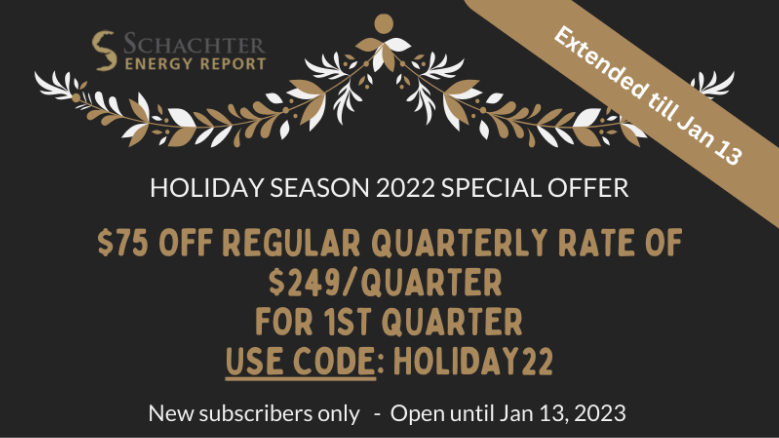
Once we see the market showing climatic bottom signals we intend to send out Action Alert BUY ideas to subscribers. Become a subscriber to get these timely BUY Action Alerts. Take advantage of this holiday season special pricing offer for new subscribers. Go to https://bit.ly/2FRrp6k.
Please feel free to forward our weekly ‘Eye on Energy’ to friends and colleagues. We always welcome new subscribers to our complimentary energy overview newsletter.
Share This:























COMMENTARY: Hot Air and Fires in Ontario Mean its Climate Panic Time in Central Canada: That’s Never Good News for Supporters of Conventional Energy Production – Jim Warren