


 CDN NEWS |
  US NEWS







By Geoffrey Cann
A town in British Columbia can’t seem to muster the business case to purchase electric vehicles. What lessons does this hold for business leaders facing similar technology upgrade decisions?
A Simple Purchase
Vernon, British Columbia, is a pleasant little town in the interior of the province. I’ve driven through Vernon many times as it’s located on one of the main routes through the Rocky Mountains and on the principal highway to Canada’s wine country.
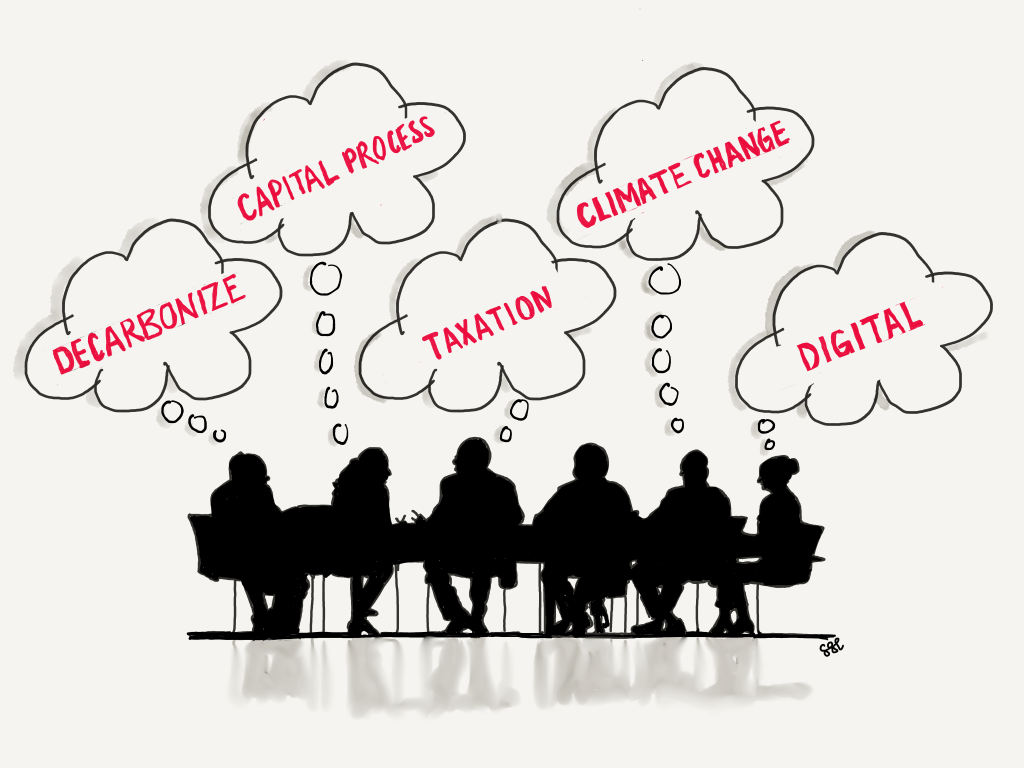
A news story caught my eye about the town’s upcoming decision about purchasing new pick up trucks (or utes, for my Australian friends). After the usual fiscal deliberations, Administration has recommended to Council that the town stick with the status quo gasoline models for now, rather than plunking down for newer more expensive electric vehicles, based on the acquisition cost of the vehicles. It’s not a big purchase, just two trucks, but the saga illustrates the challenges that await all businesses, not just small municipalities, about facing up to the pressures of decarbonization and digitalization.
And the story encapsulates why I wrote ‘Carbon, Capital, and the Cloud’. Let me explain.
Decarbonization and Digitalization
You may be wondering how a battery vehicle purchase decision for a small municipality not involved in oil and gas perfectly illustrates a book about digital adoption in the oil and gas industry.
THE CARBON ANGLE
Fossil fuel vehicles are the vanguard of energy transition, which is the carbon story. The growing number of battery vehicles represent a permanent demand shift for fuel. Once users become accustomed to electric vehicles in general, they rarely switch back, in which case their forward purchase of petroleum fuel vanishes permanently. It’s important for the oil and gas industry to keep an eye on this trend so as to inform future investment decisions on new fuel infrastructure (such as new wells, gasoline stations, tank farms, pipelines, and fuel distribution equipment).
Carbon is a key factor, if not the dominant factor, in whatever environmental, social and governance (or ESG) metrics most businesses have endorsed. For those that ignore it, carbon is increasingly a brand problem, and makes for a higher cost of doing business as carbon taxes kick in to raise the cost of fossil fuel, and the lower cost renewable energy is not exploited.
THE CAPITAL ANGLE
There are many dimensions here related to capital, starting with the decision process itself. The decision process of a vehicle purchase is a proxy for all kinds of technology upgrade decisions that operations and financial officers will need to make as formerly non-digital mechanical things digitize, and not just for fuel reasons. The people tasked with doing the analysis and making the recommendations do not typically start with “how do we make this decision”. The process is usually defined by the Chief of Finance so that investment decisions follow the same process and analysis so as to yield comparable outcomes and unbiased decisions.
The Vernon story is about capital and capital allocation at the very margin—general purpose low cost utility vehicles. The process is that financial analysts are tasked with carrying out the economics comparing the legacy technology with the possibilities of adopting new technology. At a time when decarbonization is a social imperative, and digital innovation has obsolesced legacy technology, the capital process paradoxically leads them to recommend the status quo. This still happens 85% of the time in BC (which has the highest penetration rate of electric vehicles in Canada).
A second hidden capital challenge relates to infrastructure. For example, servicing new battery vehicles requires a supply chain of companies that provide maintenance and repair support. New charge points need to be installed. The old infrastructure of fuel tanks and dispensers (if they exist) is a little less used, and its cost must be spread out over a smaller fleet. A new set of skills is required to maintain new kinds of kit (in the case of digitally enabled gear, business needs more digital skills). These systemic items pose huge barriers to new technology adoption at the margin.
A third capital factor is company valuations. The capital market now clearly places far greater value on pure digital vehicle makers (Tesla) than the incumbents (Ford), which gives the incumbents the incentive to move away from the status quo. The Vernons of the world won’t be given a choice of vehicle in just a few years time.
These same pressures and incentives now weigh on virtually every aspect of industrial equipment manufacturing and purchase as every manufacturer either digitalizes and decarbonizes, or faces demise.
THE CLOUD ANGLE
I view vehicles as merely a proxy for all kinds of industrial equipment, including boilers, compressors, drill rigs, and pumps, faced with the pressures of digitalization. Consider how the automotive industry is reimagining its vehicles as software platforms, an inherently digital concept. Software is continuously upgradable, and over a network, while a mechanical vehicle is frozen in time at the point of its design. Today’s vehicles may have limited software features, but the field is advancing quickly, and it’s hard to price future digital innovation.
As the price of digital tumbles, all equipment makers are weighing the costs of leaving their equipment ‘dumb’, the market opportunity from selling smarter gear, and the valuation uplift that comes from modernizing the business.
The Ironies
If there is one place on earth whose capital allocation process should result in the adoption of digitalized, low carbon vehicles, it would be BC.
Environmentally, BC is surprisingly vulnerable to climate change. The province is heavily forested, which is positive as a carbon sink, but those trees are combustible. Summers are often choking with smoke from fires. An unheard of heat dome settled over the coastal area in June of 2021, killing dozens of people and over a billion sea creatures. A series of atmospheric rivers (periods of intense rain) in November of 2021 caused $675 million in insured costs to replace washed out roads, rail and power infrastructure. Some farm businesses never recovered. 2022 has seen unparalleled drought across the West Coast, in what is supposed to be a rain forest.
Politically, BC is pathologically opposed to oil infrastructure. The oil industry has been unable to build new oil pipelines to the coast for a decade, despite the demand for oil in Asia, the closest market, and oil companies are discouraged from investing in new local fossil fuel infrastructure. Yet the province consumes more oil than it produces, making it vulnerable to supply disruptions. Keeping your town dependent on a fuel that your province is bent on eradicating looks misaligned.
Socially, BC is the most switched on to new electric vehicles. 13% of all new vehicle sales are zero emissions, leading to one of the highest penetration rate of electric vehicles in the world. The province is blessed with copious amounts of clean renewable energy options, from existing hydro electric power, to vast untapped wind resources, and ample coastal resources for tidal power. Embracing the province’s natural low carbon energy as fuel looks like an easy way to decarbonize operations.
Economically, BC is a hotbed for digital innovation. Amazon is opening a big new office in Vancouver, and the city is home to lots of technology companies, digital media companies, and video game studios. Being in the same time zone as Silicon Valley, and sharing the same weather as Redmond (home of Microsoft), the lower mainland area is a magnet for digital talent.
Surely these factors would count, but clearly it doesn’t work that way.
Why Capital Processes Are Failing
For many businesses and institutions, the capital allocation process doesn’t yield the intuitive result. Why?
The full costs of our high carbon status quo do not factor into decisions at the margin. For example, Vernon, like many municipalities and businesses, has almost certainly paid out plenty already in climate related costs, and will pay out even more to make its municipal facilities and operations resilient in the face of climate change. But the costs of facilities upgrades are likely in a different budget line than that for vehicle purchases. The potential savings to be captured are likely in another budget, and none of these come together for this analysis.
The cost of carbon at the margin (in terms of lifetime fuel cost) is still not high enough to shift the investment calculus. We can’t expect business and towns the world over to favour decarbon over carbon if the cost equation tells them that carbon is cheaper.
The possibilities presented by digital are hard to value for capital purposes. That’s why the automotive industry in Germany is in full meltdown—the entire industry didn’t see how digital innovations would upend their world-beating franchise. VW, the occasional world’s largest vehicle maker, is dismembering itself (selling off Porsche) to raise the money to pay for its late transformation. Capital processes are often unable to take into account the rapid pace of technological evolution happening on industrial equipment.
These are all failures of a key CFO-owned process, namely capital evaluation and allocation. The CFO, and their organization define the swim lanes, set the rules, dictate the parameters (such as interest rates and carbon prices), and manage the overall process. If the process yields a status quo outcome, in this instance, a gasoline vehicle purchase recommendation in the same week that COP27 is happening, the process is failing.
Conclusions
Vernon’s public decision is at the very cusp of two sweeping industrial changes facing civilization: decarbonization and digitalization.
At what point do you make jump from dirty to clean and from dumb to smart? For businesses, that decision is clearly hard to make. It’s going to be up to the CFOs to change the way capital decisions are taken so that we accelerate our way to a digital energy future.
Check out my latest book, ‘Carbon, Capital, and the Cloud: A Playbook for Digital Oil and Gas’, available on Amazon and other on-line bookshops.
You might also like my first book, Bits, Bytes, and Barrels: The Digital Transformation of Oil and Gas’, also available on Amazon.
Take Digital Oil and Gas, the one-day on-line digital oil and gas awareness course on Udemy.
Take the one-hour Digital for the Front Line Worker in Oil and Gas, on Udemy.
Mobile: +1(587)830-6900
email: [email protected]
website: geoffreycann.com
LinkedIn: www.linkedin.com/in/training-digital-oil-gas
Share This:




















SETTING OFF ALARM BELLS: Carney’s EU Deal Threatens Alberta, Energy, & Sovereignty – 170,000 Reasons to Reject Canada’s EU “Associate Membership” – The Nemeth Report